Last Updated: October 21, 2026
Last Updated: October 21, 2026





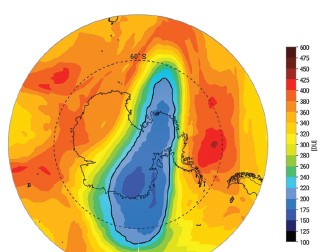
The Antarctic ozone hole has closed earlier than usual this year, offering a rare moment of environmental optimism at a time when global temperatures are breaking records. Copernicus, the European Earth observation agency, confirmed that the hole, which formed in August, had fully closed by December 1, 2025. This development comes despite October 2025 registering temperatures 1.55 degrees Celsius above the pre-industrial average, highlighting an encouraging trend in ozone layer recovery.
According to Copernicus, the 2025 ozone hole was the smallest in five years and the second consecutive year in which the hole remained relatively limited in both size and duration. This marks a noticeable shift from the large and persistent ozone holes recorded between 2020 and 2023. Higher ozone concentrations were observed throughout the season, reinforcing hopes that global efforts to phase out ozone-depleting substances are continuing to yield results.
The formation of the ozone hole is a seasonal occurrence in the stratosphere, with the most severe thinning typically observed over Antarctica during the austral spring from September to November. This year’s ozone hole followed a path similar to the 2023 episode, which had been the largest in recent years. In September, it expanded to more than 21 million square kilometres before beginning to shrink. For comparison, the largest ozone hole ever documented, recorded in 2006, exceeded 29 million square kilometres.
Laurence Rouil, director of the Copernicus Atmosphere Monitoring Service, noted that the early closure and relatively limited size of this year’s hole reflect consistent annual progress driven by global restrictions on ozone-depleting chemicals. He described the development as a reassuring sign and a reminder of what coordinated international action can achieve.
The ozone hole was first detected in 1985 and quickly became one of the world’s most pressing environmental crises. It is caused primarily by human-made chemicals such as chlorofluorocarbons, which break down ozone molecules and weaken the protective layer that shields the planet from harmful ultraviolet radiation. While ozone depletion occurs everywhere, the most extreme thinning takes place over Antarctica due to the region’s extremely cold temperatures and the specific chemical reactions that occur in the stratosphere during the southern spring.
The progress recorded this year underscores the long-term benefits of global cooperation and sustained environmental regulation.
State Bank of India has confirmed that 3,897 customer records containing personal information were found on the dark...

A fire in a hut in Nonapar village of Deoria district claimed three lives, including those of a...

Amit Shah paid tribute to police personnel who died in the line of duty at the National Police...

Reduced water levels at Har Ki Pauri and other Haridwar ghats have inconvenienced pilgrims during the Upper Ganga...

Six people returning from a Dussehra Mela were seriously injured when a car hit them on National Highway...

Two people were killed and ten injured after a passenger bus met with an accident at Gala Pachound...

Aries: The day will be auspicious...