Last Updated: November 25, 2026
Last Updated: November 25, 2026





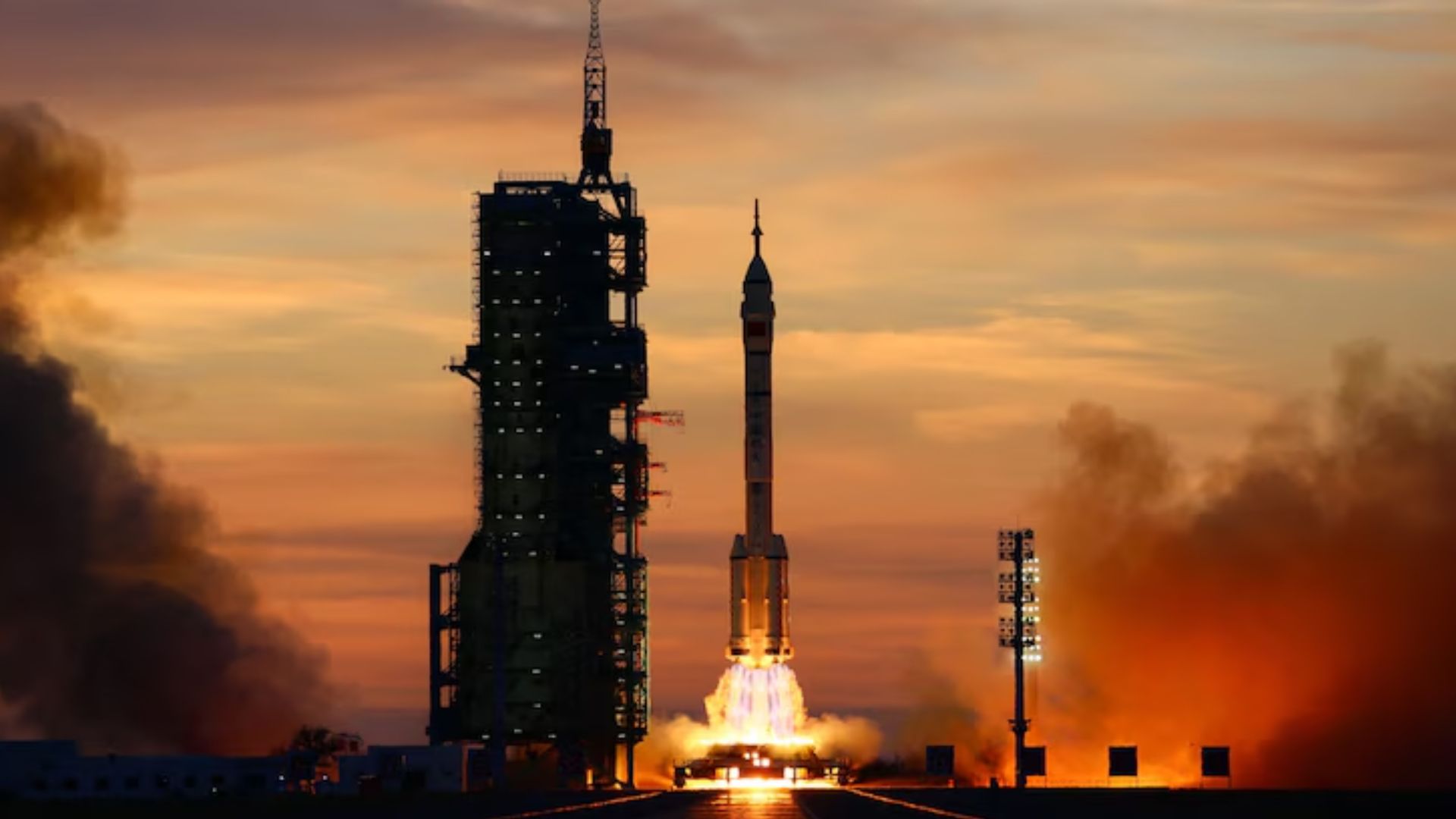
Islamabad/Beijing: Pakistan achieved a major milestone in the field of space exploration on Wednesday. The country’s first astronaut has departed for the Tiangong Space Station aboard a Chinese spacecraft. With this historic mission, Pakistan joins an exclusive group of nations whose citizens have reached a space station orbiting the Earth. This is also considered a significant achievement for China’s international space program.
At 5:48 AM Indian Standard Time, a Long March-2F rocket lifted off from China’s Jiuquan Satellite Launch Center, located in the Gobi Desert. On board were Pakistani Air Force astronaut Muhammad Zeeshan Ali, alongside two Chinese astronauts, Tang Hongbo and Wu Yi.
Chinese officials declared the launch a complete success, confirming that the Shenzhou spacecraft had safely reached its intended orbit.
A Decades-Long Dream Realized for Pakistan
With this launch, Pakistan has reached a new milestone in space exploration. This marks the first time a Pakistani citizen has embarked on a mission to live and work aboard a space station.
The journey toward this achievement began three years ago. In 2023, entrepreneur and adventurer Namira Salim became the first Pakistani to travel to space, participating in a suborbital space tourism flight with Virgin Galactic. However, her journey lasted only a few minutes before she returned to Earth.
In contrast, Zeeshan Ali’s mission is quite different. He will spend approximately one week aboard the space station, located hundreds of kilometers above Earth. During this time, he will conduct scientific experiments in microgravity and participate in various educational activities. With this, Pakistan has now joined the ranks of nations whose citizens have participated in scientific activities aboard a space station as part of a government-led human spaceflight program.
China Opens Its Doors to a Foreign Astronaut for the First Time
This mission marks a significant achievement for China as well. Beijing completed the construction of the Tiangong Space Station five years ago. Since then, China has consistently emphasized its vision of establishing the station as a hub for international cooperation and scientific research.
With Wednesday’s flight, China has, for the first time, welcomed a foreign astronaut aboard its space station. This underscores both China’s human spaceflight capabilities and its ambition to advance its space projects on an international scale.
‘Tiangong’ translates to ‘Heavenly Palace.’ It stands as one of the most critical projects within China’s space program. China developed its own independent space station after being excluded from the International Space Station (ISS) program. The station serves as a venue for long-duration missions, scientific research, and experiments involving new technologies.
By accommodating a Pakistani astronaut, China has taken a step toward developing Tiangong into a new center for international collaboration.
Strengthening the Space Partnership Between China and Pakistan
This mission reflects the deepening space cooperation between the two nations. Over the past decade, China and Pakistan have expanded their collaboration in areas such as satellite technology, communications, Earth observation, and remote sensing.
Human spaceflight has now emerged as the most significant and symbolic component of this partnership. In both countries, this achievement is viewed as a form of cooperation that transcends traditional diplomatic and economic ties.
Zeeshan Ali Selected from 200 Candidates
Reaching this milestone was no easy feat for Pakistan. According to officials, approximately 200 candidates initially applied for the country’s astronaut program. From this group, two finalists were ultimately selected. These individuals included Muhammad Zeeshan Ali and Khurram Dawood. Both are affiliated with the Pakistan Army.
The selected candidates underwent extensive training in China starting in 2025. This training encompassed spacecraft operations, handling emergency situations, survival training, conducting scientific experiments, and physical conditioning.
Zeeshan Ali’s participation was confirmed just one day before the launch. He is now on his way to becoming the first Pakistani citizen to live and work in space.
Pakistani Astronaut to Conduct Scientific Experiments in Space
The objective of this mission extends beyond achieving a historic milestone; it also encompasses scientific goals. During his stay aboard the Tiangong space station, Zeeshan Ali will participate in several microgravity experiments.
Such experiments help scientists understand how matter, biological systems, and physical processes behave in space. This research could provide valuable insights for the development of future technologies and long-duration space missions.
This mission is also expected to inspire students and researchers in Pakistan. Seeing a Pakistani astronaut conducting experiments aboard a space station could foster greater interest in science and technology within the country.
U.S. President Donald Trump is preparing to increase tariffs on goods imported from several countries, including China and...

The collapse in Turkiye exposes a diplomacy that protects fossil-fuel power while leaving vulnerable countries to pay the...
Trump claims credit for Huang’s return, raising concerns over federal government meddling in corporate board decisions.

Talks with different political powers give Yashar leverage. But they also give Likud renewed political relevance. His Yashar...

Nepal is the only Hindu nation in the world. India has a Hindu majority, but here the Ganga-Jamuna...
Female singer Parastu Ahmadi and her companions have been sentenced to 74 lashes each for singing in public...