Last Updated: October 13, 2026
Last Updated: October 13, 2026





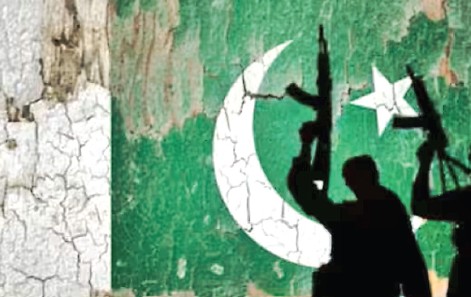
Pakistan is no longer showing signs of temporary instability. It is breaking apart in full public view. A former prime minister remains held without access, the army is tied down in a grinding border conflict it cannot finish, and the Taliban government in Kabul now challenges Pakistan rather than following its lead. For decades, Islamabad relied on two pillars: a military that dominated domestic politics and a network of proxies that shaped Afghanistan. Today, one pillar is weakening and the other has turned into a threat.
The condition of Imran Khan illustrates how far state decay has advanced. His situation is not simply the story of one political leader. It reflects the erosion of institutional checks that once held the system together. When a small Kabul-based outlet claimed he had been killed in Adiala Jail, the rumour set off international alarm. Pakistan’s state agencies were forced to issue hurried denials, yet they were unable to present independent confirmation of his status for hours. In functioning political systems, leaders may lose power or face trial, but they remain visible. In states undergoing institutional decomposition, political figures vanish into opaque detention and the public cannot verify even basic information about them.
This institutional opacity sits on top of a worsening security landscape. The Pakistan Institute for Peace Studies recorded 521 terrorist attacks in 2024, a rise of 70 per cent from the previous year. These incidents killed 852 people, with ninety-five per cent concentrated in Khyber Pakhtunkhwa and Balochistan. The Centre for Research and Security Studies reported 2,546 fatalities the same year, a jump of 66 per cent. The figure included 685 security personnel, the highest toll in nearly ten years. These numbers reflect an environment in which the state is losing ground rather than restoring it.
The economic picture is no less severe. Pakistan has turned to the International Monetary Fund more than twenty times since 1958. The most recent arrangement is a seven-billion-dollar rollover that keeps the government solvent but does not repair fundamental weaknesses. The economy continues to operate in a narrow survival mode. It can service debts, but it lacks the capacity to stabilise provinces, enforce borders, or maintain administrative control. The result is not a short-term crisis. It is a slow collapse managed through repeated external interventions.
At the centre of this decline lies a strategic doctrine that has reversed itself. For decades, Pakistan sought to shape Afghanistan through a policy known as strategic depth. The idea was simple: by supporting factions and armed groups in Afghanistan, Pakistan could prevent India from gaining influence in Kabul and could contain Pashtun nationalism. In this vision, Afghanistan was not viewed as an independent state with its own political memory. It was treated as an extension of Pakistan’s security perimeter.
This approach began to fail the moment the Taliban achieved something Pakistan had not anticipated: autonomy from Pakistani control. When the United States withdrew in 2021, Islamabad believed it had regained influence. Instead, the Taliban government returned with its own ideology, its own domestic support base, and its own diplomatic contacts in countries ranging from China and Iran to Russia and Qatar. A proxy that acquires independent sources of legitimacy is no longer a reliable instrument. This reality now sits at the core of Pakistan’s strategic dilemma.
The consequences have been swift. Militant groups that draw inspiration from the Taliban have expanded their activities inside Pakistan. They have benefited from safe havens and ideological encouragement across the border. The provinces once described as Pakistan’s strategic depth, Khyber Pakhtunkhwa and Balochistan, now function as active insurgency zones. Security forces face regular ambushes, and local administrations struggle to operate beyond district headquarters. Pakistan now loses soldiers faster than it can rotate or reinforce units in these regions.
The same terrain that Pakistan once hoped would shield it from external threats has become the route through which violence returns. The state faces a conflict environment in which its traditional tools no longer work. A doctrine built on controlling neighbours has turned into a trap that exposes Pakistan’s own weaknesses.
The combined effect of political opacity, rising militancy, economic fragility, and a failed regional strategy has produced a moment of deep structural instability. Pakistan is not facing a temporary political crisis. It is confronting a steady breakdown of authority that cuts across institutions, borders, and long-held assumptions about power.
A major train accident occurred on Tuesday in the Multan district of Pakistan's Punjab province. At least four...
Canadian Foreign Minister Anita Anand will arrive in New Delhi on an official visit on Tuesday. During her...
International human rights organization Amnesty International has expressed serious concern over the alleged arbitrary arrests of prominent leaders...
US President Donald Trump says Vladimir Putin may be more willing than Volodymyr Zelenskyy to reach a peace...

A magnitude 6.1 earthquake struck Panama early Tuesday at a depth of 10 kilometres. The tremor followed a...

US President Donald Trump has indicated the possibility of meeting North Korean leader Kim Jong Un during his...
Aries: The day will be auspicious...