Last Updated: October 12, 2026
Last Updated: October 12, 2026






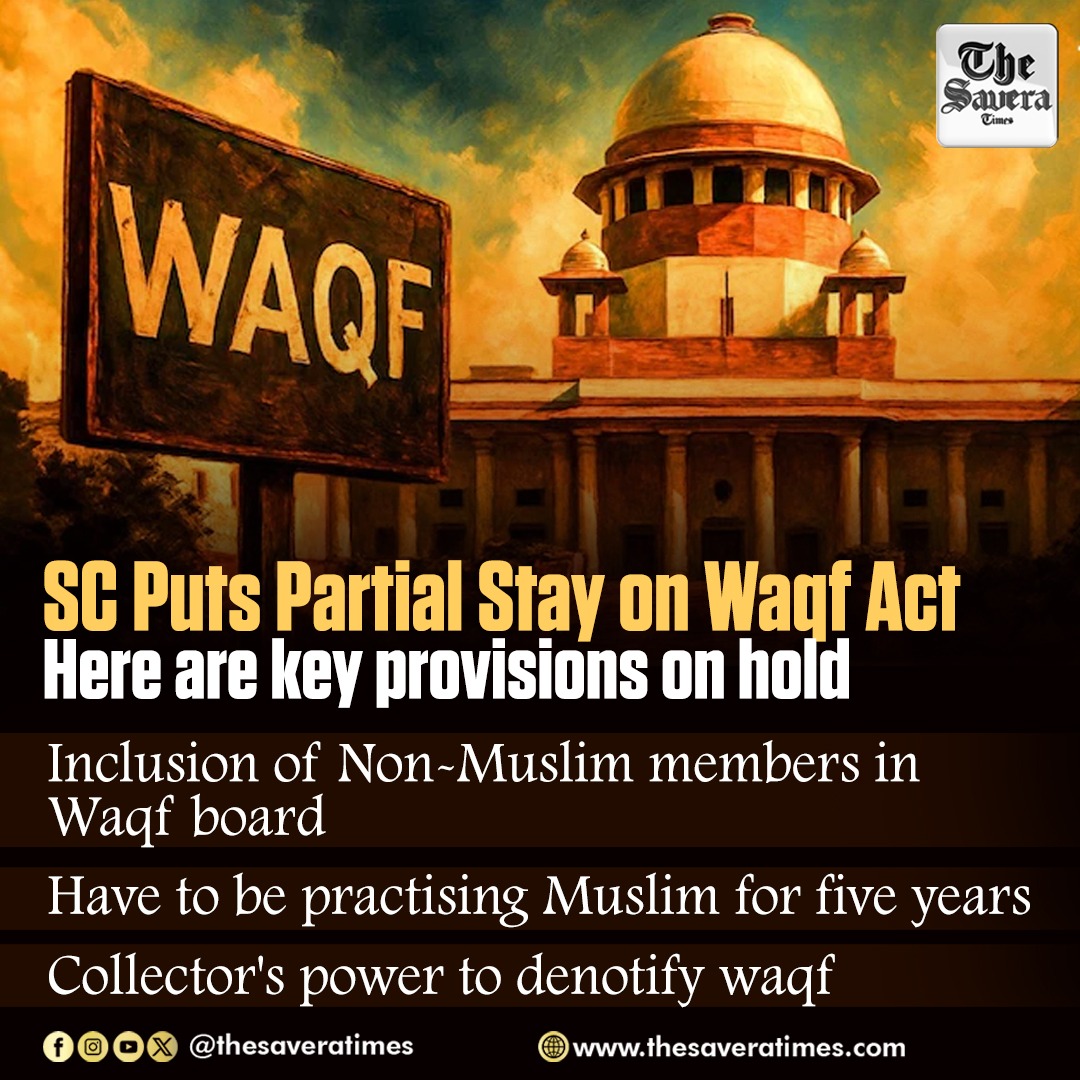
New Delhi Supreme Court puts on hold the provision in the Waqf Amendment Act 2025 that a person should be a practitioner of Islam for 5 years to create a Waqf. Supreme Court said that the provision will be stayed till rules are framed on determining whether a person is a practitioner of Islam. Supreme Court refuses to stay the entire provisions of the Waqf (Amendment) Act, 2025. The court, however, says that some sections need some protection.
The Supreme Court also stays a provision of the Waqf Act which empowered a Collector to determine whether a property declared as Waqf is government property and pass orders. Supreme Court says the Collector cannot be permitted to adjudicate rights of personal citizens and this will violate the separation of powers
Supreme Court also says that the provision of not more than three non-Muslim members should be included in the Waqf Board, and in total not more than four non-Muslims shall be included in the Waqf Councils for now.
The CJI-led Bench, which also includes Justice A.G. Masih, concluded hearings on May 22 after three sessions of arguments presented by both the petitioners and the Centre. The order was reserved following these hearings.
The validity of the amended Act, which received Presidential assent and came into force on April 5, 2025, has been challenged in the Supreme Court by several parties, including AIMIM MP Asaduddin Owaisi and Congress MP Mohammad Jawed.
The petitioners contend that the amendment is discriminatory and unfairly targets the Muslim community. Senior advocate Kapil Sibal, representing the petitioners, described the amended law as, “unconstitutional” and “arbitrary”, particularly objecting to a provision that allows the suspension of a property’s Waqf status during an ongoing investigation.
Joining the argument, senior advocate, Rajeev Dhavan emphasised the religious and social importance of Waqf in the Muslim community. “Waqf is not just a legal entity, but a spiritual and social institution deeply woven into the lives of Muslims,” said Dhavan, citing past Supreme Court rulings. He also argued that no external authority or officer has the jurisdiction to determine what constitutes an essential religious practice.
Earlier, Solicitor General Tushar Mehta, the second-highest law officer of the Centre, argued that the concept of Waqf is not essentially a religious practice. He said that Waqf boards administering such properties were engaged in secular and administrative functions. The new law amended the Waqf Act, 1995, to address the regulation of Waqf properties, that is, religious endowments or properties dedicated exclusively for religious or charitable purposes under Islamic law.
On April 17, a Bench headed by then CJI Sanjiv Khanna decided not to order a stay on the Waqf (Amendment) Act, 2025, after the Centre assured the apex court that the contentious provisions would not be implemented for the time being.
Good Evening Viewers! Stay updated with The Savera Times Evening Bulletin for the latest news from Punjab, India...

eader of the Opposition in the Lok Sabha, Rahul Gandhi and 10 other INDIA bloc leaders have moved...

Amidst protests in central Delhi, the Delhi Metro Rail Corporation (DMRC) announced the reopening of entry and exit...

The Delhi Police has registered an FIR regarding the alleged disturbance at the Bangla Sahib Gurdwara in...
The Delhi Police on Monday removed Jantar Mantar from the list of officially designated protest sites. The police...

The Supreme Court on Monday clarified that it has not passed any judgment on the Election Commission's (ECI)...
Aries: The day will be auspicious...