Last Updated: October 21, 2026
Last Updated: October 21, 2026






New Delhi: Delhi High Court recently passed an interim order to prevent the unlawful use of a Bollywood star’s name, image and voice. The court, through its order, restrained persons at large from infringing the personality rights of the actor. Many Bollywood celebrities reached court to reserve their Personality Rights. Now, understand why it is important to reserve Personality rights in this AI and deepfake era.
Firstly, know what personality rights are?
In this day and age, where AI and deepfakes can give rise to realistic fake video or audio, protecting one’s token public image has never been more justified
“Personality rights,” or the right of publicity, are the rights of people to protect, control and profit from their own name, image, voice, or likeness. These rights give individuals the ability to prohibit others — especially public figures like actors, sportspersons, or politicians from using their image in commercial form without permission.
There are two essential matters with personality rights:
Right of publicity: The right of publicity is the right to prevent another from using their name, face, or voice in advertisements or merchandise without their consent.
Right to privacy: this right protects individuals from being photographed, shown, or used without permission in any manner that may detract from their personal dignity as a person.
Why Famous People Are Affected Even More
When a person achieves celebrity status, their name and likeness can be worth considerable value. Brands pay them to publicly endorse products and their likeness has the ability to generate millions of views whenever an image is posted on a social media channel.
With AI technology and deepfake capabilities growing faster than you could ever imagine, there is now even a greater risk to these celebrities. Anyone could make a video or an audio of a celebrity actor/actress or musician doing or saying something, even though they didn’t.
Recent Legal Moves in India
Recently, Aishwarya Rai Bachchan and Abhishek Bachchan filed lawsuits seeking protection for their names, voices, and other distinctive traits. Similarly, director Karan Johar and other film personalities have approached the Delhi High Court to prevent unauthorized commercial use, fake profiles, obscene AI-generated content, and other misrepresentations.
The court has already upheld their rights in multiple cases, directing platforms and individuals to remove infringing content. Bollywood has witnessed a surge in such cases over the past few years. For example:
Anil Kapoor in 2023 sued websites for exploiting his name, image, voice, and catchphrase “jhakaas.”
Jackie Shroff saw the Delhi High Court prohibit the use of his name, image, and nicknames without permission.
Daler Mehndi, in 2002, secured legal protection when unauthorized dolls in his likeness were sold commercially.
Despite these victories, India still lacks a codified law specifically dedicated to personality rights. Courts rely primarily on common law doctrines, including privacy and publicity rights, and sometimes invoke other statutes such as the Copyright Act, Trademark Act, and constitutional protections.
Deepfake Dangers Go Beyond Celebrities
Deepfakes aren’t just a risk to celebrities and film stars. Just recently, fake videos went viral of CEOs related to stock exchange sharing misleading financial advice. The ‘NSE’ and ‘BSE’ even had to issue public warnings.
More to the point, the aforementioned examples exemplify how deepfake technology could create financial disruption too: markets, finance, and the overall economy could be adversely impacted with misinformation, fake news, and false public discourse.
Lawmaking in India
As of now, a dedicated law regarding personality rights does not exist in India. However, it seems that the Courts are now utilizing current privacy laws and IP (intellectual property) laws to provide a degree of protection.
Several courts now accept that a person’s name, face, and voice are part of their identity and cannot be used without consent. But without a specific law, enforcement remains limited, and cases are still dealt with on a case-by-case basis.
The AI Consideration
AI and deep fake technology can be so good that they can imitate a person’s face and voice almost perfectly. Therefore, it is simple to create fake videos of a celebrity, influencer, or even a politician.
These fakes can ruin reputations, spread untruths, or even are used to scam people. As it becomes more difficult to recognize AI based impersonation, legal remedies must develop.
Indian courts are attempting to protect personality rights using outdated legislation, but that will not be sufficient. Experts say it’s time to draft strong and clear laws .
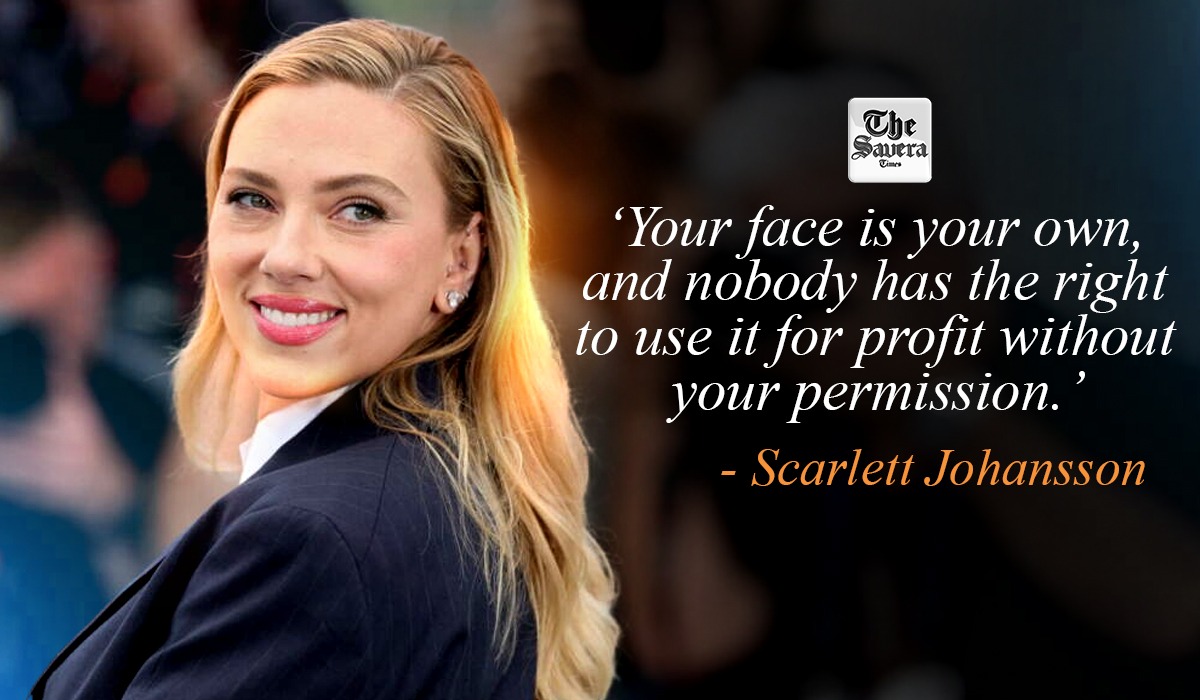
Actress Scarlett Johansson accused OpenAI of using her voice in AI training for GPT-4o without permission (a claim the company denied).
Experts argue that codifying personality rights in India could clarify legal protection, define compensation for misuse, and act as a deterrent. For instance, damages for unauthorized use or reputational harm could be explicitly included in the law.
While India’s legal system is evolving, the combination of common law protections, intellectual property laws, and judicial interpretation currently forms the backbone of personality rights enforcement. The ongoing debates and court cases reflect a crucial balancing act between safeguarding individuals’ identities and navigating the challenges of the digital age.
Good Evening Viewers! Catch up on the day's biggest stories with The Savera Times Evening Bulletin. Get the...

Congress leaders continued their protest outside the Jaipur Police Commissionerate on Tuesday, demanding the registration of a zero...
On the auspicious occasion of Vijayadashami, Prime Minister Narendra Modi on Tuesday called on the countrymen to unite...
A historic milestone was achieved on Tuesday in the expansion of Chhattisgarh's rail networkA historic milestone was achieved...

Model Shraddha Dubey, one of the main accused in the death of Lucknow businessman Shiv Sharma, has been...
Rashtriya Swayamsevak Sangh (RSS) chief Mohan Bhagwat on Tuesday called for strengthening national unity, social harmony, indigenous practices...
Aries: The day will be auspicious...