Last Updated: October 25, 2026
Last Updated: October 25, 2026





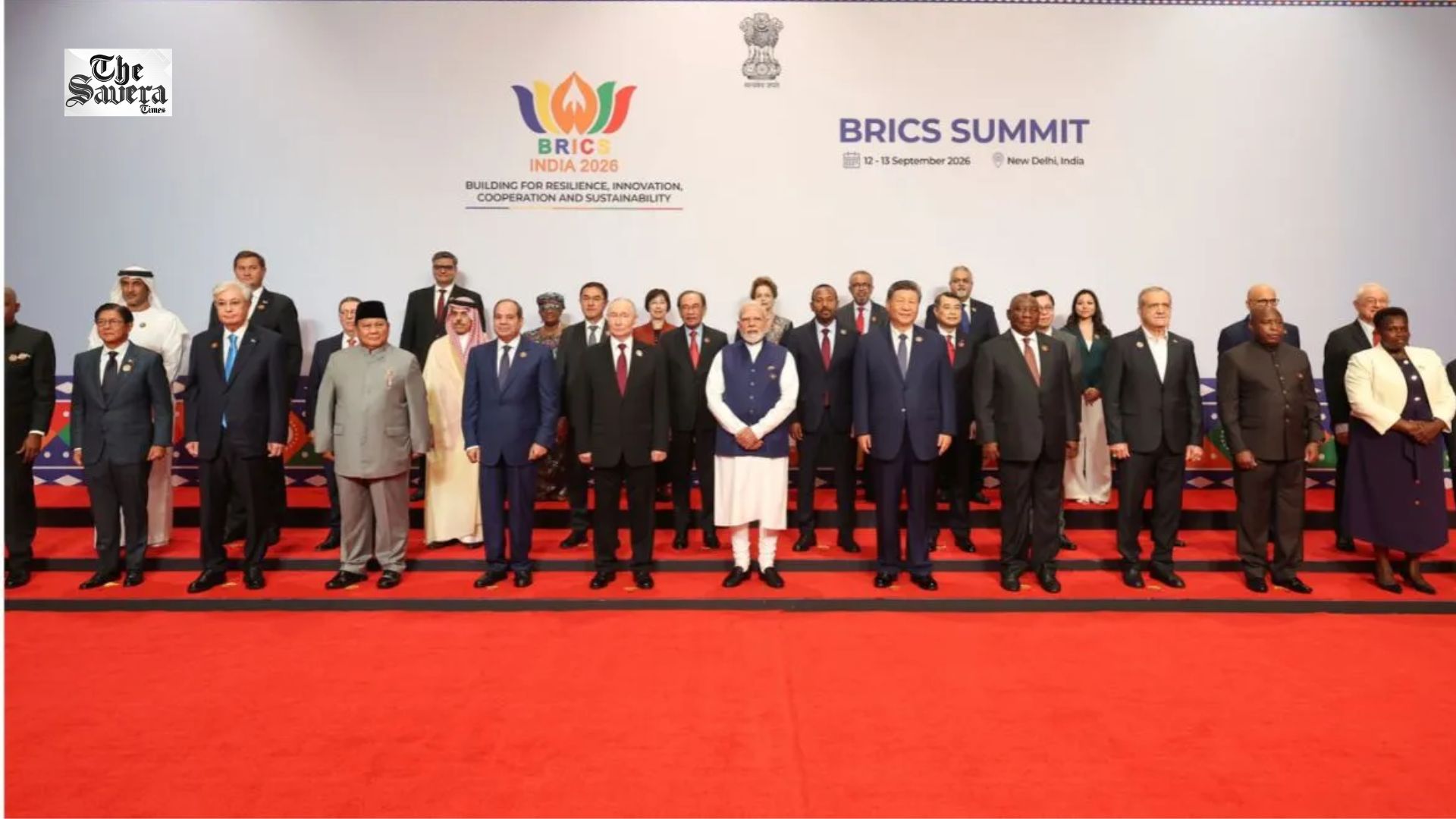
New Delhi: Prime Minister Narendra Modi held as many as 15 bilateral meetings with heads of state and government over three days on the sidelines of the 18th BRICS Summit at Bharat Mandapam in New Delhi, underlining the intense diplomatic engagement surrounding India’s BRICS chairship in 2026.
The meetings, held between September 11 and 13, covered India’s ties with major powers including Russia, China and Iran, as well as key partners across Asia, Africa and the Global South.
In addition to the formal bilateral meetings, Modi also held several pull-aside interactions with world leaders and heads of international organisations, giving India an opportunity to discuss regional and global issues alongside the main BRICS agenda.
The engagements came as India hosted the 18th BRICS Summit on September 12 and 13, bringing together leaders of BRICS member countries, partner countries and international organisations.
Day 1: Modi Meets Putin, Pezeshkian and Guterres
The Prime Minister’s diplomatic engagements began on September 11 with meetings with Russian President Vladimir Putin, Iranian President Masoud Pezeshkian and United Nations Secretary-General António Guterres.
Modi’s meeting with Putin lasted around 45 minutes and focused on strengthening the India-Russia Special and Privileged Strategic Partnership across political, economic, defence, energy, space, skill mobility and people-to-people cooperation.
The two leaders also discussed the conflicts in West Asia and the Black Sea region, particularly their impact on maritime trade and the safety of Indian seafarers. Modi reiterated that dialogue and diplomacy were the way forward in resolving conflicts. Putin also invited Modi to Russia for the 24th India-Russia Annual Summit, which the Prime Minister accepted.
During his meeting with Iranian President Masoud Pezeshkian, Modi discussed bilateral relations as well as developments in West Asia. India reiterated its position that issues in the region should be resolved through dialogue and diplomacy, while also stressing the importance of freedom of navigation, commerce and the safety of seafarers.
Modi also met UN Secretary-General António Guterres. The two discussed multilateralism, reform of global institutions including the UN Security Council, ongoing conflicts, freedom of navigation, sustainable development, human-centric artificial intelligence, renewable energy and global food security.
Day 2: Xi Jinping Meeting Becomes Key Diplomatic Moment
On September 12, Modi held bilateral meetings with Chinese President Xi Jinping, UAE Crown Prince Sheikh Khaled bin Mohamed bin Zayed Al Nahyan, Malaysian Prime Minister Anwar Ibrahim, Ethiopian Prime Minister Abiy Ahmed Ali and Vietnamese Prime Minister Le Minh Hung.
The meeting with Xi Jinping attracted particular attention as it marked the Chinese President’s first visit to India in seven years.
During the Modi-Xi meeting, India and China agreed on the importance of addressing their differences through dialogue and maintaining peace and tranquillity along the Line of Actual Control (LAC).
The two leaders also discussed the broader India-China relationship and the need to continue efforts towards improving bilateral ties.
Modi’s meeting with Malaysian Prime Minister Anwar Ibrahim reviewed cooperation in areas including trade and investment, defence and security, semiconductors, infrastructure, digital economy, energy, fintech, education and tourism. Malaysia also conveyed its concurrence with the establishment of an Indian Consulate General in Kota Kinabalu, Sabah.
With Ethiopian Prime Minister Abiy Ahmed, discussions focused on strengthening the bilateral Strategic Partnership, including economic cooperation, defence and security and capacity building.
Modi also met Vietnamese Prime Minister Le Minh Hung, with both sides reviewing progress in bilateral ties and reaffirming their commitment to further strengthen the Enhanced Comprehensive Strategic Partnership between India and Vietnam.
Day 3: Seven More Bilaterals with Global South Leaders
The diplomatic engagements continued on September 13, when Modi held bilateral meetings with South African President Cyril Ramaphosa, Indonesian President Prabowo Subianto, Egyptian President Abdel Fattah El-Sisi, Philippine President Ferdinand Marcos Jr, Ugandan Vice President Jessica Alupo, Burundian President Évariste Ndayishimiye, and Kazakhstan President Kassym-Jomart Tokayev.
The meetings focused broadly on strengthening bilateral relations, expanding cooperation and exchanging views on regional and global developments.
The engagement with South Africa was particularly significant as both India and South Africa are key members of BRICS and have been working to strengthen cooperation within the grouping and across the Global South.
The meetings with Indonesia, Egypt, the Philippines, Uganda, Burundi and Kazakhstan also provided an opportunity to deepen India’s engagement with partners across Asia, Africa and other regions of the Global South.
BRICS Summit Gives India a Major Diplomatic Platform
The 18th BRICS Summit, hosted by India in New Delhi under its 2026 chairship, provided a major platform for Modi to advance India’s bilateral and multilateral diplomatic priorities.
Beyond the formal summit sessions, the series of bilateral meetings allowed India to discuss issues ranging from trade, investment, defence, energy and technology to regional conflicts, maritime security, global governance and cooperation with the Global South.
The scale of Modi’s engagements over the three days also highlighted the diplomatic importance India attached to its BRICS chairship.
The Prime Minister’s meetings with leaders of Russia, China, Iran, South Africa and other major partner countries came against the backdrop of significant geopolitical developments, including conflicts in West Asia and the Black Sea region, concerns over maritime security and India’s push for stronger multilateral institutions.
India has repeatedly positioned BRICS as an important platform for cooperation among emerging economies and countries of the Global South. The New Delhi summit therefore became not only a multilateral gathering but also a significant opportunity for India to strengthen its bilateral partnerships.
With 15 bilateral meetings in three days, alongside additional pull-aside interactions, Modi’s BRICS schedule emerged as one of the most intensive diplomatic engagements of India’s 2026 BRICS presidency.
A charkha spinning in a village once spoke of nationalism. Today, that spirit is taking new shape through...
With their habitat constantly under threat, conservationists in India have called for greater efforts to monitor snow leopards,...

All countries involved in international forums often say the same thing: to solve the problem of terrorism, all...
One morning in a Jain household, after the days of spiritual austerity had ended, an elderly man picked...

India has moved into the development phase of a national action plan for inland small-scale fisheries, with a...
India’s progress toward becoming a developed nation by 2047 will depend on how effectively it responds to global...
Aries: The day will be auspicious...