


~Abhishek Vij
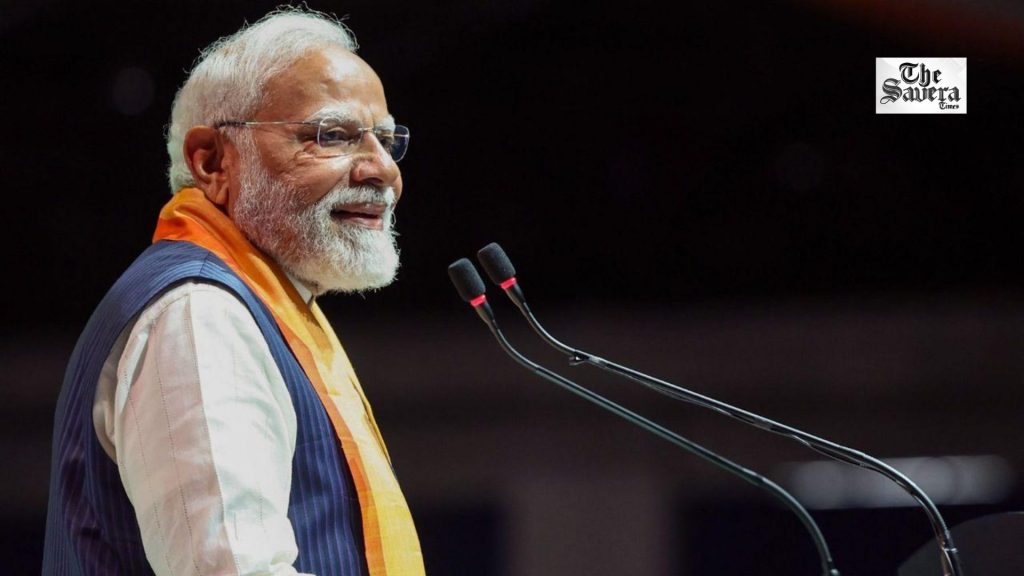
Delhi is currently hosting the inaugural threeday Bloomberg New Economy Forum, which concludes today, October 15. On Tuesday, Prime Minister Narendra Modi delivered a compelling 25-minute address, presenting an Indian economic perspective centered on the philosophy of moving forward together with the rest of the world. He offered suggestions to open new doors for a progressive global economic order and economic thought. While India has long championed the concept of ‘Vasudhaiva Kutumbakam’ (the world is one family), Prime Minister Modi has introduced a fresh economic vision—one that emerges amidst a backdrop of global conflicts, intense national rivalries, and the aggressive pursuit of seizing others’ resources. He emphasized that India—and nations rooted in similar spiritual traditions—strive for progress, but only by marching in step with the entire world. We do not seek to advance by snatching the bread from another’s mouth or by pushing others aside to bring them down. His remarks contained an implicit reference to the United States—a nation that, on one hand, has Trump claiming he deserves a Nobel Peace Prize for halting eight wars, yet on the other, initiates tariff wars against weaker nations to secure its own access to natural resources or to establish a monopoly in the energy market. For instance, the U.S. has threatened India, suggesting that if it continues to engage with Russia—specifically by purchasing crude oil and gas— it will face a 100 percent tariff as a penalty. Furthermore, the U.S. maintains a presence near the Strait of Hormuz, effectively positioning itself to disrupt energy supplies from the Gulf nations, while using the threat of heavy levies to enforce a de facto blockade. This is a flawed approach; just as the Gulf nations were beginning to embrace a new era of development after centuries, they have been struck by the devastating blow of conflict. This is an economics of pure self-interest—a mindset that prioritizes one’s own prosperity, regardless of whether it comes at the cost of destroying the homes of others. Modi remarked that today, technology, data, and innovation are forms of power; yet, the real question is not who possesses this power, but rather how it is being utilized. At this forum—hosted in India for the first time, where strategies are being explored to mitigate economic uncertainties for the sake of growth—India’s message is clear: progress must be achieved by moving forward together, not by tripping one another up. If wealthy nations impose taxes that cripple poorer countries, how can the latter ever hope to advance? Consequently, Modi articulated a vision for India’s economic framework rooted in the principle of bahujan hitaya—ensuring the well-being of all, which inherently includes the well-being of India itself. The world should heed Modi’s words, as it places its trust in India. In an era defined by unprecedented tension— where stock markets are collapsing—India stands firm, maintaining an estimated economic growth rate of 7 percent; a figure corroborated by the International Monetary Fund (IMF). Modi explained that India has been able to sustain its economic momentum amidst such an extraordinary climate—characterized by supply-chain uncertainties— precisely because we chose a path of collective progress. He noted that India has contributed significantly to the world without ever demanding a price in return.
India’s Economic Vision for Advancing Together with World
India’s Economic Vision for Advancing Together with World