Last Updated: October 23, 2026
Last Updated: October 23, 2026





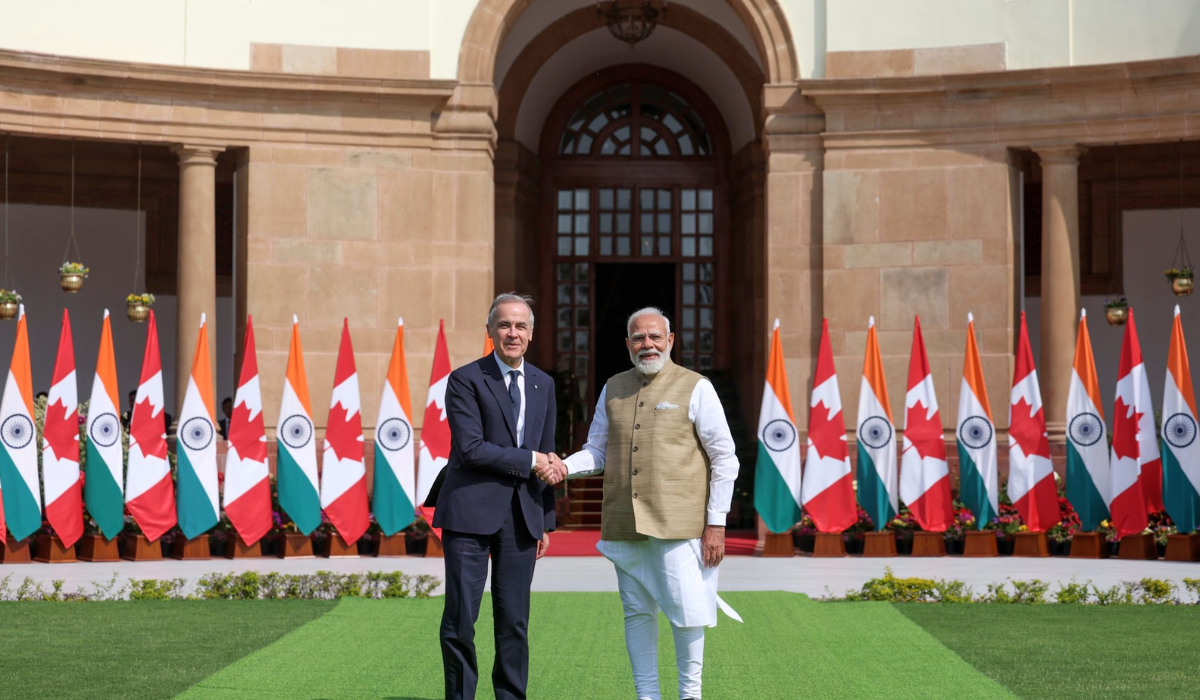
New Delhi: Prime Minister Narendra Modi and Canadian Prime Minister Mark Carney on Monday agreed to strengthen bilateral ties and formally launched negotiations for a Comprehensive Economic Partnership Agreement (CEPA). The agreement aims to increase trade in goods and services to 70 billion Canadian dollars by 2030, and negotiations are targeted to be completed by the end of 2026.
This visit was Carney’s first visit to India since assuming office and the first bilateral visit by a Canadian Prime Minister to India since 2018. The visit included senior ministers, provincial leaders, and business representatives. The two leaders underscored the importance of a strong partnership amid global instability and reiterated their commitment to sovereignty, the rule of law, and multilateral cooperation.
Energy, Defense, and Critical Minerals Cooperation
India and Canada agreed to advance a strategic energy partnership, encompassing clean and conventional energy, civil nuclear cooperation, and critical minerals. As a significant outcome, a long-term uranium supply agreement worth CAD 2.6 billion was signed between Canada’s Cameco and India’s Department of Atomic Energy.
The two countries also signed Memoranda of Understanding (MoU) on renewable energy, critical minerals, and energy transition initiatives such as solar, wind, bioenergy, and grid modernization. Defense cooperation was strengthened through the establishment of the India-Canada Defense Dialogue, a maritime security partnership, and counter-terrorism and law enforcement cooperation. Canada appointed a Defense Attaché in India to ensure close coordination and cooperation.
Education, Research, and Talent Mobility
Both sides emphasized student and researcher exchange programs. The new MoU between India’s All India Council for Technical Education and Canada’s Mitacs expands the Globalink Research Internship, which will provide fully funded research opportunities for 300 Indian students each year. A joint talent and innovation strategy was also launched, and 24 education-related agreements were signed to further deepen institutional collaboration.
Cultural and scientific ties were also strengthened. Agreements were reached on arts, heritage, audiovisual media, emerging technologies, artificial intelligence, space, and digital public infrastructure. India and Canada agreed to conduct joint projects under the Indian Space Research Organization and the Canadian Space Agency, including in atmospheric science, space exploration, and quantum communications.
Strengthening Bilateral Trade, Security, and Global Cooperation
The leaders pledged to revitalize trade and investment through ministerial-level visits and private sector participation. Cooperation will be enhanced in agriculture, nutrition, pulse protein research, and food processing innovation. Both countries reiterated their shared commitment to a free, open, and inclusive Indo-Pacific region, and India supported Canada’s participation as a correspondent member in the Indian Ocean Rim Association (IORA).
Carney thanked India for its hospitality and reiterated Canada’s commitment to advancing the comprehensive partnership. Both leaders expressed confidence that the outcomes and agreements reached during the visit will provide long-term benefits for the economies and citizens of both countries, as well as contribute to regional stability and global resilience.
Cockroach Janta Party leaders Saurav Das and Ashutosh Ranka appeared before the Delhi Police Crime Branch on Friday...

Delhi Police has transferred 25 IPS and DANIPS officers, assigning new roles across the Crime Branch, Special Cell,...

Gold and silver prices have dropped ahead of Dhanteras and Diwali 2026, going against the usual festive-season trend....

Indian para shooter Mona Agarwal won her second gold medal at the Aichi-Nagoya 2026 Asian Para Games on...

Leh: The Civil Society Forum of Ladakh has accused activist Sonam Wangchuk of hijacking the original agenda of...
New Delhi: Indian women’s team top-order batter Sabbineni Meghana has announced her retirement from all the forms of...

Aries: The day will be auspicious...