Last Updated: October 17, 2026
Last Updated: October 17, 2026





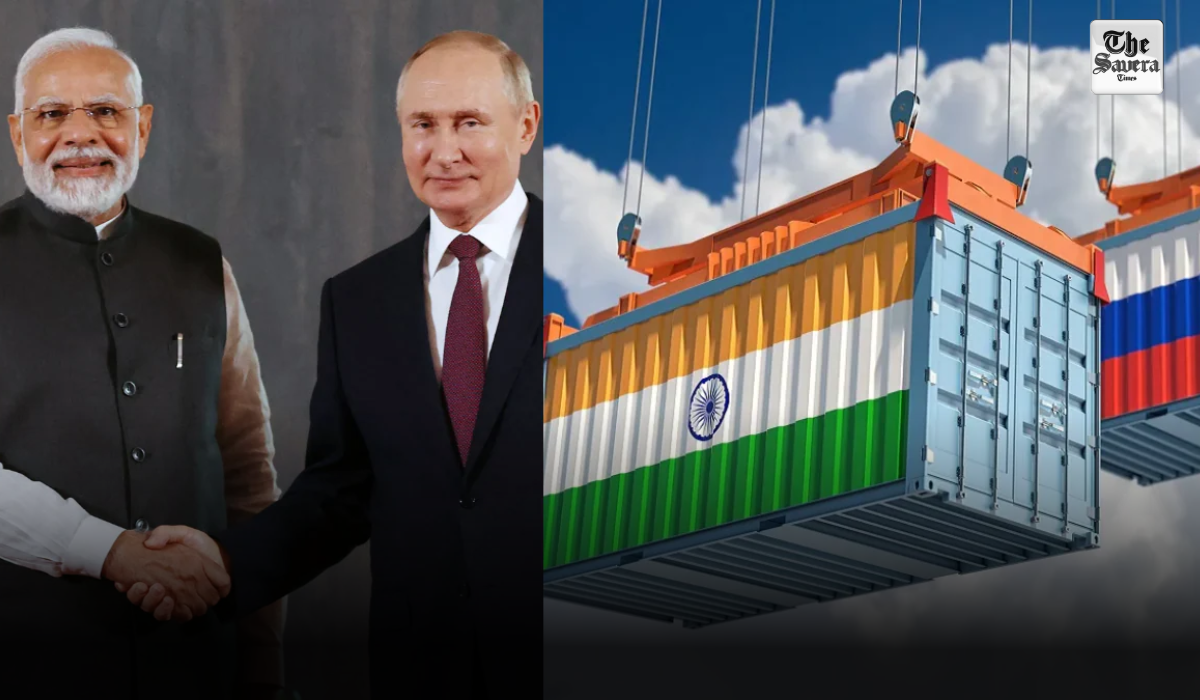
New Delhi: India and Russia have agreed on a long-term economic cooperation programme that will guide trade expansion until 2030, Prime Minister Narendra Modi announced on Friday during a joint press conference with Russian President Vladimir Putin.
Speaking after wide-ranging talks, PM Modi said both sides are working to speed up the Free Trade Agreement (FTA) with the Eurasian Economic Union. “We are trying for an early conclusion of the FTA with the Eurasian Economic Union. India and Russia have agreed on an economic cooperation programme to expand trade till 2030,” he said.
Both countries are pushing toward ambitious economic targets set by their leaders — $50 billion in mutual investments by 2025 and $100 billion in annual bilateral trade by 2030. Officials said the newly adopted programme lays out sector-wise plans to deepen cooperation over the next five years.
Multiple Agreements Signed Across Key Sectors
Modi and Putin witnessed the signing of several agreements spanning fertilisers, food safety, shipping, chemicals, and industrial cooperation. The agreements aim to strengthen supply chains, boost manufacturing, and improve regulatory coordination between the two countries.
One of the key announcements came from President Putin, who said Russia will ensure uninterrupted fuel supplies to India as its economy continues to grow rapidly. “We are ready to continue uninterrupted shipments of fuel for the growing Indian economy,” Putin said, noting that energy cooperation remains a pillar of the partnership.
In a major industrial development, Indian firms signed an agreement with Russian company URALCHEM to set up a urea manufacturing plant in Russia. This project is expected to secure long-term fertiliser supplies for India and deepen industrial cooperation in the chemicals sector.
2030 Strategic Programme Adopted
During the talks, Modi and Putin adopted a comprehensive programme for developing strategic areas of India–Russia economic cooperation till 2030. The programme outlines joint initiatives in trade, investment, transport, energy, industrial production, and scientific research.
Both leaders reviewed ongoing projects and discussed regional and global matters of shared interest. Officials from both sides said that the discussions were “productive” and “future-oriented”.
Food safety
Medical sciences
Consumer protection
Training and operations of ships
Shipping and port logistics
These MoUs involve bodies such as India’s FSSAI, Russia’s consumer protection agency, and companies in the fertiliser and chemicals sector.
PM Modi highlighted that India and Russia will work closely on expanding urea production and supply, which is a key priority for India’s agriculture sector.
Stronger Maritime and Logistics Cooperation
India and Russia also signed an MoU to increase cooperation in the port and shipping sector, aiming to boost maritime connectivity and reduce logistics costs. The agreement is expected to support new trade routes and encourage greater use of the Chennai–Vladivostok maritime corridor.
Officials noted that stronger maritime infrastructure will be critical for achieving the ambitious trade targets set for 2030.
Russia Joins India’s Big Cat Alliance
In an important multilateral development, Russia agreed to join the framework agreement for the International Big Cat Alliance (IBCA) — a global wildlife protection initiative led by India. The alliance focuses on conserving tigers, lions, leopards, and other big cat species.
“A Relationship That Has Stood the Test of Time”
Addressing the joint press meet, PM Modi said President Putin’s visit comes at a time when India–Russia relations are hitting several “historic milestones”. He noted that despite global uncertainties over the past decade, the partnership has remained stable and trustworthy.
He also recalled that nearly twenty-five years ago, President Putin helped lay the foundation of the India–Russia Strategic Partnership, which has since grown into one of India’s most important international relationships.
Read The Savera Times Evening Bulletin for the top India and world news, latest breaking headlines, major developments...

New Delhi: India and Vietnam on Friday reviewed their cooperation across key areas, including economic security, maritime engagements,...
New Delhi: The Union Ministry of Home Affairs (MHA) has sought detailed reports from the Punjab government on...
New Delhi: All India Students’ Association (AISA) National President Neha Bora was detained by the Delhi Police on...
New Delhi: The Directorate of Enforcement (ED) has provisionally attached assets and proceeds of crime worth Rs 136.44...
Mumbai: Jindal Saw on Friday reported a steep decline in its earnings for the second quarter of FY27,...
Aries: The day will be auspicious...