Last Updated: October 21, 2026
Last Updated: October 21, 2026





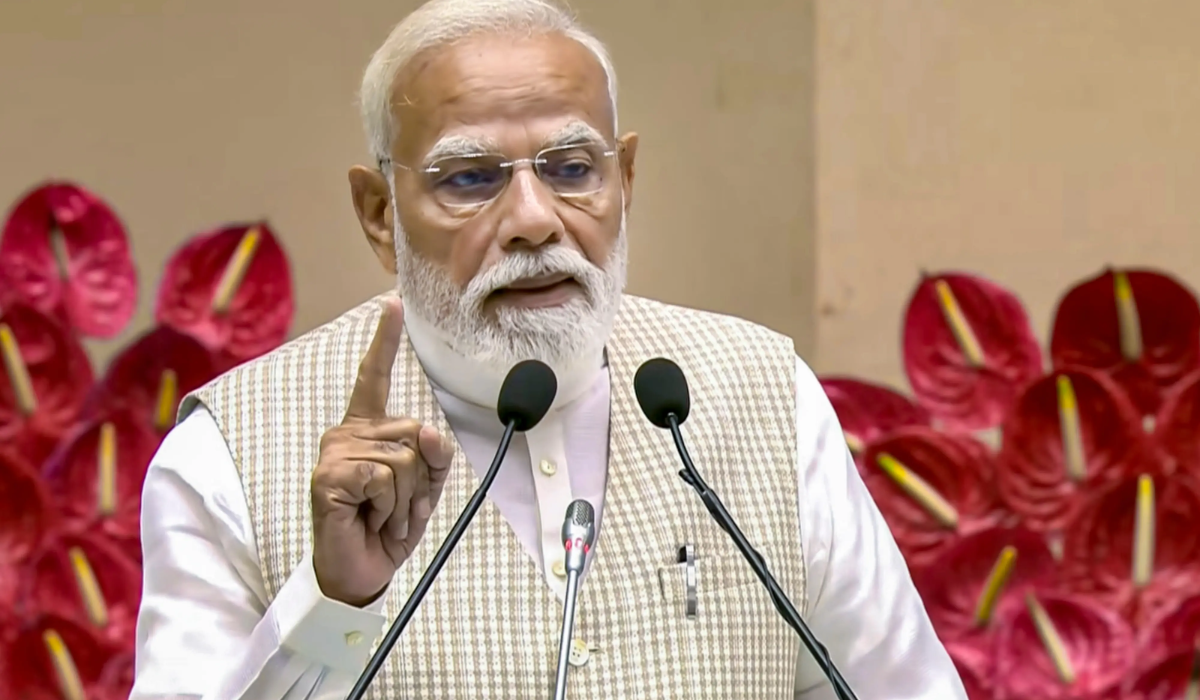
New Delhi: Prime Minister Narendra Modi on Thursday strongly defended the push for women’s reservation, asserting that those who opposed granting this right in the past have faced electoral consequences.
Speaking during the special session of Parliament, he emphasised that the issue transcends political interests and should be seen as a defining moment for India’s democracy.
‘Opponents of Women’s Rights Faced Voters’ Wrath’
Addressing the House, the Prime Minister said that resistance to women’s reservation has historically not been forgiven by voters, particularly women.
“Ever since the discussion on women’s reservation took place in our country, and every time elections have come around thereafter, any individual who has opposed this right of women has not been forgiven by them,” he said.
He noted that the situation was different in the 2024 elections, as all political parties had unanimously supported the measure, removing it as a point of contention.
“Those who opposed giving this right to women have not been forgiven by the women of this country. They have faced the consequences,” he reiterated.
Call for Political Consensus Over Credit
PM Modi urged all parties to rise above political considerations and work collectively to strengthen democracy. He stressed that the credit for such a historic reform should not belong to any one party or leader.
“If we all come together, history is witness, it won’t go in favour of any one political side. It will go in favour of the country’s democracy,” he said.
He added that neither the Treasury benches nor he personally should claim ownership of the reform, urging members not to politicise the issue.
“Anyone who smells politics in this should take a look at their own outcomes from the past 30 years. There is no need to give it a political colour,” he said.
Historic Moment for Parliamentary Democracy
Describing the ongoing debate as a landmark in India’s democratic journey, the Prime Minister said such moments reflect both the mindset of society and the capability of leadership.
“There are some important moments in the life of a country… In the history of India’s parliamentary democracy, these are such moments,” he remarked, while refraining from going into specific issues raised by members during the discussion.
Lok Sabha Witnesses Heated Debate
The special three-day session of Parliament saw intense exchanges between the government and the Opposition over three key legislations — The Constitution (One Hundred and Thirty-First Amendment) Bill, 2026, The Delimitation Bill, 2026, and The Union Territories Laws (Amendment) Bill, 2026.
The proposed amendments aim to operationalise women’s reservation ahead of the 2029 general elections, alongside a delimitation exercise based on population data. The government has proposed increasing Lok Sabha seats from 543 to a maximum of 850.
Union ministers introduced the bills amid protests, with the Opposition alleging that the move could alter the constitutional and federal structure of the country.
Opposition Raises Concerns Over Delimitation
Opposition leaders, including Samajwadi Party and AIMIM members, strongly criticised the proposals. They argued that linking women’s reservation with delimitation without an updated Census could disadvantage certain regions and communities.
AIMIM chief Asaduddin Owaisi warned that removing the freeze on delimitation could disproportionately increase representation of more populous states, potentially undermining federal balance.
Similarly, Samajwadi Party leaders demanded that a fresh Census and caste-based enumeration be conducted before implementing reservation.
Voting Scheduled After Extended Debate
Parliamentary Affairs Minister Kiren Rijiju proposed a 12-hour debate, but Lok Sabha Speaker Om Birla extended it to 15–18 hours, ensuring detailed deliberations. Voting on the three bills is scheduled for 4 PM on Friday.
As the debate continues, the government maintains that the reforms are essential for women’s empowerment, while the Opposition insists on safeguards to ensure equitable representation.
The Delhi Police on Wednesday sought a three-day extension in the judicial custody of Cockroach Janata Party (CJP)...
Following the deterioration of air quality in Delhi-NCR, the Commission for Air Quality Management (CAQM) on Wednesday implemented...
Prime Minister Narendra Modi will visit Varanasi and Kedarnath on a two-day visit on October 24 and 25....
Stay updated with the latest national, international, Punjab, political, business, crime, weather, sports and entertainment news with The...

The family of 5-year-old Fabiana Cabello in New York City, USA, is in deep shock after her death....

The Delhi High Court on Wednesday posed several questions to Cockroach Janata Party (CJP) leaders Sourav Das and...
Aries: The day will be auspicious...