


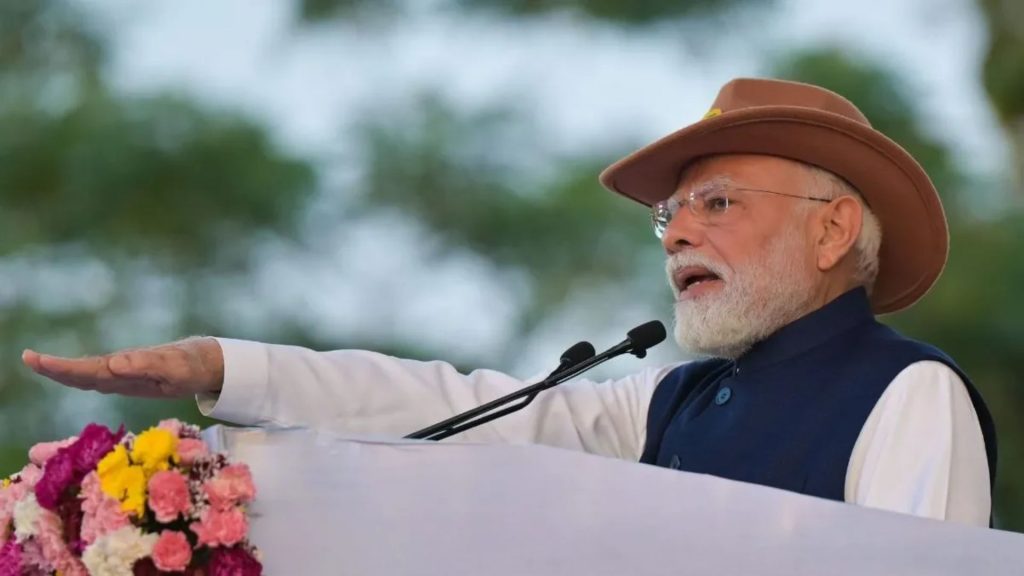
New Delhi: Prime Minister Narendra Modi has highlighted India’s significant progress in poverty reduction, citing a latest World Bank report that shows a sharp decline in the country’s extreme poverty rate between 2011 and 2023.
Describing the development as a historic achievement, Modi said the reduction in poverty reflected a generational rise in opportunities for millions of Indians.
In an Instagram post featuring the song ‘Thaan Liya’ from the Bollywood film Dasvi, the Prime Minister shared key findings from the World Bank report and highlighted improvements in poverty levels, employment and economic inequality.
According to the figures cited by Modi, around 49.6 crore people moved out of poverty between 2011 and 2023. During the same period, India’s extreme poverty rate declined from 27.1 per cent to 2.6 per cent, representing a reduction of more than 90 per cent.
The Prime Minister also highlighted employment growth, saying that 13.4 crore jobs were added over six years, nearly twice the increase in India’s working-age population.
Modi further pointed to a decline in economic inequality, with India’s Gini Index falling to 23.0.
Taking a swipe at the Congress over its long-standing ‘Garibi Hatao’ slogan, the Prime Minister said poverty eradication was not merely a political promise for his government but a commitment.
“India has recorded one of the fastest poverty declines in the world. This is what the World Bank is saying,” he said.
World Bank report highlights sharp fall in poverty
The World Bank’s India Poverty and Equity Brief: October 2026 highlights substantial improvements in India’s poverty indicators over the past decade.
According to the report, the proportion of people living below the lower-middle-income poverty threshold of $4.20 per day declined from 57.7 per cent to 16.1 per cent between 2011 and 2023.
This translated into approximately 496 million people moving above that poverty threshold.
The report also recorded a significant reduction in extreme poverty, measured against the $3-per-day poverty line. The rate fell from 27.1 per cent in 2011 to 2.6 per cent in 2023.
The estimates are calculated using purchasing power parity (PPP) at 2021 prices, allowing comparisons of living standards across countries.
The World Bank noted that India has achieved one of the fastest declines in poverty globally, with improvements across both monetary and non-monetary indicators.
Free food schemes and employment support poverty reduction
The report identified several factors contributing to India’s poverty reduction, including consumption growth, employment expansion and social protection programmes.
Government initiatives providing free and subsidised food have played an important role in supporting low-income households, particularly in rural areas.
The report also highlighted rising employment, including increased participation by women, alongside improvements in household consumption.
These factors have contributed to reducing the gap between rural and urban poverty levels.
Multidimensional poverty also declines
India has also registered improvements in non-monetary measures of poverty, which assess living conditions beyond household income and consumption.
According to the figures cited in the report, India’s multidimensional poverty rate, measured through the Oxford Poverty and Human Development Initiative’s Multidimensional Poverty Index, declined from 53.8 per cent in 2005-06 to 16.4 per cent in 2019-21.
The assessment considers factors such as education, healthcare and living standards.
Despite the progress, poverty remains unevenly distributed across the country. The report highlighted that around 57 per cent of India’s poor population is concentrated in the eastern and northern belt stretching from Uttar Pradesh to West Bengal.
Employment and inequality remain key challenges
While poverty indicators have improved, employment opportunities and income distribution continue to require attention.
The Prime Minister highlighted that employment increased by 13.4 crore over six years, but concerns around youth unemployment and access to suitable jobs remain relevant.
The report also highlighted the decline in India’s Gini Index, which measures consumption inequality. The index fell from 28.8 in 2011-12 to 23.0 in 2023, indicating a reduction in measured consumption inequality.
However, the World Bank’s findings should be viewed in the context of the poverty thresholds and household consumption data used for the estimates.
Overall, the latest figures point to a substantial reduction in poverty in India over the past decade, while also highlighting the need for continued efforts to improve employment opportunities, living standards and economic inclusion.