Last Updated: October 22, 2026
Last Updated: October 22, 2026





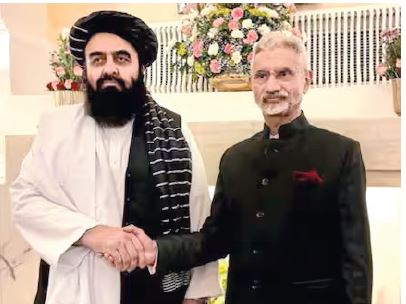
When Afghan Taliban Foreign Minister Amir Khan Muttaqi was received by External Affairs Minister S. Jaishankar at Hyderabad House with full diplomatic protocol, India sent a clear signal that its engagement with Afghanistan is guided by national interest and regional stability. The meeting marked a significant moment in India’s calibrated approach towards the Taliban, which continues to face international criticism over gender restrictions and the absence of democratic governance.
The Islamic Emirate of Afghanistan, led by Emir Haibatullah Akhundzada, remains globally isolated. The International Criminal Court has issued an arrest warrant against Akhundzada for crimes against humanity related to gender-based discrimination. The Taliban’s return to power in August 2021 — through military force for the second time — stands as an anomaly in modern history.
India’s relationship with Afghanistan has undergone multiple shifts. Historically, New Delhi shared close cultural and trade links with Kabul. However, decades of instability and successive regime changes forced India to repeatedly close its embassy and consulates in Herat, Mazar-e-Sharif, Jalalabad and Kandahar. Despite these setbacks, India continues to maintain humanitarian and diplomatic engagement with the Afghan people.
In a joint statement following his meeting with Muttaqi, Jaishankar described India as an “Afghanistan-contiguous neighbour,” highlighting historical and geographic ties that transcend current political barriers. The comment reflected India’s effort to preserve influence in a region increasingly shaped by the strategic presence of China and Russia.
The Taliban regime of 1996–2001 was previously recognised by Pakistan, Saudi Arabia and the UAE. However, both Gulf states severed relations after the Taliban refused to hand over Osama bin Laden. Today, Russia remains the only country to have officially recognised the Islamic Emirate. China, several Arab nations, and Central Asian states have exchanged ambassadors with the Taliban but stopped short of granting full diplomatic status.
Moscow’s engagement with Kabul has continued under what it calls the “Moscow Format,” established in 2022 to coordinate regional policy on Afghanistan. The forum includes India, China, Iran, and Central Asian countries. During the latest meeting, attended by Indian representatives, participants collectively opposed any foreign military presence in Afghanistan — a reference to the United States’ former Bagram base. They also called for the release of around nine billion dollars in Afghan assets frozen by Washington.
Russia’s growing involvement is driven by its strategic interest in maintaining Afghanistan as a bridge between South, Central and East Asia. President Vladimir Putin described the Taliban as “allies in fighting terrorism” in 2024, signalling a shift from Moscow’s earlier hostility toward the group.
Meanwhile, China has intensified its engagement with Kabul through infrastructure investments and mining projects. Beijing views Afghanistan as a key link in its Belt and Road Initiative. However, its increasing economic footprint has raised concerns in New Delhi, which remains wary of expanding Chinese influence in the region.
Parallel to regional diplomacy, the United Nations-led Doha process has been holding periodic meetings on issues such as health, education, gender, and human rights. Despite these efforts, conditions in Afghanistan remain grim. Women are banned from most forms of employment and higher education, with more than 2.2 million girls over the age of 12 denied access to schools. Over 85 per cent of the country’s 22 million citizens live below the poverty line, surviving on less than a dollar a day. Internet-based education initiatives have failed to bridge the gap due to limited connectivity.
The Taliban commemorates August 15 — the day Kabul fell in 2021 — with a military parade at the former US Bagram base. On the same occasion, the reclusive Emir Akhundzada reaffirmed his commitment to enforcing Sharia law through morality codes and the Ministry for Propagation of Virtue and Prevention of Vice.
Despite the appearance of unity, internal divisions persist between the Kabul and Kandahar factions, mainly over women’s rights, foreign aid management, and control of key military installations. The Pashtun majority continues to dominate the political structure, while Tajik, Uzbek, and Hazara minorities have little representation.
The National Resistance Front (NRF), led by Ahmad Massoud from exile in Tajikistan, remains the principal opposition group. After initial resistance in northern Afghanistan, its activities have declined. In a striking reversal, Pakistan — once a principal supporter of the Taliban — is now reportedly backing the NRF, the same Northern Alliance that the US and India supported against the Taliban in 2001.
India’s engagement with the Taliban today reflects pragmatic diplomacy — maintaining contact without conferring recognition. In a volatile region where alliances shift rapidly, New Delhi’s policy aims to secure stability, safeguard its interests, and ensure that Afghanistan does not once again become a haven for terrorism.
Good Evening Viewers! Get the latest updates from India and around the world with The Savera Times Evening...

Bharatiya Janata Party (BJP) National General Secretary Smriti Zubin Irani launched a scathing attack on Congress MP and...
New Delhi: Cockroach Janata Party (CJP) leaders Saurav Das and Ashutosh Ranka will be released from judicial custody...
According to police, three suspicious young men are seen in CCTV footage. Efforts are underway to identify them....
A video has surfaced of an alleged attempted assault on Jan Suraj Party's Bihar president Manoj Bharti. The...
Two accused have been convicted and sentenced to 10 years of rigorous imprisonment in a 2017 drug trafficking...
Aries: The day will be auspicious...