Last Updated: October 17, 2026
Last Updated: October 17, 2026





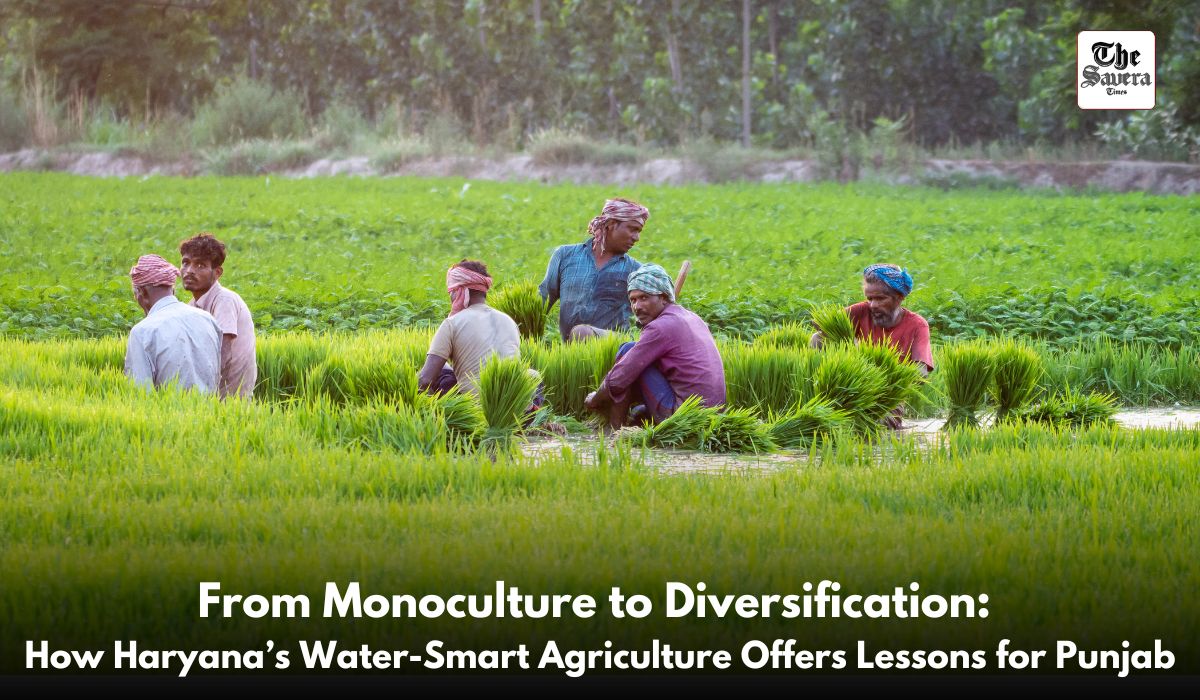
Written by Vivianna: Both Punjab and Haryana, carved out from the same region in 1966, began their agricultural journey on common ground during India’s Green Revolution. Fast forward five decades, and the two states have adopted markedly different trajectories. Punjab remains entrenched in a water-intensive, monoculture-based farming model, while Haryana has demonstrated a promising shift toward diversified, sustainable agriculture—despite facing greater water scarcity. This divergence offers crucial lessons for Punjab, especially in areas of water management, policy implementation, and farmer resilience.
Divergent Agrarian Systems Punjab: Caught in the RiceWheat Trap Punjab’s agriculture is exemplary of the unintended consequences of Green Revolution successes. With rice occupying nearly 87% of the kharif cropped area and wheat covering 98% of the rabi season, Punjab has evolved into a monoculture-heavy system. This heavy reliance on two crops has led to an alarming ecological imbalance. Groundwater is depleting by over half a meter annually, with approximately two-thirds of the state’s wells showing declining water levels. Irrigation further intensifies the problem. Rice requires as many as 25 irrigation cycles, compared to 4–5 for wheat, leading to excessive extraction of groundwater and contributing to a looming water crisis.
Haryana: A Model for Crop Diversification
Haryana, while agriculturally similar in its early years, has taken a more adaptive path. Rice claims less than 50% of the state’s kharif cropped area, and wheat covers about three-fourths of rabi cultivation. Importantly, Haryana grows a variety of crops—cotton, bajra, and guar during kharif, and mustard, sunflower, and chickpeas in rabi. More than half its rice area is under basmati cultivation, which uses less water, is rain-dependent, and fetches higher prices in global markets. By contrast, Punjab has only around 17% of its rice area under basmati.
Water Availability and Policy Innovation Groundwater:
Shared Concern, Different Outcomes Despite its higher dependency on groundwater (90% of irrigation), Haryana’s water crisis is relatively controlled compared to Punjab. Only 40% of Haryana’s groundwater wells show declining trends, versus 65% in Punjab. This improvement is attributed to aggressive water-saving strategies and better enforcement of conservation measures.
Key Water-Saving Initiatives in Haryana
• Integrated Water Resources Action Plan (IWRAP): Aims to reuse 50% of treated wastewater by 2025 and 100% by 2028.
• Direct Seeded Rice (DSR): Haryana offers India’s highest DSR subsidy, over Rs 4,000 per acre.
• Groundwater Recharge Programs: Haryana recorded an 11% rise in water recharge between 2023 and 2024.
• Massive Water Savings: The state saved 5.8 billion cubic meters of water between March 2023 and February 2025, achieving 85% of its conservation targets.
Agricultural Policy and Government Initiatives Haryana: A Coordinated Push for Sustainability
Mera Pani Meri Virasat Scheme: Farmers receive Rs 8,000 per acre for switching from paddy to alternative crops. In 2020, 63,743 acres were diversified, saving 226 million cubic meters of water. Over three years, tens of thousands of hectares have shifted to other crops.
Natural Farming Promotion: With a dedicated portal and Rs 97 crore fund, over 1.84 lakh farmers have enrolled, covering nearly 2.74 lakh acres. Subsidies include Rs 30,000 for indigenous cow purchase and Rs 20,000 for branding support.
Market and Infrastructure Support: Natural and organic mandis have been launched in Gurugram and Hisar, alongside training centres and quality testing labs.
Punjab: Policy on Paper, Little on Ground
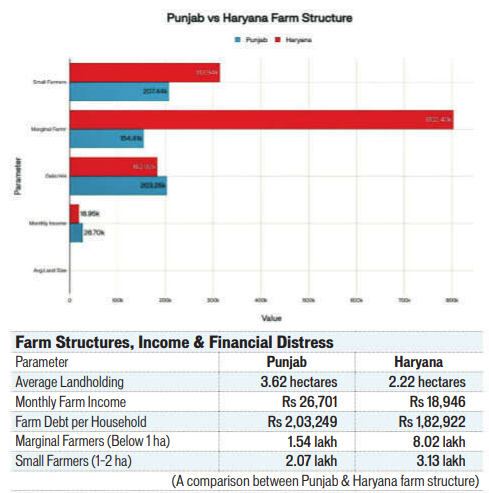
Punjab’s diversification incentive stands at Rs 17,500 per hectare, but this is dwarfed by much higher returns from paddy due to existing subsidies and assured procurement. On average, Punjab farmers receive nearly Rs 39,000 per hectare in input subsidies for paddy. The Punjab Agriculture Policy of 2023 advocated for systemic changes but has struggled with poor execution due to administrative delays and lack of political consensus. Diversification has not taken off meaningfully. Though Punjab farmers earn more due to larger average holdings and higher paddy returns, this model brings deep liabilities in the form of high debt and ecological costs. Debt across all categories has soared— over 107% for marginal and 170% for medium farmers over the last two decades. Haryana farmers also carry debt, but their exposure is moderately lower, and efforts at promoting alternative livelihoods have cushioned some of this burden.
Suicides and Farmer Distress Punjab:
A Deepening Crisis Farmer suicides in Punjab have surged since 2015, rising from an average of 70 per year to over 260 annually. In 2018 alone, 323 suicides were recorded. Most of these cases involved indebted small and marginal farmers.
The causes are multifaceted:
•Over 50% linked directly to debt.
•Nearly 30% involving illness or family problems.
• The remainder due to crop failure and market failures.
Haryana: A Contrasting Reality
In 2022, Haryana recorded 266 farm-related suicides—but only one involved a cultivator. The rest were agricultural labourers. This indicates stronger systemic support and greater resilience among landowning farmers, aided by crop diversification and better policies.
Farmer Protests: Haryana Steps Back, Punjab Stands Firm
Punjab remains the nerve centre of farmer protests. From the 2020- 21 protests against central farm laws to the more recent year-long agitation (Feb 2024–March 2025), Punjab farmers have remained highly mobilized. They have blocked highways, held up rail networks, and faced state crackdowns.
In stark contrast, Haryana witnessed far fewer protests in recent years. The reduced restiveness is due to:
• Better-targeted government support
•More robust procurement for non-paddy crops (24 currently include MSP procurement)
• A less polarizing farmer union landscape
• A more diversified rural economy with greater non-farm opportunities
Environmental and Technological Gains in Haryana
• Large-scale adoption of Direct Seeded Rice on 4.5 lakh acres
• Significant expansion of microirrigation systems
• Decline in stubble burning through better crop planning
• Improved recharge of aquifers and treated wastewater reuse development
Lessons Punjab Can Learn from Haryana
1. Implement Policy with Urgency: Punjab must activate its Agricultural Policy of 2023 with top-level political backing and interdepartmental coordination.
2. Increase Diversification Incentives: Raise cash incentives to at least Rs 35,000/ha—backed by repurposing subsidies and with multiyear guarantees to secure farmer buy-in.
3. Build Markets for New Crops: Develop infrastructure for pulses, oilseeds, and horticulture like Haryana’s natural farm mandis and link with export markets through better basmati pricing.
4. Water Management Reforms: Push for widespread DSR adoption, regulate borewell drilling, reuse wastewater, and expand microirrigation.
5. Capacity Building and Farmer Engagement: Set up demonstration farms, training programs, and support networks to help farmers transition smoothly and sustainably.
Conclusion: A Call for Transformative Change
While Punjab enjoys higher per capita farm income, this comes at a daunting cost to its environment and farmer well-being.
Haryana, facing greater natural limitations, has demonstrated what sustained policy focus, financial backing, and farmer participation can achieve in moving toward sustainable systems.
The need for Punjab to change course is urgent and nonnegotiable. Haryana has shown that transformation is possible— even in a water-constrained, semi-arid landscape. With political will, farmer trust, and sustained commitment, Punjab too can transition toward a more resilient and sustainable agricultural future. The blueprint exists just next door.
(The writer is a student researcher passionate about ecological and environmental preservation)
Chandigarh: In a major breakthrough, Punjab Police have busted an interstate illegal weapons supply module with the arrest...

Chandigarh: Haryana Leader of the Opposition (LoP) Bhupinder Hooda on Saturday raised concerns over the state’s financial position,...
Mansa: BJP State President of the Bharatiya Janata Party, Kewal Singh Dhillon, visited Parminder Singh Jhota’s Insaaf Morcha...

New Delhi: The Enforcement Directorate (ED) has detained Amardeep Singh Grewal, a close aide of Punjab Chief Minister...

Punjab CM Bhagwant Singh Mann has condemned Parvinder Singh Jhota’s murder in Mansa, confirmed the main accused’s arrest...
Punjab Chief Minister Bhagwant Mann dedicated 154 new Aam Aadmi Clinics in Hoshiarpur, taking the state total to...