Last Updated: October 21, 2026
Last Updated: October 21, 2026





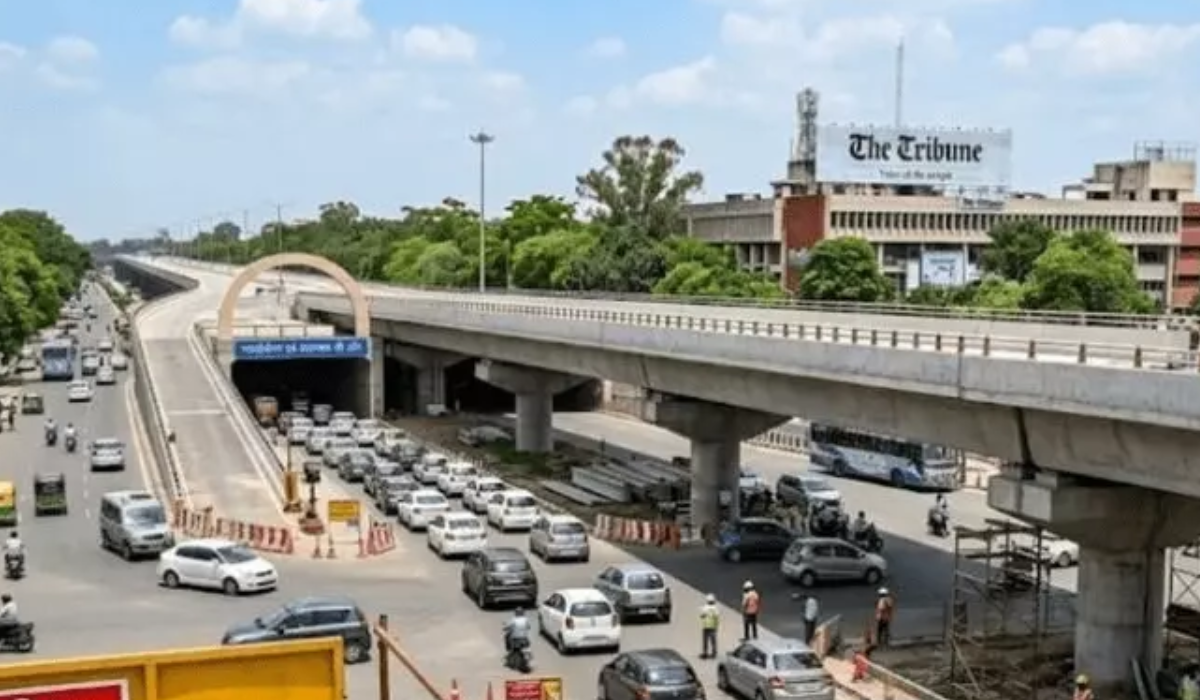
Chandigarh: The proposed flyover project at Tribune Chowk in Chandigarh has suffered a major setback after the Punjab and Haryana High Court ruled that the construction cannot be permitted as it is not in line with the Chandigarh Master Plan-2031.
A division bench headed by Chief Justice Sheel Nagu on Friday observed that the proposed flyover on Dakshin Marg does not conform to the city’s planning framework. The court suggested that an underpass could be considered as an alternative solution to ease traffic congestion.
Court Stresses Preservation of Chandigarh’s Identity
During the hearing, the bench emphasized that Chandigarh’s original urban character and green landscape must be protected while undertaking development projects. The court noted that the unique design and planning of the city should not be compromised in the name of infrastructure expansion.
It further stated that the original urban form of Phase-1 sectors and the Dakshin Marg corridor must be preserved. To tackle increasing traffic pressure, the court highlighted the need to reduce dependence on private vehicles and strengthen public transportation systems.
The High Court had previously stayed the felling of trees for the project. The bench observed that many trees, including mango trees around Tribune Chowk, are more than 50 years old. Since the flyover construction could have led to their cutting or extensive pruning, the court intervened to ensure their protection.
Petitioners Oppose Flyover
Appearing for the petitioners, advocate Tanu Bedi argued that the proposed flyover is contrary to the Chandigarh Master Plan-2031. She contended that the project would negatively impact the city’s planned structure, green belts, and pedestrian-friendly environment.
According to the petitioners, Chandigarh was designed as a walkable and cycle-friendly city. They argued that flyovers not only alter the city’s visual identity but also discourage non-motorized modes of transport. They further maintained that building additional road infrastructure for private vehicles merely shifts traffic congestion from one location to another instead of solving the problem.
Chandigarh Administration Defends Project
Representing the Chandigarh Administration, advocate Amit Jhaji argued that the Master Plan-2031 allows for the construction of a flyover. He stated that the project is necessary to manage rising traffic volumes in the city.
The administration also argued that Chandigarh’s heritage zones are limited to Sectors 1 to 30 and do not cover the entire city. It further pointed to the rapid expansion of the Tricity region and increasing population as reasons for developing additional traffic infrastructure.
Court Rejects Administration’s Stand
However, the High Court was not convinced by these arguments. The bench clarified that the proposed flyover does not align with the spirit and objectives of the Chandigarh Master Plan-2031.
The court concluded that alternative traffic management solutions should be explored, indicating that an underpass could be a more suitable option than the proposed flyover.
Punjab Chief Minister Bhagwant Mann was allegedly detained for three hours at Delhi airport upon his return from...
The Punjab Vigilance Bureau (VB) during its ongoing drive against corruption in the state, has apprehended Inspector Gulshan...
Chief Minister Bhagwant Mann may soon hold a press conference or release a video message amid Union Home...
Punjab Cabinet Minister Aman Arora welcomed Union Home Minister Amit Shah's visit to Punjab on Tuesday. However, he...
Gurdaspur: Union Home Minister Amit Shah on Tuesday met with the families of those who spoke out against...
Mansa: A shocking incident was reported from Mansa in Punjab on Tuesday morning, where a Punjab Police head constable...