Last Updated: October 21, 2026
Last Updated: October 21, 2026





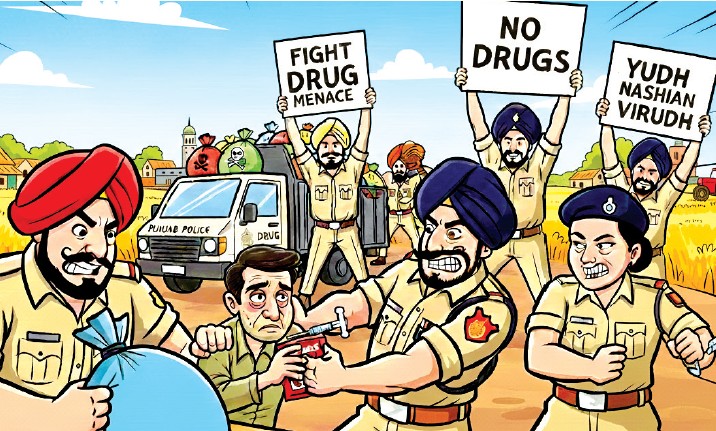
Punjab’s campaign against drugs has entered a new phase in 2025, shaped by an assertive political will, an expanding police effort and growing public participation. What began as a state initiative in February has evolved into a broad social movement backed by village groups, urban welfare bodies and citizens who view the crisis not only as a law and order issue but as a direct challenge to the health and stability of families. Chief Minister Bhagwant Singh Mann has framed the drive as a defining mission of his administration, a mission he often describes as a collective pledge to secure the future of Punjab’s youth. His message has been blunt. He has repeatedly said that the state cannot afford complacency and that no force is strong enough to derail the public resolve to eliminate drugs.
The government has moved forward with a policy that places absolute priority on dismantling supply channels. Officials say the state’s approach is anchored in deterrence. This is visible along the 553 kilometer Punjab Pakistan border, where anti drone systems have been deployed to tackle airborne smuggling networks that have become more active in recent years. These systems have already intercepted several attempts involving high altitude drones capable of carrying heroin, synthetic narcotics and precursor chemicals. By combining technology, surveillance and cooperation with national agencies, the state aims to choke cross border routes that fuel the trade.
Another side of enforcement is the crackdown on properties linked to illegal drug money. Buildings, plots and vehicles tied to traffickers have been demolished or seized in multiple districts, a step the government believes sends a clear message to organised networks that Punjab will no longer offer safe ground. These actions have drawn strong reactions across communities. Supporters argue that they restore confidence in law enforcement and discourage aspirants who view drug trafficking as a path to wealth. Critics worry about procedural issues, though the government maintains that all actions follow legal scrutiny. What remains certain is that such visible measures have changed the tone of the anti drug effort by demonstrating the cost of involvement in the trade.
The scale of the policing operation continues to widen. On November 23, the state completed the 267th consecutive day of coordinated raids under the banner of Yudh Nashian Virudh. More than 800 personnel formed over 100 police teams for the latest round of checks, covering 282 locations across the state. The operation led to the arrest of 66 individuals and the registration of 49 FIRs. With these arrests, the total number of apprehended drug smugglers has reached 37,737 since the campaign began. The police also recovered 5.1 kilograms of heroin, more than one thousand intoxicant pills and a small amount of drug money. Officers reported that 297 suspicious persons were questioned during the day long operation.
Senior officials say that these numbers reflect both the scale of the problem and the intensity of the response. The creation of a five member Cabinet Sub Committee headed by Finance Minister Harpal Singh Cheema has added another layer of oversight. The committee monitors enforcement trends, interdepartmental coordination and the performance of district administrations. Commissioners of Police, Deputy Commissioners and Senior Superintendents of Police have been directed to maintain strict action and ensure that investigative work leads to court ready cases.
Yet the government has repeatedly stressed that enforcement alone cannot deliver a long term solution. Punjab’s strategy combines policing with public health and education, built around a three part framework of Enforcement, Deaddiction and Prevention. Health departments and social welfare teams work alongside police units to contact individuals struggling with addiction. As part of this effort, twenty four persons were persuaded to enter deaddiction and rehabilitation facilities on the same day the raids took place. Officials say that outreach is often the most difficult part of the process, since many users fear stigma or punishment. By involving local leaders, counsellors and volunteers, the state hopes to shift attitudes and encourage early treatment.
Community participation is becoming a visible feature of the campaign. Urban neighbourhoods have formed watch groups. Village panchayats have passed resolutions against drug peddling. School volunteers participate in awareness drives. These activities are more than symbolic. They reflect a shift in public opinion where families see addiction as a shared threat rather than a private issue. Government officers note that tip offs have increased and that families are more willing to cooperate with police and health workers.
Despite these gains, the challenge remains vast. Punjab’s proximity to an international border, the profitability of narcotics and the presence of entrenched networks mean that progress has to be sustained. Experts argue that the state will need continued investment in rehabilitation centres, trained counsellors and long term monitoring of recovered individuals. They also point to the need for education programs that reach schools and colleges with clear information on risks, legal consequences and avenues for help.
The campaign’s future will depend on whether the state can maintain public trust. Transparency in enforcement, timely support for families and visible action against high level traffickers will shape public confidence. For many, the central question is whether Punjab can transform this momentum into lasting institutional change. Early signs suggest that the movement is gaining acceptance and that citizens recognise the cost of inaction.
Punjab’s battle against drugs is moving quickly, supported by technology, law enforcement and growing social engagement. The government presents it as a historic responsibility. The months ahead will test whether the state can build on its current gains and create a stable, healthier future for its
Member Parliament Gurmeet Singh Meet Hayer today said that in a monumental milestone for the state’s sporting history,...

The Punjab government has suspended DSP Harjinder Singh Gill and drug inspector Naresh Kumar in connection with the...
To honour the valiant police personnel who laid down their lives while fighting militants and criminals for the...
Punjab government employees are observing a two-day mass casual leave protest on October 21 and 22. The agitation...
Punjab Police have arrested seven people in a suspected drug, arms and explosives smuggling case in Amritsar. A...

Punjab has reported 404 stubble-burning incidents, with Tarn Taran and Amritsar accounting for the highest numbers. Authorities have...
Aries: The day will be auspicious...