Last Updated: October 24, 2026
Last Updated: October 24, 2026





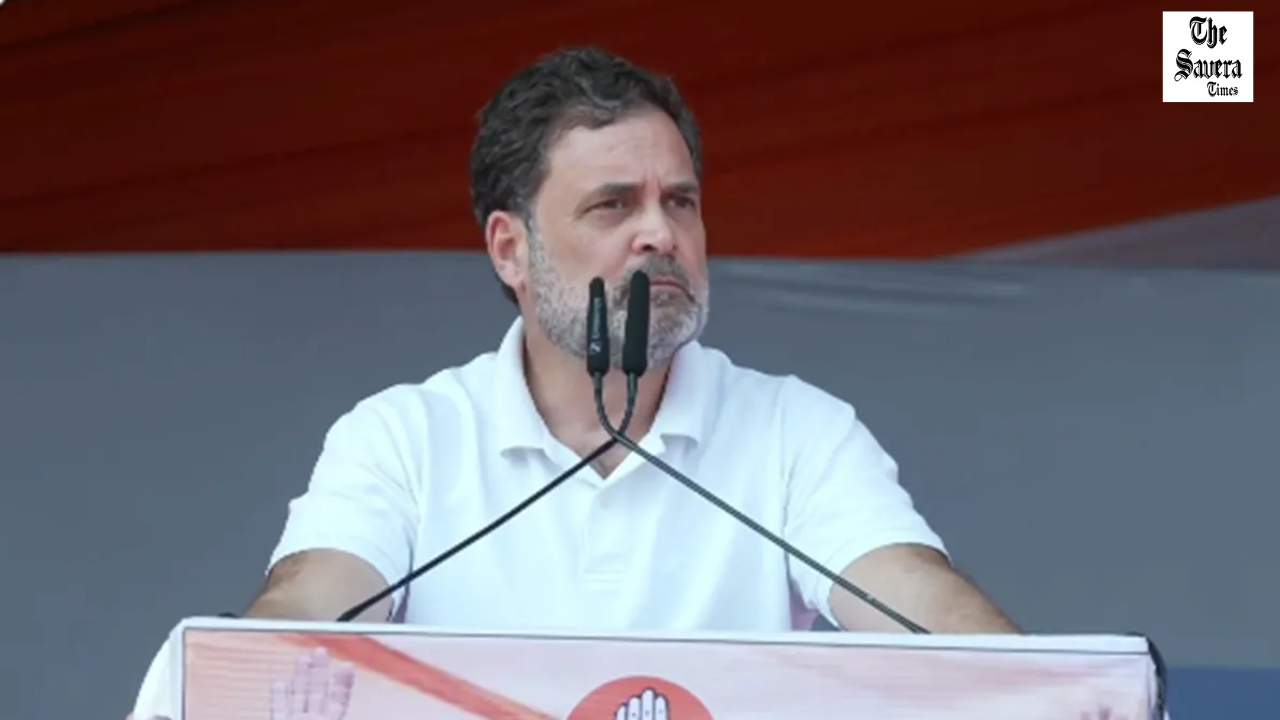
Congress leader Rahul Gandhi launched a sharp criticism of the Narendra Modi-led central government during a Kisan Maha Chaupal in Bhopal on Tuesday, issuing a public challenge to the Prime Minister to cancel a proposed trade deal with the United States. Addressing a gathering of farmers and party workers, Rahul Gandhi contended that the agreement would harm Indian agricultural interests and weaken local economies.
He accused the government of prioritizing corporate and foreign interests over farmers and domestic producers, asserting that any trade deal with the US should be reconsidered in light of the potential negative impact on key sectors such as agriculture, dairy and small-scale industries.
While details of the trade deal mentioned by Gandhi remain subject to ongoing policy discussions between New Delhi and Washington, he argued that the terms would open Indian markets to American agricultural imports, which could undercut local farmers’ prices and undermine food security. Farmers in Madhya Pradesh and other regions have long expressed concern that lowering tariff barriers could flood domestic markets with cheaper foreign produce, challenging India’s farmer base.
Gandhi said that the government’s focus should instead be on strengthening India’s agricultural infrastructure, enhancing MSP (minimum support price) mechanisms, and protecting small and marginal farmers from price volatility.
During his address, Rahul Gandhi framed his challenge within a broader critique of the Modi government’s economic policies. He alleged that the administration was increasingly reliant on agreements that favour multinational corporations at the expense of Indian producers. Gandhi told the crowd that he would hold the Centre accountable for any policy that adversely affects the “backbone of the Indian economy our farmers.”
He also underscored Congress’s commitment to protecting India’s sovereignty in trade negotiations, which he said should priorities jobs, local industry and self-reliant growth over foreign commitments that could erode domestic capacity.
The Kisan Maha Chaupal saw a robust turnout of farmers, many of whom echoed Rahul Gandhi’s concerns about trade liberalization. Several attendees told reporters that they fear loss of livelihood if tariff protections are removed or softened too rapidly under external pressure.
Some farmers pointed to sectors like pulses, dairy and horticulture as particularly vulnerable if cheaper foreign produce enters the Indian market. Others said that they hoped political leaders would raise these issues not only in rallies but also in Parliament and bilateral talks.
The Centre has not officially commented on Rahul Gandhi’s challenge or specified whether a trade deal with the United States is imminent. Government sources have previously indicated that India evaluates trade agreements based on national interest, with careful consideration given to economic sectors that might be affected.
Officials have maintained that India’s participation in trade talks is guided by long-term strategic interests, market access goals and reciprocal arrangements with partner countries.
Analysts say Rahul Gandhi’s remarks are part of Congress’s strategy to galvanize farmer support ahead of upcoming elections in several states and at the national level. Agriculture remains a sensitive and high-impact issue in Indian politics, and any suggestion that farmers’ interests are being compromised is likely to resonate with rural voters.
Political commentators note that by directly challenging a proposed trade deal, Gandhi is positioning the Congress as a defender of the rural economy, seeking to draw a contrast with the ruling party’s economic policies.
It remains to be seen whether the government will respond directly to Rahul Gandhi’s challenge or clarify India’s stance on the bilateral trade discussions with the United States. Meanwhile, the debate is expected to feature prominently in political discourse, particularly as parties intensify campaigns in agricultural states.
As the monsoon approaches and the first rains arrive, cities across India begin preparations to address the seasonal...

UDAN completes ten years in 2026. Over the past decade, it has expanded India’s regional aviation network, connecting...

A powerful explosion erupted after firecrackers stored in a house in Alampur village, Siwan district, Bihar, on Friday
A Delhi court on Friday sent social media influencer Amir Shokeen to one-day judicial custody in connection with...
The Delhi High Court on Friday dismissed All India Students' Association (AISA) President Neha Bora's plea challenging the...
India's Ministry of External Affairs (MEA) on Friday clarified the government's position on the alleged ongoing face-off with...
Aries: The day will be auspicious...