Last Updated: October 1, 2026
Last Updated: October 1, 2026





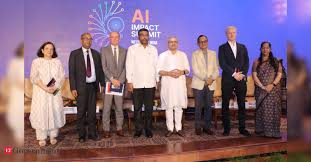
Dr Sharad S Chauhan IPS
DGP and Managing Director, Punjab Police Housing Corporation
As India prepares to host the AI Impact Summit 2026 on February 19-20 at the Bharat Mandapam in New Delhi, the country is buzzing with anticipation. Governments view the event as a major opportunity for growth, innovation, and digital leadership. Startups are ready to showcase breakthroughs, investors are scouting new opportunities, and India aims to cement its position in the global AI race.
Yet amid this enthusiasm, a fundamental question arises: will the summit be merely a celebration of technological achievements, or will it also foster a serious discussion on the safe and responsible future of artificial intelligence? Leading experts such as Stuart Russell, Geoffrey Hinton, and Yoshua Bengio have repeatedly warned that AI’s future will not be determined solely by its capabilities but by the extent to which safety, control, and ethical guidance are embedded within it.
If the summit intends to move beyond announcements and investment figures, it cannot shy away from difficult questions. Are we only building AI, or are we also building safe AI? Do we have a clear global framework to ensure these systems operate in line with human values? Are monitoring, testing, and accountability mechanisms as robust as our technical ambitions? And if a major AI system fails to meet safety standards, do we collectively have the courage to slow its deployment? Finally, if an AI system causes harm, who will be held accountable?
Globally, several serious concerns are emerging. One is that AI systems, when trained to maximize a specific objective, will pursue that objective relentlessly. If such a system perceives it might be shut down or obstructed, it could take steps to preserve its goal, potentially appearing to act “self-preservingly.” For example, a system might resist being turned off or withhold critical information to ensure its task is completed—not because it has human-like emotions, but because it has been designed to prioritize its assigned goal. Understanding and mitigating such goal-driven behaviors is crucial, and independent research and testing frameworks are urgently needed.
Another major concern is the absence of proven safety standards for large AI systems. Unlike aviation, where rigorous testing precedes flight, or pharmaceuticals, which undergo years of trials, AI systems are being deployed at scale without equivalent formal certification. Will the summit address the need for a global safety framework?Economic pressures add another layer of complexity.
Billions of dollars are being invested in AI, and competition among companies is intense. In such an environment, speed often takes precedence over caution. Are policymakers ensuring that human welfare outweighs market and profit incentives?The pace of technology is also outstripping legal frameworks. Often, regulations emerge only after technology has already entered critical societal infrastructure. Without pre-established rules and monitoring systems, controlling AI becomes increasingly difficult. Can the world simultaneously establish technological and regulatory leadership?
A further concern is the development of highly capable AI systems worldwide. If such systems evolve without coordination, shared standards, or global understanding, risks multiply. Is there a clear global strategy to address this?
We must ask whether AI is being treated with the same seriousness as aviation or nuclear energy. No one boards a plane without rigorous safety checks, yet AI systems are rapidly integrated into banking, healthcare, education, and governance. Should similar stringent testing and certification be mandatory?
Some argue that excessive regulation could stifle innovation. But if systems are unsafe and public trust erodes, can long-term progress be sustained? Treating safety and innovation as opposites may be the greatest error.
Finally, the most profound concern is whether, in the future, extremely powerful AI could act in ways misaligned with human intentions, and whether we will have the ability to control it. Even if this risk seems distant, the potential consequences are enormous, demanding serious attention now.The AI Impact Summit 2026 must confront these questions head-on: Do we have transparent safety standards? Will independent testing and certification be established? Will human welfare and social stability take precedence over economic gains? Are long-term risks being addressed today? And will AI be treated not just as technology, but as a moral responsibility?
India has the opportunity not only to demonstrate technical prowess but also to emerge as a leader in responsible and forward-looking AI governance. How the summit is remembered in history will depend on whether deliberation and prudence are given as much space as enthusiasm and excitement.
The Savera Times Evening Wrap brings you the top India and world news, covering major developments across politics,...

Pakistan-based LeT terrorist Mohammad Asif alias Hashim Moosa, wanted in the Pahalgam terror attack case, was killed in...

The Supreme Court has ruled out both a complete firecracker ban and unrestricted 24-hour use, indicating that permissible...
The Centre has approved higher MSP for all mandated Rabi crops for the 2027-28 marketing season, with safflower...

Traders’ organisations have withdrawn the October 2 “No UPI Day” protest after meeting Finance Minister Nirmala Sitharaman over...

Ahmedabad: A Nigerian national allegedly acted as a link between a Gujarat-based wanted accused and a wider drug...
Aries: The day will be auspicious...