Last Updated: October 21, 2026
Last Updated: October 21, 2026





Sheena Sandhu
Ministers on the ground, cheques in hand, and reforms on paper — Delhi has signalled intent. The challenge is to turn visits into verifiable fixes. In a federal system, disasters are stress-tests. They measure not just nature’s force but the state’s capacity and the Centre’s seriousness. The 2025 floods in Punjab—breaches of the Sutlej, over 1,900 villages inundated, crops flattened across 12 districts, more than 40 lives lost—offered just such a test. What stood out this time was not the water, but the traffic from Delhi.
From the Prime Minister down to junior ministers, the Centre sent a procession of responsibility into Punjab’s flood belts. These were not ceremonial fly-bys. Each visit came tagged with money transfers, promises that can be tracked, and public numbers that can be contested. The effect: Delhi signalling that Punjab’s recovery would not wait on Chandigarh’s paperwork.
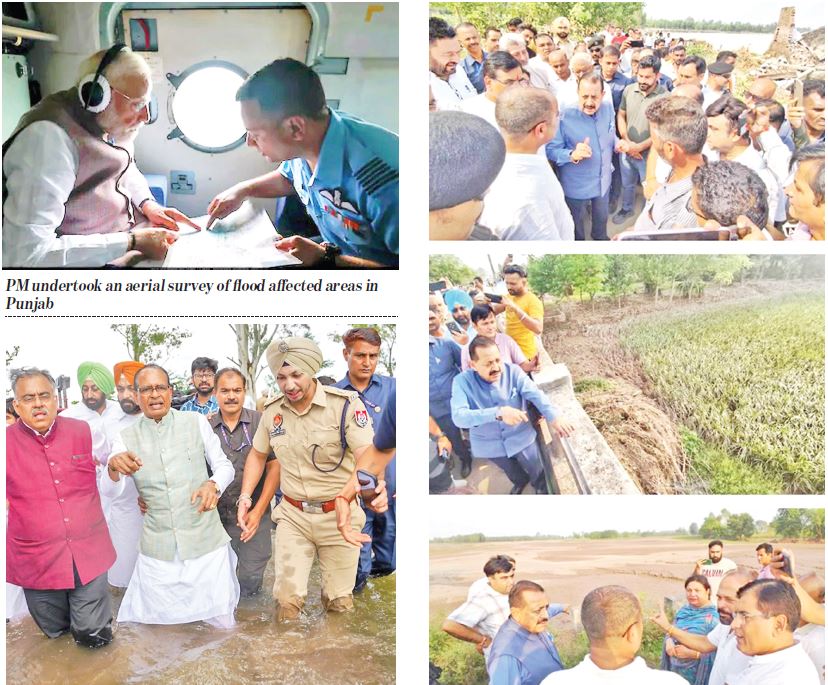
The tone was set on September 9, when the Prime Minister conducted an aerial survey over Gurdaspur and immediately announced a Rs 1,600 crore special package. Standard ex-gratia followed—Rs 2 lakh to the next of kin of the deceased, Rs 50,000 for the injured—along with the instruction that Punjab should tap its own State Disaster Response Fund balances. Within days, the Ministry of Home Affairs reminded reporters that Punjab’s SDRF kitty held Rs 12,589 crore, even as Rs 805 crore from the Prime Minister’s package had already been disbursed, including Rs 170 crore from NHAI for highway repairs.
Even before Punjab could file a formal memorandum of damages, the Centre constituted an Inter-Ministerial Central Team (IMCT) on September 1 and dispatched it to begin ground assessments in Fazilka and adjoining districts on September 3. The choice of Fazilka—both border district and hydraulic choke-point—was not accidental. The administrative signal was clear: relief would be “memo-later, action-now.”
Other ministers fanned out across the flood zone. Shivraj Singh Chouhan, Agriculture Minister, toured Amritsar, Gurdaspur and Kapurthala, meeting farmers in relief camps. His message was practical: the 21st instalment of PM-KISAN would be advanced for Punjab, Haryana and Himachal Pradesh. On September 26, that commitment materialised as Rs 540 crore transferred digitally to 27 lakh farmers. For smallholders, this was not charity—it was cash flow for the next sowing. Chouhan also raised an uncomfortable truth: illegal mining had worsened flood damage by destabilising embankments. Relief was paired with accountability.
Jitendra Singh (MoS, PMO) and Jitin Prasada (Union Minister) made rounds in Pathankot and adjoining villages. L. Murugan (MoS, I&B) visited Rupnagar, inspecting relief shelters along the Sutlej. Their presence may not have generated large cheques, but it did generate detailed field notes that feed directly into central files. Disaster relief is logistics as much as largesse, and on-site notes matter.
Ravneet Singh Bittu (MoS, Railways and Food Processing) chose transparency as his message. From Sultanpur Lodhi he gave reporters a line-by-line account: total SDRF balances, tranches already disbursed, number of villages covered, warehouses opened, medical camps functioning. In a state where Centre–State relations are often mired in allegation and counter-allegation, numbers are harder to dismiss.
The most politically resonant visit came from Arjun Ram Meghwal, Law and Justice Minister, who stopped in Abohar and Fazilka. There, beyond reviewing flood relief, he announced that Fazilka would be added to the Centre’s “Aspirational Districts” programme. Local leaders, including Fazilka’s MLA, publicly thanked him on X. Formal notification is awaited, but the promise matters: it would bring a border district, battered by floods, onto a data-driven reform dashboard with monthly monitoring and flexible central funding. If delivered, Fazilka would join the cohort of districts that have shown measurable gains in school outcomes, healthcare access and rural skilling. Relief would segue into multi-year development.
Critics will dismiss this ministerial cavalcade as optics. After all, culverts are rebuilt by engineers, not entourages. But the evidence this time is that visits mapped to disbursements. The PM’s tour produced an immediate package. The Agriculture Minister’s assurance turned into direct transfers within three weeks. The Home Ministry’s early IMCT move meant assessment before memo. The Law Minister’s Fazilka announcement aligned with the programme’s own dashboard logic. Even the junior ministers’ site reviews left paper trails in PIB releases and local X updates.
The real test, however, is not visits but revisits. Three markers in the next 90 days will decide whether seriousness endures.
First, notification. Will Fazilka be formally added to the Aspirational Districts roster, with a published baseline and targets? Will the IMCT’s report be uploaded, time-stamped, and linked to specific fund releases? Without paperwork, promises drift.
Second, engineering fixes. Will NHAI and Punjab’s PWD issue a pre-monsoon culvert and embankment retrofit plan for the Sutlej-Beas-Ghaggar system? Ministers invoked illegal mining and faulty road drainage as culprits; unless those points are addressed before June 2026, another flood season will turn rhetoric into déjà vu.
Third, automaticity of money. Can SDRF tranches be linked to IMD red alerts and satellite flood maps, so that money moves when the rivers rise, not weeks later? The Centre’s “IMCT first, memo later” stance hints at appetite for such auto-trigger releases. Codifying it would turn precedent into protocol.Federalism thrives on friction, and Punjab’s government has rightly challenged the adequacy of central aid. But beneath the argument, a pattern has emerged: Delhi’s visits were not mere political theatre. They came attached to cheques, dashboards and deadlines. That is the difference between solidarity as photo-op and solidarity as system.
xDisasters will recur; the monsoon will not wait for consensus. But if the Centre’s ministerial matrix—Prime Minister, Home, Agriculture, Railways, Law, I&B, PMO—can deliver both immediate relief and institutional reform, then Punjab’s tragedy may yet leave behind a blueprint for federal responsibility. A government proves its seriousness not when it arrives, but when it returns—with spreadsheets. After the deluge, Delhi has already shown up twice: in person and in the ledger. The third appearance, in published progress charts, will tell Punjabis whether help was fleeting, or foundational.
(The writer is a retired civil servant, views are personal.)
Punjab Chief Minister Bhagwant Mann was allegedly detained for three hours at Delhi airport upon his return from...

The Punjab Vigilance Bureau (VB) during its ongoing drive against corruption in the state, has apprehended Inspector Gulshan...
Chief Minister Bhagwant Mann may soon hold a press conference or release a video message amid Union Home...
Punjab Cabinet Minister Aman Arora welcomed Union Home Minister Amit Shah's visit to Punjab on Tuesday. However, he...
Gurdaspur: Union Home Minister Amit Shah on Tuesday met with the families of those who spoke out against...
Mansa: A shocking incident was reported from Mansa in Punjab on Tuesday morning, where a Punjab Police head constable...