Last Updated: October 20, 2026
Last Updated: October 20, 2026





Abhishek Vij
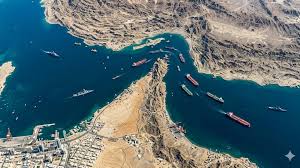
Immediately after US President Donald Trump stated on Thursday that countries wishing to purchase oil and gas from the Gulf nations should take it upon themselves to ensure the passage through the Strait of Hormuz remains open, Britain took charge of the issue.
France and China extended their support to Britain. On Friday, representatives from 60 nations gathered to deliberate on this matter. While British Prime Minister Keir Starmer had initially cited a figure of 35 nations, the broad scope of the issue ultimately led to the participation of 60 countries. Foreign Secretary Vikram Misri represented India at the meeting. The proceedings were conducted via video conferencing. French President Emmanuel Macron asserted that the Strait of Hormuz cannot be reopened through the use of military force—a stance endorsed by China. Britain has unequivocally declared that a potential conflict between Iran and the US is not its concern. Meanwhile, the Iranian Parliament has ratified a law imposing a “Hormuz Tax.” The Strait of Hormuz lies just five kilometers off the Iranian coast; under international maritime law, a nation exercises sovereignty over the waters extending up to 22 kilometers from its shoreline.
The proposed tax is to be legitimized by the International Maritime Council, the WTO, and the IMF. Iran argues that the Strait of Hormuz constitutes its natural maritime route. Consequently, Iran will now be able to levy a daily tax on traffic passing through the Strait. Gulf nations—specifically the UAE, Oman, and Bahrain—have expressed their support for these negotiations. For the time being, however, Iran has refused to reopen the Strait of Hormuz. Its position is that it will first “bring the US to its senses” before allowing passage through the Strait.
It is worth noting that even amidst the fierce conflict that has been raging between the US, Israel, and Iran since February 28, Iran has granted safe passage to six Indian tankers laden with gas. Nevertheless, this gesture alone does not resolve the larger issue; a true resolution can only be achieved if the Strait of Hormuz is fully reopened to all traffic. Only then will the shortage of gas and oil be alleviated in India and most other countries of the world. The question remains: how will the Strait of Hormuz be reopened? A fierce conflict is currently raging among Israel, the United States, and Iran. Israel has deployed its paratroopers in Lebanon, where they are attempting to neutralize Hezbollah adversaries. Meanwhile, the United States has blown up Iran’s largest bridge—the Karaj Bridge—using explosives. In retaliation, Iran has released a list of eight major bridges across the Middle East, threatening to destroy them.
Iran is well aware that these bridges are absolutely vital for connectivity and transportation across several nations. Iran’s list includes numerous critical bridges located in Kuwait, the UAE, Saudi Arabia, and Jordan. The now-damaged Karaj Bridge was considered the tallest bridge in the Middle East. Approximately 1,050 meters long and 136 meters high, the bridge cost nearly $400 million (approximately Rs3,800 crore) to construct. Prior to this, Israel had launched an attack on the residence of Kamal Kharazi—an advisor to Supreme Leader Mojtaba Khamenei—in Tehran.
Kharazi sustained severe injuries in the attack, while his wife was killed. At this moment, the intensity of the war has reached its zenith. Trump is fighting as if not merely America’s interests, but his own personal honor, were at stake. It appears that this conflict is now morphing into a war of bridge destruction. Iran, for its part, is increasingly relying on drone attacks. How can this war be resolved? Pakistan, which had attempted to position itself as a key mediator, has failed.
It is now being suggested that if India, Russia, and China were to join forces in a concerted effort to initiate peace talks, a ceasefire might potentially be achieved. Given the current circumstances, it is difficult to predict what the future holds; for the time being, however, the war continues to unleash a daily dance of death and destruction. Due to the ongoing war, most countries are grappling with shortages of oil and gas. This is having an adverse impact on stock markets worldwide, including in India. The major lesson that India—along with most other nations—should draw from the current crisis is that self-reliance in the oil and gas sector is essential.
Good Evening Viewers! Catch up on the day's biggest stories with The Savera Times Evening Bulletin. Get the...

Congress leaders continued their protest outside the Jaipur Police Commissionerate on Tuesday, demanding the registration of a zero...
On the auspicious occasion of Vijayadashami, Prime Minister Narendra Modi on Tuesday called on the countrymen to unite...
A historic milestone was achieved on Tuesday in the expansion of Chhattisgarh's rail networkA historic milestone was achieved...

Model Shraddha Dubey, one of the main accused in the death of Lucknow businessman Shiv Sharma, has been...

Rashtriya Swayamsevak Sangh (RSS) chief Mohan Bhagwat on Tuesday called for strengthening national unity, social harmony, indigenous practices...
Aries: The day will be auspicious...