


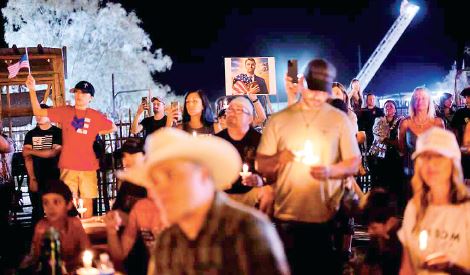
A mass memorial for Charlie Kirk at State Farm Stadium has become one of the biggest security and political tests the United States has faced in recent weeks, underscoring how a single killing has widened fault lines at home and rippled abroad. Organizers held the public memorial on September 21 at the NFL stadium in Glendale, Arizona, drawing top Republican figures and large crowds and forcing a multiagency security response on an extraordinary scale.
Kirk, a prominent conservative activist and founder of Turning Point USA, was shot on September 10 while speaking at Utah Valley University. Police arrested 22-year-old Tyler Robinson and charged him in the killing; prosecutors said they would seek the death penalty. The slaying prompted national debate about political violence and prompted hurried preparations for the Arizona memorial.
Federal and local law enforcement declared the event a national security priority and mounted Super Bowl-level precautions. Authorities reported multiple threats of varying credibility and briefly detained a man outside the stadium who was accused of impersonating an officer while armed. Officials described the scale of the operation as unprecedented for a memorial and warned it would strain protective resources.
The funeral and its aftermath have sharpened partisan rhetoric. President Donald Trump seized on the killing to announce plans to designate the anti-fascist movement known as antifa as a “major terrorist organization,” a move legal experts and observers said would be difficult to implement because antifa is a decentralized ideology rather than a single group. The announcement intensified debate over the boundaries of national security and free speech.
The cultural and media fallout has been immediate. Broadcasters and employers moved to discipline or remove some public figures for on-air comments or social posts about the killing, and at least one high-profile late-night show was pulled from its schedule pending review. Critics warned such actions risk chilling legitimate commentary, while supporters argued they were necessary responses to tasteless or threatening remarks.
The week’s events have intersected with wider geopolitics. Trump’s state visit to the United Kingdom drew lavish ceremony and street protests, highlighting the international dimension of his presidency even as the U.S. handled a domestic security emergency.
Elsewhere, the Macrons opened a transatlantic legal front by suing U.S. commentator Candace Owens for defamation and signalled they will present photographic and scientific evidence in a Delaware court to rebut false claims about Brigitte Macron’s identity. The case underlined how online disinformation can provoke cross-border legal and reputational battles.
Regional diplomacy also shifted. Saudi Arabia and Pakistan signed a strategic mutual defence agreement that commits both states to treat aggression against one as aggression against both, a pact analysts say recalibrates security in the Middle East and South Asia. At the same time the U.S. moved to revoke a sanctions exemption for operations at Iran’s Chabahar port, a change New Delhi is examining for its strategic consequences.
Back in South Asia, Indian outlets published a video in which a Jaish-e-Mohammed commander claimed Pakistan’s military ordered officers to attend funerals after India’s Operation Sindoor. Those reports, if authentic, add another layer to already strained ties, though media organisations noted that such footage has not been independently verified by neutral international agencies.
The week’s trajectory — an assassination, a high-risk national memorial, sweeping political reactions and rapid diplomatic shifts — illustrates a fraught moment. Security agencies were tested, broadcasters and employers moved quickly to discipline public figures, and governments recalibrated foreign-policy positions. For now, the immediate challenge is operational: keeping large gatherings safe while the deeper task remains political and legal. The public and institutions must reckon with how to preserve open discourse and civil order in a climate of rising polarization.