Last Updated: October 22, 2026
Last Updated: October 22, 2026





Rajesh Kumar
A famous mantra from the Rigveda, recited by Rashtriya Swayamsevak Sangh volunteers, captures their core belief in unity and social harmony: “Sangacchadhwam Samvadadhwam Sam Vo Manansi Janatam Deva Bhagam Yatha Purve Sanjanana Upasate”.
The essence of which is that we should all live together, and we should all become knowledgeable and wise. We should behave like our ancestors. In ancient times, the conduct of the gods was exactly like this.
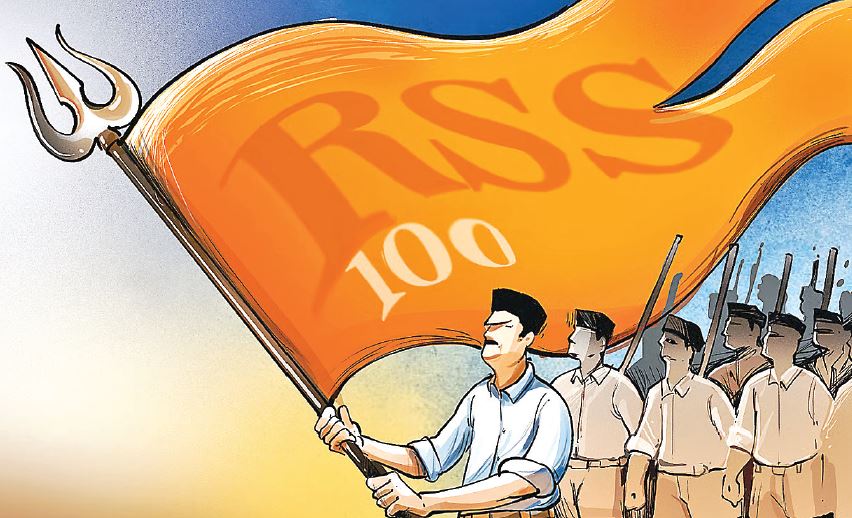
Exactly 22 years before independence, the year was 1925. The country was shackled by the chains of British rule. During this period of slavery, a man on the sacred land of Nagpur, along with his 17 companions, took a pledge: “I will organize the Hindus along with the independence of India.” The pledge that the volunteers took at the beginning of the Sangh was – “I will dedicate my body, mind, and wealth to make India a free, prosperous, and glorious nation.” At that time, this idea was neither a political slogan nor a movement of protest, but rather the seed of a cultural renaissance. Dr. Keshav Baliram Hedgewar not only sowed this seed in society and the nation, but as long as he lived, he continuously nurtured it with his ideas. A hundred years later, the same seed has transformed into a gigantic banyan tree in the form of expansion of service, organization, values, and social transformation.
Dr. Hedgewar was a visionary. He knew that an organization would be formed, but for the organization to remain, he did not merely give speeches or sermons; instead, he developed a systematic methodology, which is known today as the ‘Shakha’ (branch). This branch was not just a place for physical exercise, but a platform for national rejuvenation where the values of discipline, patriotism, and service were instilled in the individual. The third Sarsanghchalak of the Sangh, Balasaheb Deoras, used to say, ‘Where there are Hindus, there is a Shakha, and where there is a Shakha, there is victory.’ According to them, ‘the Shakha (branch) is a vibrant expression of the spirit of women’s safety and national defense.’ Over time, this one-hour branch meeting has transformed from a laboratory of individual development into a laboratory of social development.
As the Sangh enters its centenary year, Dr. Hedgewar’s foundational dream is now a reality, not just a concept.
On the occasion of completing its hundred years, the Sangh clearly states that it aims to become all-encompassing and all-inclusive. That is, in the centenary year, the Sangh’s ideology should reach every village, settlement, individual, and family. The action plan created by the Sangh to achieve this goal is as practical as its broad vision.
The first major program of the Sangh’s centenary year was the procession at the Mandal and suburban levels on Vijayadashami. In Haryana alone, on Vijayadashami, out of 1443 settlements in all 257 urban units, 1398 settlements (97%) and out of 882 rural Mandals, 862 Mandals (98%) and 4016 out of 6701 villages (60%) participated, with 84,519 volunteers, 2925 band members (RSS band), 57,065 members from volunteer families (including 9886 women), and 1062 special guests and spectators, completing 1111 programs. In a progressive state like Haryana, where farmers, soldiers, athletes, and young men and women are symbols of energy, the expansion of this ideology is becoming a means of awakening a new consciousness in society.
On festivals like Vijayadashami, the branch meetings, conferences, and dialogues are not just celebrations, but also introspection and self-reflection in the direction of the Sangh’s hundred years. It would not be wrong to say that these are also the foundation of future plans. The upcoming programs, including reaching out to every household by December 2025 and organizing Hindu conferences in every Mandal (a group of 8 to 10 villages) and every settlement (with a population of 8,000 to 10,000) in February 2026, will be highly effective in uniting society.
Dr. Hedgewar’s vision was to empower the nation; it is essential to have a sense of organization in every section of society, not just in politics. He never aspired for any position or power. His only goal was a strong nation through an organized society.
“Path ka antim lakshya nahin hai singhasan chadhte jana.
Sab samaj ko liye saath mein aage hai badhte jana. ”
This idea is as relevant today as it was a hundred years ago. Society will only be strong when it has unity, harmony, discipline, and self-confidence. The Shakha system has instilled these qualities deep within society. This system leads the individual from ‘I’ to ‘we’. Only when every individual in society dedicates some time to the welfare of their village, settlement, and neighborhood will the process of nation-building be strengthened.
Dr. Hedgewar’s dream was not merely of an organization, but of a process of national character building. Today, when the youth are making the principles of “service, organization, and dedication” the foundation of their lives, the belief is strengthened that the coming centuries will belong to India. An India that will remain firmly rooted in its cultural heritage while embracing modernity.
Dr. Hedgewar’s words have become not just history, but a living truth of the present –” Sangathit samaj hi sashakt Bharat ka aadhar hai.”
(Rajesh Kumar, Prant Prachar Pramukh, Rashtriya Swayamsevak Sangh, Haryana)
Good Evening Viewers! Get the latest updates from India and around the world with The Savera Times Evening...

Bharatiya Janata Party (BJP) National General Secretary Smriti Zubin Irani launched a scathing attack on Congress MP and...

New Delhi: Cockroach Janata Party (CJP) leaders Saurav Das and Ashutosh Ranka will be released from judicial custody...
According to police, three suspicious young men are seen in CCTV footage. Efforts are underway to identify them....
A video has surfaced of an alleged attempted assault on Jan Suraj Party's Bihar president Manoj Bharti. The...
Two accused have been convicted and sentenced to 10 years of rigorous imprisonment in a 2017 drug trafficking...

Aries: The day will be auspicious...