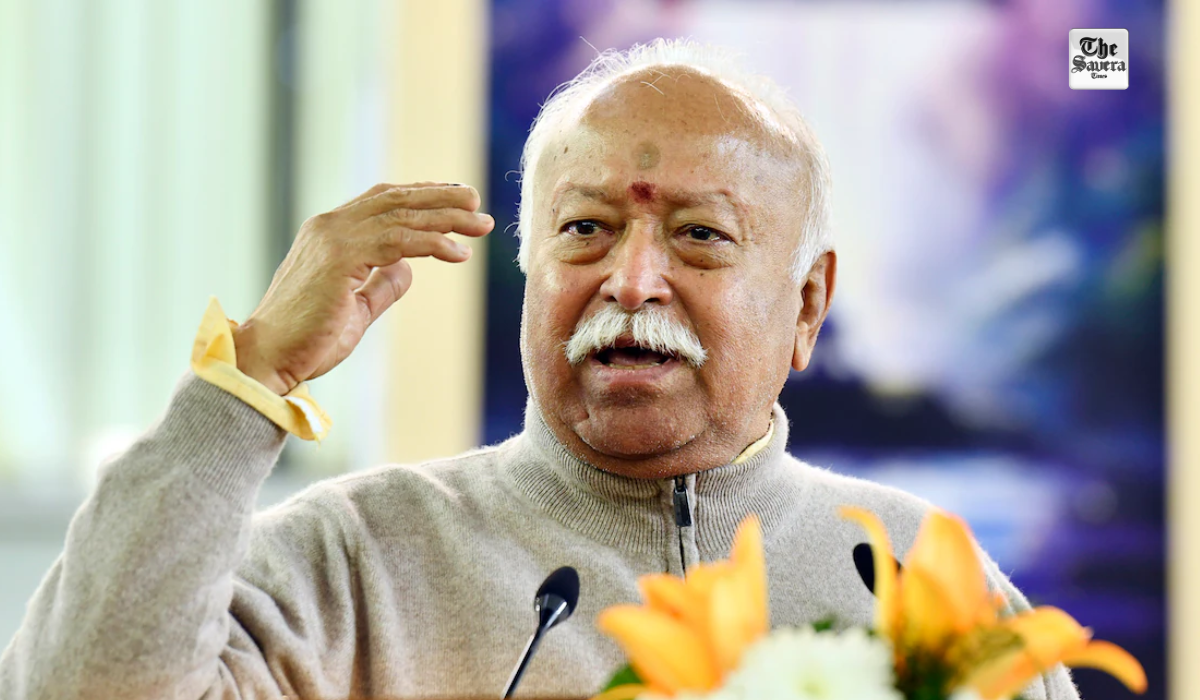
Addressing a research scholars’ dialogue programme at the Malviya Auditorium of the University of Lucknow, Bhagwat said the British altered India’s education structure to create a class of “black Englishmen” who would serve their administrative needs. He stressed that the damage inflicted during colonial rule must be corrected.
Education, Healthcare and Social Responsibility
He said education and healthcare are fundamental necessities and should not be treated as commercial enterprises. “Education and health must be accessible to all,” he said.
Stating that the Rashtriya Swayamsevak Sangh (RSS) is committed to building a prosperous and united nation, Bhagwat said the organisation works for social cohesion rather than popularity or political power.
“If you want to understand the RSS, come and see it from within. It cannot be understood merely by reading about it,” he said, adding that its core objective is to unite Hindu society and strengthen national character.
Research, Truth and National Character
Highlighting the role of research in shaping India’s future, he urged scholars to pursue their work with authenticity and a spirit of service to the nation.
“Truthful facts must be brought to light. Ignorance prevents us from understanding India,” he said.
He also claimed that there has been “negative propaganda” against the Sangh and called upon researchers to present facts objectively.
Globalisation, Indian Philosophy and World Leadership
On globalisation, Bhagwat remarked that the concept has increasingly become synonymous with commercialisation and materialism, which he termed dangerous.
Referring to the Indian philosophy of Vasudhaiva Kutumbakam (the world is one family), he said India advocates collective well-being rather than consumerism. He contrasted this with what he described as Western materialist approaches, asserting that India possesses solutions to global challenges.
“If we aspire to become a world leader, we must be strong in every sphere. The world respects truth only when it is backed by power,” he said.
Dharma and Environmental Responsibility
Speaking on dharma, Bhagwat described it as an eternal principle governing life and the universe. He said that it promotes harmony and collective happiness.
“We are meant to live together, not in isolation,” he said, adding that conduct may vary according to time and place, but foundational values remain constant.
He also emphasised environmental responsibility, urging citizens to adopt eco-friendly practices such as tree plantation, water conservation, and avoiding single-use plastics, while leveraging modern technology for sustainable development.