Last Updated: October 21, 2026
Last Updated: October 21, 2026






K SIVA PRASAD
Retired senior IAS officer in the Punjab Government
Krishna says ‘sat’ (reality/permanence) never ceases to be and ‘asat’(unreal/impermanence) has no existence. A jnani is the one who can distinguish between the two (2.16).
The rope and snake analogy is often quoted in many cultures to understand the intricacies of ‘sat’ and ‘asat’.
A man returned home at dusk and found a coiled snake at the entrance to his home. But in reality, it was a rope left by children that looked like a snake in the semi-darkness.
While the rope signifies ‘sat’, the snake signifies‘asat’. Until he realizes ‘sat’ i.e. the rope, he is likely to adopt many strategies to handle ‘asat’ i.e. the illusory snake. He could attack it with a stick (fight), run away (flight) or he may try to light a torch to check out the reality.
The best strategies and skills would go in vain when our perception is that of ‘asat’.
‘Asat’always derives its existence from ‘sat’, just as the snake doesn’t exist without the rope.
Because‘asat’ derives its existence from ‘sat’, it can influence us much like a nightmare- causing real physical reactions, such as sweating, even while we sleep.
A litmus test given by Krishna to identify ‘asat’ is; that ‘which didn’t exist in the past and wouldn’t be there in the future’.
If we take the example of sensual pleasure, it wasn’t there before and wouldn’t be there after some time. The same is the case with pain and for that matter all polarities.
The indication is that ‘asat’ exists in time whereas ‘sat’ is eternal.
The ‘sat’ is the inner self which is eternal and ahankaar is ‘asat’ which sustains itself with the support of the inner self. The day we discover our inner self (rope), the ahankaar (snake) automatically disappears.
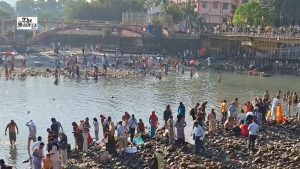
Reduced water levels at Har Ki Pauri and other Haridwar ghats have inconvenienced pilgrims during the Upper Ganga...
Six people returning from a Dussehra Mela were seriously injured when a car hit them on National Highway...

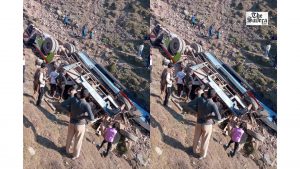
A bus travelling from Pachiound to Ramnagar fell into a gorge at Gulli Gula in Udhampur district. Nine...
Start your day with The Savera Morning Brief, bringing you the latest news from India and around the...

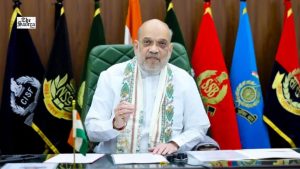
Union Home Minister Amit Shah will pay tribute to police martyrs at the National Police Memorial in New...
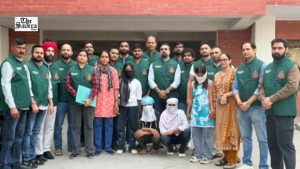
Four more people, including two women, have been arrested in the Tiger Shroff firing case. Delhi Police are...
Aries: The day will be auspicious...