Last Updated: October 21, 2026
Last Updated: October 21, 2026





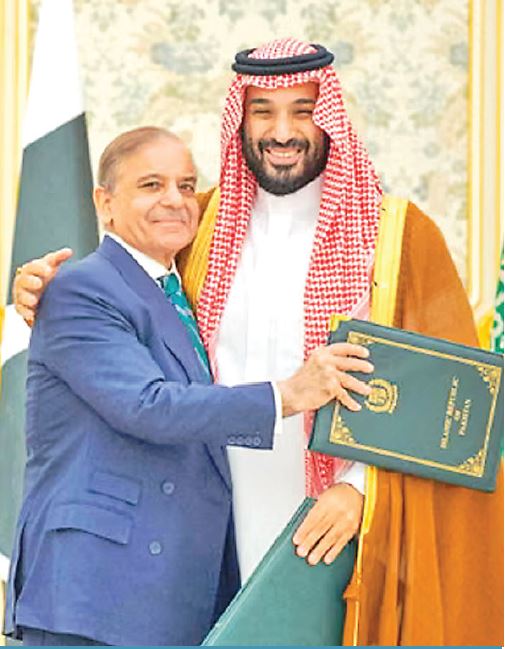
Pakistan and Saudi Arabia have signed a new mutual defence pact that both governments describe as a culmination of decades of cooperation. The agreement, announced during Pakistani Prime Minister Shehbaz Sharif’s recent visit to Riyadh, contains a clause similar to NATO’s principle of collective defence: an attack on one will be considered an attack on both.
The pact comes against a turbulent backdrop in the region. Sharif recently attended the Arab-Islamic summit in Doha convened by the Organisation of Islamic Cooperation (OIC) following Israel’s strike on Hamas leaders in Qatar. The strike coincided with fragile ceasefire discussions over Gaza. In South Asia, India’s Operation Sindoor in May, launched in retaliation to the Pahalgam terror attack that killed 26 people in April, targeted terror installations deep inside Pakistan.
These developments have added to the strategic weight of the new agreement. For India, the pact signals a shift worth close attention. The Ministry of External Affairs has said it was aware of discussions between Islamabad and Riyadh over such an arrangement and will “study the implications of this development for our national security as well as for regional and global stability.”
A Longstanding Partnership Formalised
Officials from both countries emphasised that the pact is not a response to recent conflicts but the result of years of negotiations. A Saudi official noted that the agreement “institutionalises longstanding and deep cooperation” and should be seen as part of a historic partnership that extends nearly eight decades.Saudi Arabia and Pakistan have been close defence partners without a formal treaty since the 1960s. Pakistan has trained over 8,200 Saudi military personnel since 1967, and joint exercises have been a regular feature. Riyadh has consistently supported Islamabad with oil supplies and financial aid during economic crises.
The new pact, therefore, cements rather than creates this alignment.The agreement pledges joint deterrence against external aggression and signals an intention to expand military cooperation across services. While questions remain over whether this includes nuclear assurances from Pakistan, Saudi officials insist it is a comprehensive defensive arrangement covering all conventional means.
Comparing Military Strengths
The pact raises the question of how the Pakistani and Saudi militaries compare with India’s armed forces. On paper, India dwarfs both.
India’s defence budget for 2024-25 stands at about \$78.3 billion (Rs 6.90 lakh crore), almost identical to Saudi Arabia’s allocation of \$78.3 billion (Rs 6.89 lakh crore). Pakistan, in contrast, spends about \$9 billion (Rs 79,300 crore). The three nations’ shares of GDP devoted to defence vary sharply: Saudi Arabia allocates nearly 7 per cent, Pakistan 3.8 per cent, and India 1.9 per cent.
According to the Global Firepower Index 2025, India ranks fourth globally, Pakistan twelfth, and Saudi Arabia twenty-fourth. India’s manpower advantage is decisive. Its 1.4 million active soldiers and 1.15 million reserves far outnumber Pakistan’s 654,000 active and 550,000 reserves, or Saudi Arabia’s 257,000 active personnel with no reserves. India’s paramilitary strength exceeds 2.5 million, compared to Pakistan’s 291,000 and Saudi Arabia’s 150,000.
Air power reflects similar disparities. India fields around 513 fighter jets, Pakistan 328, and Saudi Arabia 283. Analysts caution, however, that India’s air fleet faces modernisation challenges, and that the combined strength of Pakistani and Chinese air forces presents a regional imbalance. On land, Saudi Arabia operates roughly 840 main battle tanks, while Pakistan possesses 2,627. India leads with around 4,200 tanks. In naval terms, India has clear superiority, operating two aircraft carriers – INS Vikrant and INS Vikramaditya – while neither Saudi Arabia nor Pakistan maintains any carriers. Both India and Pakistan are nuclear-armed, but Saudi Arabia is not.These figures show that while Saudi and Pakistani forces combined can supplement each other, India’s scale and diversified capabilities remain unmatched in the region.
India’s Ties with Saudi Arabia
India and Saudi Arabia established diplomatic ties in 1947 and gradually built a wide-ranging partnership. A breakthrough came in 2006 when King Abdullah visited India, followed by the elevation of relations to a strategic partnership in 2010 during Prime Minister Manmohan Singh’s visit.
Under Prime Minister Narendra Modi, relations have deepened further. Modi has visited Riyadh three times, in 2016, 2019, and 2025. His first visit saw him receive the King Abdulaziz Sash, the kingdom’s highest civilian honour. Crown Prince Mohammed bin Salman’s 2019 visit to New Delhi announced plans for Saudi investment worth \$100 billion in India, accompanied by multiple memorandums of understanding.
Today, the two nations share strong economic ties. India is Riyadh’s second-largest trading partner, while Saudi Arabia is New Delhi’s fifth-largest. Bilateral trade in 2023-24 stood at \$42.98 billion (Rs 3.79 lakh crore), with Indian exports worth \$11.56 billion and imports worth \$31.42 billion.
Defence cooperation has also grown. The two countries have held two editions of the bilateral naval exercise Al Mohed Al Hindi, and in 2024, they conducted their first joint land exercise, Ex-Sada Tanseeq I. That same year, Munitions India Ltd signed a \$225 million defence export deal with Saudi Arabia.Saudi officials underline that their deepening ties with Islamabad will not come at the expense of relations with New Delhi. Riyadh has condemned terror attacks in India, including the Pahalgam incident, and has repeatedly affirmed its support for peace and stability in South Asia.
India’s Measured Response
For New Delhi, the Saudi-Pakistan pact is a development that cannot be ignored, but it may not immediately alter India’s strategic calculus. Saudi Arabia’s insistence that the agreement is not aimed at any specific country, coupled with its growing partnership with India, suggests a balancing approach.The Ministry of External Affairs has responded cautiously, stating that India will study the agreement’s implications. MEA spokesperson Randhir Jaiswal reiterated that the government remains committed to protecting national interests and ensuring “comprehensive national security in all domains.” Prime Minister Modi has also emphasised that India will not allow nuclear blackmail or tolerate terrorism, regardless of whether threats emanate from state or non-state actors.
Given India’s defence capacities and robust ties with Saudi Arabia, officials in New Delhi appear confident that the agreement will not significantly undermine India’s position. The new pact between Islamabad and Riyadh reflects shifting alignments in a region marked by overlapping conflicts and competing partnerships. For India, the task ahead will be to reinforce its own strategic and economic bonds with Riyadh while keeping a close watch on how Pakistan and Saudi Arabia choose to operationalise their new commitment.
North Korean leader Kim Jong-un's influential sister, Kim Yo-jong, and a military marshal inspected fortification work along the...

New Delhi: US Secretary of State Marco Rubio has assured India that America’s relations with any country in...

The family of 5-year-old Fabiana Cabello in New York City, USA, is in deep shock after her death....

A Cessna 177A crashed onto Capitol Expressway in San Jose on October 17. Three people on board, including...

Protests in Jakarta, Yogyakarta and Bandung brought students onto the streets over rising costs, forest fires and civil...
Organisations linked to Neville Roy Singham are under US congressional scrutiny over funding. Their coverage of protests in...