Last Updated: October 15, 2026
Last Updated: October 15, 2026





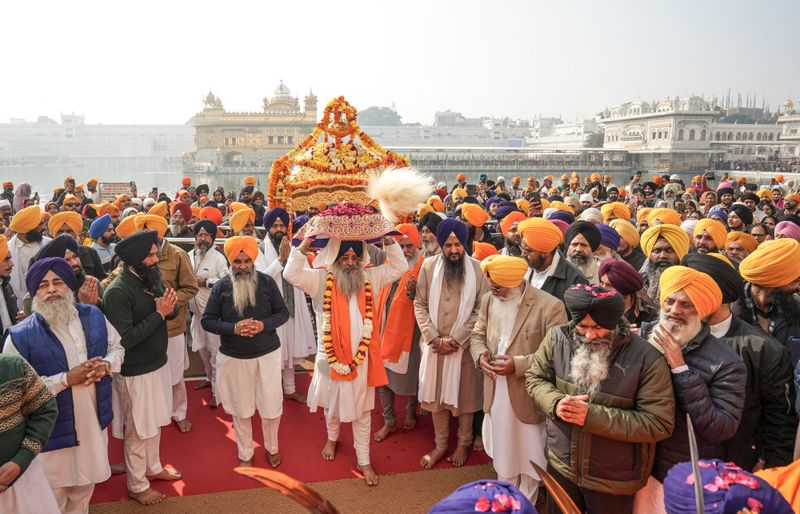
For more than five centuries, Sikhism has stood as one of the world’s most remarkable faith traditions. Founded on the timeless principles of devotion to one God, equality of all humanity, justice, selfless service (seva), and courage, it has survived persecution, imperial rule, Partition, terrorism, and political upheaval. Yet today, many Sikhs believe that the greatest challenge facing the Panth is no longer external oppression alone, but internal fragmentation, political polarization, religious confusion, and the gradual weakening of the Sikh community’s relationship with the Shabad Guru.
Recent controversies involving Punjab Chief Minister Bhagwant Mann and Sikh religious institutions have once again demonstrated that political leaders, regardless of party affiliation, must exercise restraint and respect when commenting on matters of faith. At the same time, Sikh religious institutions also carry the responsibility of maintaining public confidence by acting fairly, transparently, and independently of partisan politics. Governments are temporary; the Guru is eternal. Sikh institutions should never become extensions of political parties, nor should politicians attempt to become interpreters of Sikh doctrine.
The defining theological principle of Sikhism is that Guru Gobind Singh Ji ended the line of human Gurus and bestowed eternal Guruship upon Sri Guru Granth Sahib Ji. The declarations “Guru Maneyo Granth” and “Guru Khalsa Maneyo Pargat Guran Ki Deh” are not merely historical events; they form the very foundation of Sikh theology. For mainstream Sikh belief, the Shabad is the Eternal Guru. This is why Sikhs reject the idea of any living individual claiming spiritual authority equal to, or succeeding, the Ten Gurus. This concern is not directed against the dignity or constitutional rights of individuals who follow different beliefs. Every citizen enjoys complete freedom of religion. Rather, it reflects the Sikh community’s commitment to preserving the integrity of its own faith as handed down by the Gurus.
History repeatedly demonstrates the dangers of personality-centered religious authority. Guru Gobind Singh Ji abolished the Masand system after it had become corrupt and directed the Khalsa to remain directly under the Guru. In the nineteenth and early twentieth centuries, the Mahant system controlling many historic gurdwaras ultimately led to the Gurdwara Reform Movement (1920–1925), which restored community control over Sikh institutions. Likewise, theological differences with organizations such as the Sant Nirankari Mission became major flashpoints in modern Sikh history. These experiences reinforce the conviction among Sikhs that preserving the exclusive authority of Sri Guru Granth Sahib Ji is essential for maintaining the distinct identity of the Pan
Ludhiana, Punjab: Tensions erupted in Ludhiana city’s Old Sabzi Mandi, Karabara Road area on Thursday afternoon when angry...

The Punjab Police's Anti-Gangster Task Force (AGTF) has arrested Gurlal Singh in a joint operation with the Haryana...

Punjab Police has busted an illegal arms supply network in SAS Nagar and arrested three accused. Among the...

Mansa City-2 SHO Beant Kaur has been suspended with immediate effect following anti-drug activist Parminder Singh Jhota’s murder....

Punjab Chief Minister Bhagwant Mann is scheduled to meet Union Power Minister Manohar Lal Khattar in Delhi at...

Punjab AGTF and Haryana STF arrested Gurlal Singh in connection with Ajmeet Singh’s September 11 murder in Naushera...

Aries: The day will be auspicious...