


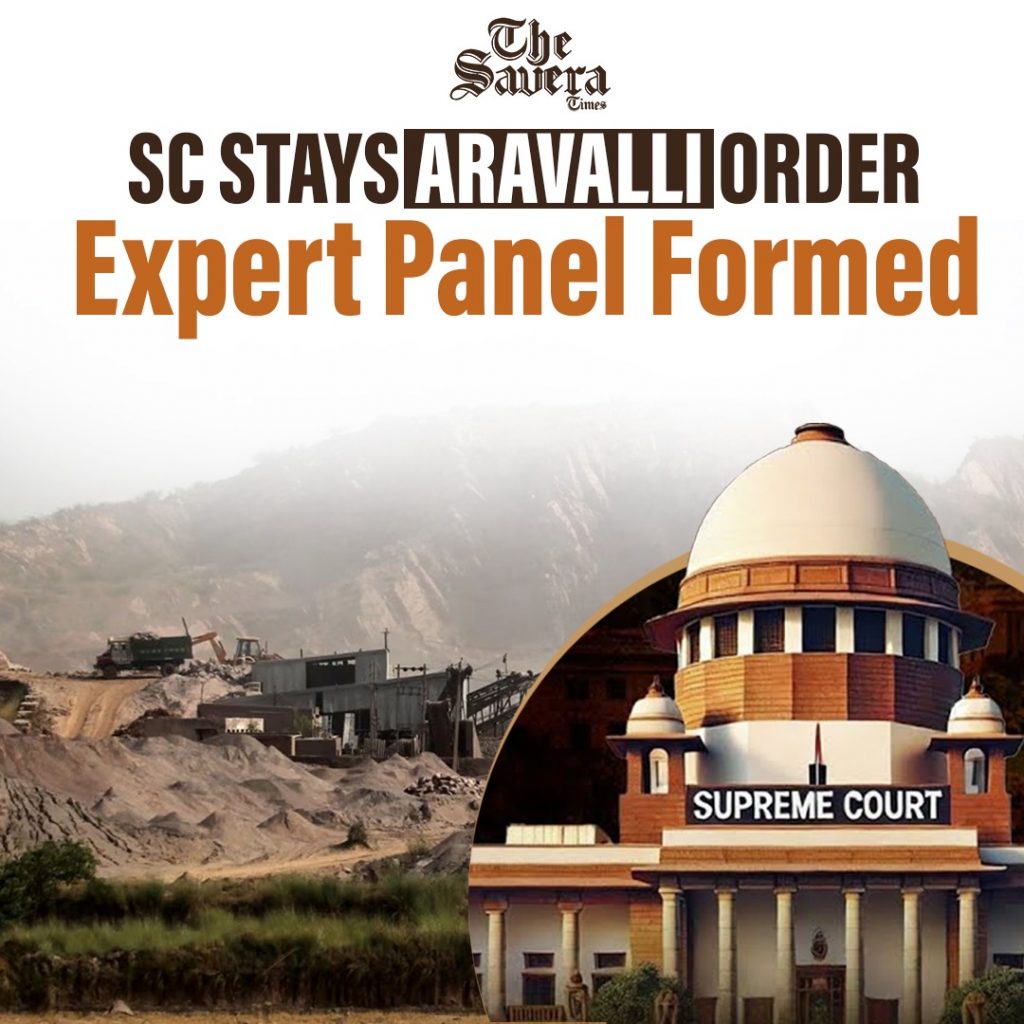
New Delhi: The Supreme Court stayed its November 20th decision, which narrowed the definition of the Aravalli range to include only those landforms that were at least 100 meters higher than the local topography. The court stated that further clarity was needed on this issue, and the previous order has been put on hold for the time being.
A bench headed by Chief Justice DY Chandrachud (or Chief Justice as per the latest information) indicated that an expert committee may be formed to study in detail the definition of the Aravalli, its height, and the scope of mining.
Former CJI’s bench adopted the contested definition
This decision is significant because the previous order accepting the contested definition was delivered by a three-judge bench headed by former Chief Justice Bhushan R. Gavai. That decision had banned new mining leases in the Aravalli region and implemented conservation standards pending the submission of an expert report.
Based on the recommendations of a Ministry of Environment committee, Aravalli “hills” were defined as landforms that rise 100 meters or more above the local topography in specified districts, and two or more such hills within 500 meters of each other would be considered a “hill range.”
The Aravalli Ranges Play a Crucial Role in the Country’s Ecology
The Aravalli Range is one of the world’s oldest mountain systems, stretching across approximately 37 districts from Delhi to Gujarat, through Haryana and Rajasthan. It plays a vital role in combating desertification, recharging groundwater, and preserving biodiversity in North India.
The Supreme Court has repeatedly warned that uncontrolled mining poses a “serious threat” to the country’s ecology, so a uniform and scientific standard for Aravalli conservation is essential.