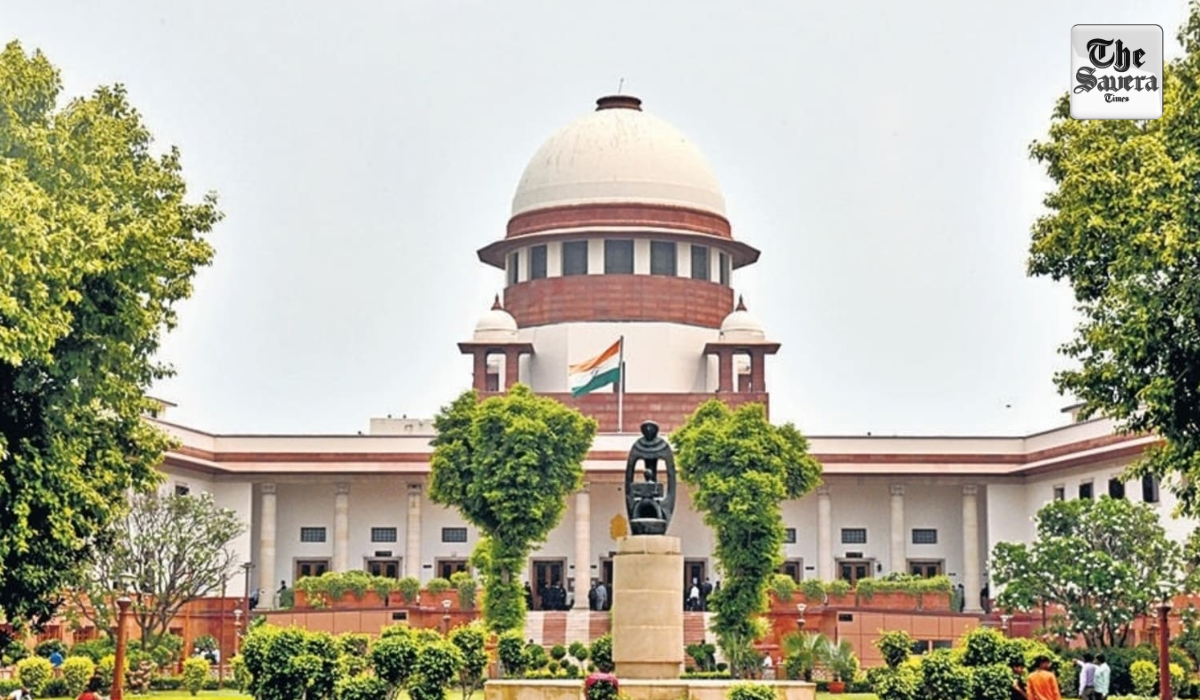
New Delhi: Hearing petitions related to the cancellation of NEET-UG 2026 over an alleged paper leak, the Supreme Court on Friday expressed serious concerns over the functioning of the National Testing Agency (NTA), observing that unless clear accountability is fixed, such controversies will continue to recur.
Supreme Court Compares NTA With UPSC
A Bench comprising Justice P.S. Narasimha and Justice Alok Aradhe was hearing petitions seeking structural reforms in the NTA and even its disbandment.
During the hearing, Justice Narasimha remarked that the NTA should learn from institutions like the Union Public Service Commission (UPSC), which conduct large-scale examinations without facing paper leak controversies.
“UPSC has never been in such a situation, you need to learn,” Justice Narasimha observed.
The Bench stressed that the root problem lay in the lack of institutional accountability.
“The real problem won’t stop till actual accountability arises. It will be effective only when we know which individual shoulders the responsibility. Unless you identify specific duty bearers, it will be difficult,” Justice Narasimha said.
He further criticised the ad-hoc functioning of institutions in the country, saying, “The problem is that most institutions are ad hoc. It’s a phenomenon everywhere in the country. It’s not the individual who has the capability but the institution.”
Court Seeks Affidavit on Institutional Reforms
After a brief hearing, the apex court directed the Union government to file an affidavit explaining how an “institutional memory of continuity” could be created within the NTA through the employment of specialised personnel and long-term structural reforms.
The Court said the agency must develop the physical and intellectual capability required to conduct national-level examinations without controversy in the future.
Advocate Tanvi Dubey, appearing in the matter, also submitted a list of suggestions aimed at strengthening the NTA’s functioning.
Court Interacts With Monitoring Committee Head
Dr K. Radhakrishnan, former ISRO Chairman and head of the monitoring committee constituted by the Supreme Court in 2024 to recommend reforms in NEET, was present during the hearing.
Justice Narasimha questioned how the current controversy could arise despite the committee’s recommendations and the reforms implemented thereafter.
“How has this failure occurred? Despite a high-powered committee, if this incident happened, there is something wrong either with the original recommendation or with the implementation,” the judge remarked.
In response, Dr Radhakrishnan informed the Court that the committee had proposed 35 long-term and around 60 short-term recommendations, many of which had already been implemented.
He stated that the reforms had largely shown positive results during NEET-PG 2025, except for minor issues like power outages.
However, Justice Narasimha pressed further on whether the committee had anticipated the kind of alleged failures that surfaced in NEET-UG 2026.
Dr Radhakrishnan said the committee had mainly focused on preventing question paper tampering and assured the Bench that vulnerabilities exposed this year had now been addressed ahead of the proposed re-NEET examination next month.
Centre Assures Court of Stronger Security Measures
Solicitor General Tushar Mehta, appearing for the Centre, assured the Court that the government was treating the issue with utmost seriousness because it directly affected the future of students across the country.
He informed the Bench that after last year’s controversy, the government carried out a detailed review of the entire examination chain — from printing presses to the distribution of question papers.
According to Mehta, new vulnerabilities were identified during the latest exam cycle and corrective mechanisms had been designed.
However, he submitted that certain security-related reforms could not be disclosed publicly for confidentiality reasons.
“The Hon’ble Prime Minister is personally supervising it,” the Solicitor General informed the Court.
SC Calls Exam Crisis ‘Traumatic’ for Students
Justice Narasimha described the incident as “traumatic” for lakhs of students who spend years preparing for NEET.
“We should not disappoint our youngsters. It’s very traumatising — so much investment of emotions and time,” he observed.
The judge also suggested creating a permanent monitoring mechanism that could regularly receive expert inputs and collaborate with leading universities and institutions.
When the Solicitor General proposed involving experts from IITs, Justice Narasimha supported the idea and highlighted the need for continuous academic and technological collaboration.
“Methods and ideas keep changing. For instance, in AI, we would be coordinating with a university,” the judge said, stressing the importance of ongoing innovation in examination management systems.