Last Updated: September 22, 2026
Last Updated: September 22, 2026





~Parneet Sachdev: Chairman of Real Estate Regulatory Authority and a leading author Antaryatra
A young woman wakes in the middle of the night. The curtains are still. The clock glows faintly. She knows she is awake. Yet she cannot move. Not a finger. Then comes the worst part. She feels a presence in the room. Something stands near the bed. A heavy weight presses upon her chest. She tries to scream, but no sound emerges. After a few terrifying moments, the spell breaks. Her body returns to her. The room is empty. For centuries, such experiences were interpreted as visits from demons, witches, ghosts, spirits, or dark forces.
In Newfoundland, David J. Hufford investigated numerous “Old Hag” cases in which people sleeping in unfamiliar houses, remote fishing settlements, boarding houses, and isolated locations reported woke up to find a terrifying presence sitting on their chest. The experiences were so consistent that entire communities believed certain houses or rooms were haunted. Hufford’s research became the basis of the classic book The Terror That Comes in the Night. In Japan, it is known as kanashibari. In parts of China and South Asia, it has often been described as ghost oppression or spirit attack. Medieval Europe spoke of the incubus sitting upon the sleeper’s chest.A common theme across cultures!
THE BRAIN’S FEAR CIRCUITRY AND REM MISMATCH
Modern sleep science gives this frightening experience a precise name: sleep paralysis. The mind becomes conscious, but the body remains temporarily locked in the paralysis of rapid eye movement, or REM, sleep. Although the exact mechanism is difficult to pinpoint, yet researchers explain that during REM sleep, the brain is active, but the body’s major voluntary muscles are inhibited. This prevents us from physically acting out our dreams. In sleep paralysis, part of this REM mechanism continues even after awareness has returned (Sharpless, 2016; NINDS, 2025). Sleep paralysis is not rare.
A systematic review by Brian Sharpless and Jacques Barber found that about 7.6 per cent of the general population reported at least one episode. The rate was much higher among students, about 28.3 per cent, and psychiatric patients, about 31.9 per cent(Sharpless & Barber, 2011). The classic symptoms are remarkably consistent. The person cannot move or speak. There may be a sensation of pressure on the chest. Breathing may feel difficult. Many people report a sinister presence in the room. Some see shadowy figures. Some hear footsteps, whispers, buzzing, or strange sounds.
Others feel as if they are floating outside the body (de Sá & MotaRolim, 2016). Why does the mind experience such frightening images? One explanation lies in the brain’s fear circuitry. When a person wakes but remains paralysed, the mind searches for a cause. The dream-generating machinery of REM sleep may still be active. In that state, the brain may convert raw fear into a figure: a ghost, a demon, an intruder, a shadow.
The mind gives a face to terror. This does not mean that the sufferer is “imagining” it in any casual sense. The experience is subjectively real. This may explain why sleep paralysis has produced such powerful folklore. Human beings do not experience biology as biology. Researchers have noted that sleep paralysis is found across cultures, but its interpretation is shaped by local beliefs (de Sá & Mota-Rolim, 2016).
THE NIGHT MARE PAINTING AND EARLY REFERENCES
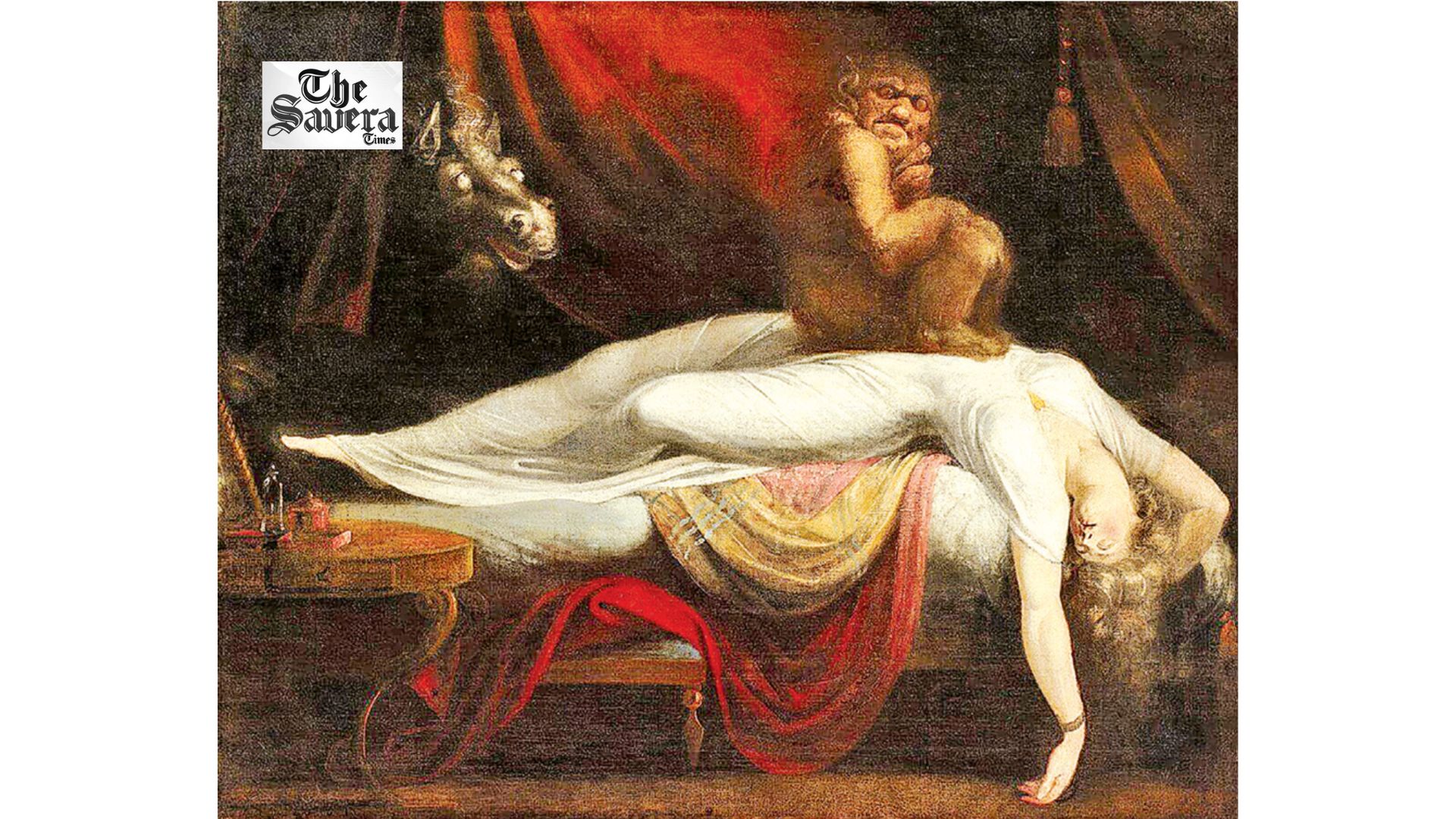
The old painting The Nightmare by Henry Fuseli, first exhibited in 1782, captures this almost perfectly. A sleeping woman lies helpless while a demonic figure squats upon her chest and a ghostly horse emerges from the shadows. The painting endures because it gives visual form to an ancient human terror. Dreams, visions, visitations, and altered states are found in almost every religious tradition. The Bible, the Upanishads, Buddhist literature, Sikh tradition, and Sufi narratives all acknowledge that the night can become a field of revelation, disturbance, or insight.
Akhawayni Bukhari(died c. 983 AD) was a 10th-century Persian physician of the Samanid Empire. He was a pioneer of medieval Persian medicine, particularly neurology and psychiatry, and authored the Hidayat al-Muta allemin fi al-Tibb (“Guide for Medical Students”), the earliest known medical text written in Persian. He described a condition called “kabus” (nightmare) in which a sleeping person feels an oppressive presence and is unable to move.The description of kabus in the Hidayat is compatible with sleep paralysis (M. G. Jalal et al., 2012). Arnald of Villanova (13th Century), a medieval physician described sufferers as follows:
“They know that they cannot speak nor freely make a sound… they strive to rise up, call out and speak, and because they cannot, they exert themselves but find themselves constrained.” Isbrand van Diemerbroeck (1664) the Dutch physician recorded one of the earliest detailed clinical cases where a woman reported that: “The devil lay upon her and held her down.”
She felt unable to move and experienced a terrifying presence while awake. Modern sleep researchers consider this a classic example of sleep paralysis. The English word nightmare originally had nothing to do with a bad dream. The word mare referred to a supernatural being believed to sit on the chest of sleeping people and suffocate them.
IS THERE A SOLUTION TO SLEEP PARALYSIS?
A terrifying night visitor may or may not be an external spirit; it may be fear itself, given form. It may be unresolved grief standing beside the bed. Irregular sleep, late-night screens, anxiety, chronic stress, shift work, and sleep deprivation all disturb the rhythm of sleep. The Mayo Clinic and other medical sources consistently recommend regular sleep timing, reduced stimulants, a restful environment, and stress management as foundations of healthy sleep (Mayo Clinic, 2024).
The link with stress is especially important. The demon in the bedroom may be the nervous system crying out for rest. What should one do during an episode? The Science Mostly, during sleep paralysis, the person becomes aware of the condition. Some Psychologists say that even though sleep paralysis is frightening, but it is usually brief. Therefore, avoid struggling violently against it, because panic often intensifies the fear. Some people find it helpful to focus on slow breathing or to try moving a small muscle, such as a toe or finger.
If episodes are frequent, distressing, or associated with excessive daytime sleepiness, medical advice is advisable because sleep paralysis can sometimes occur with sleep disorders such as narcolepsy. The Spiritual Solution In an article published by Tweak India (2024), a woman recounts moving into a shared residence where one of the flatmates began experiencing terrifying nocturnal episodes.
She reported awakening around 3:30 a.m., hearing disturbing sounds, feeling overwhelming fear, and later experiencing classic symptoms associated with sleep paralysis. Some spiritual writings say that as soon as a person becomes aware of sleep paralysis, one should start reciting a powerful mantra like the Mool Mantra of the Sikhs, the Gayatri Mantra from Hinduism or BuddhamSaranam Gacchami (I take refuge in the Buddha) from Buddhism.
No man-made mantras; rather a simple powerful mantra from the Divine texts can be chanted. Experience shows that within a few seconds, the paralysis ends. This should usually be followed by a 25-minute chanting of the same mantra for seven days to prevent recurrence.
Spiritual writings also say that when going into a new place like a hotel room such a mantra should be chanted for 25 minutes when alone in the room, so as to prevent any such attack. Both science and spiritual tradition do accept the presence of such a phenomenon. Both provide different solutions. However, one fact stands out.
The night visitor that some experience, may be an external presence,a projection of fear, or a mystery yet to be understood;the fact remains that consciousness is deeper and stranger than what ordinary waking life suggests.
Self-medication is a global phenomenon and a potential contributor to antimicrobial resistance. The adverse consequences of such practices...
There is a crucial link and health and the current status of Delhi stands as a testimony to...

(Can we remove pain forever) A young woman, Ivy, once entered past-life regression therapy because her present relationship...

Scientists at the University of California, San Francisco (UCSF) and the University of California, Berkeley have identified two...
Are you wondering why your waistline is expanding? Don’t watch what you eat; watch how you eat. People...

The Central Drugs Standard Control Organization (CDSCO) has issued a public health alert regarding the sale of certain...

Aries: The day will be auspicious...