Last Updated: November 11, 2026
Last Updated: November 11, 2026





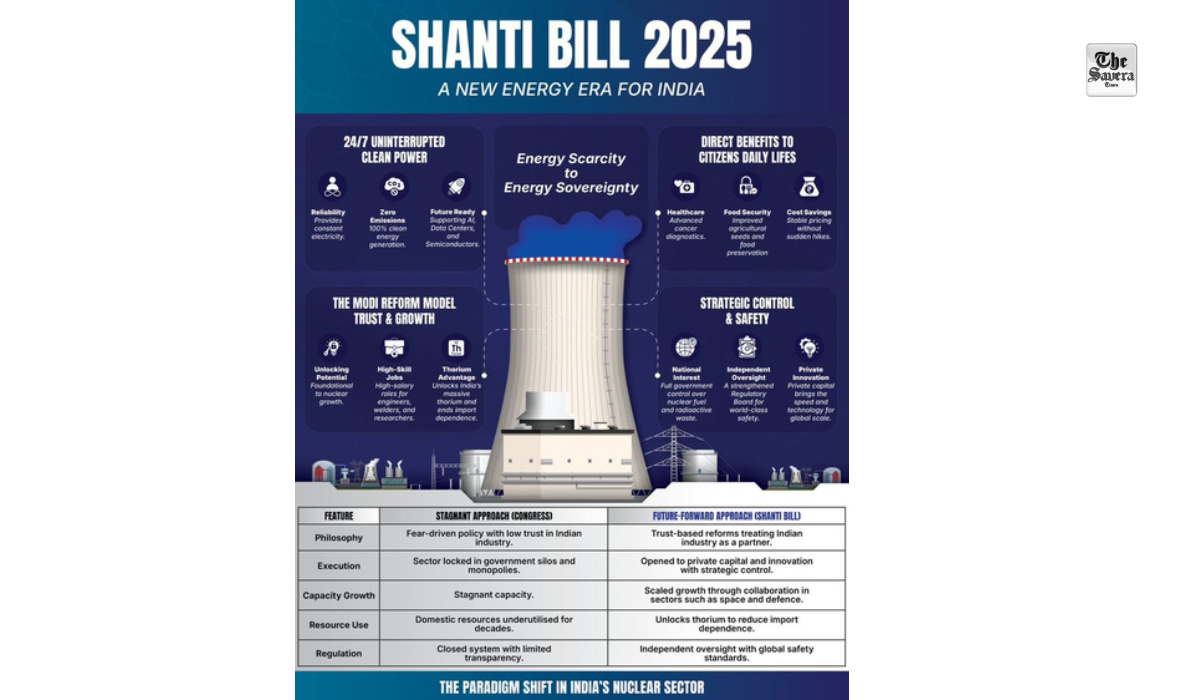
New Delhi: The Sustainable Harnessing and Advancement of Nuclear Energy for Transforming India (SHANTI) Bill, 2025, passed by the Lok Sabha and Rajya Sabha, aims to make India self-reliant in nuclear energy and achieve clean energy goals by 2047. This legislation creates a conducive environment for clean and reliable energy, while also advancing the long-standing commitment to the peaceful uses of nuclear energy.
Key features and provisions of the bill
The SHANTI Bill, 2025, consolidates the provisions of the Atomic Energy Act 1962, the Civil Liability for Nuclear Damage (CLND) Act, and gives legal status to the Atomic Energy Regulatory Board (AERB).
The bill allows private and joint venture participation in the nuclear sector to address resource constraints, reduce construction time, and achieve the goal of achieving 100 GW of nuclear capacity by 2047 without compromising national security or public interest.
Private participation will be limited to limited areas, such as exploration activities, while the government will always retain control over uranium mining, spent fuel management, and strategic materials such as fissile materials, source materials, and heavy water. The bill also includes environmental and economic losses in the definition of nuclear harm.
Safety and Surveillance Measures
Science and Technology Minister Dr. Jitendra Singh stated that nuclear safety standards will remain in accordance with the Atomic Energy Act of 1962, with the principle of “safety first, production second.”
Safety measures include:
* Quarterly inspections during construction
* Semiannual inspections during operation
* License renewal every five years
* Expanded powers of the Atomic Energy Regulatory Board, now granted legal status
* Monitoring in accordance with International Atomic Energy Agency (IAEA) standards
India’s nuclear plants are geographically located away from seismic faults, and their radiation levels are several times lower than global standards.
Implementation of the Bill and Target Areas
The Bill is aligned with India’s long-term energy and climate goals and lays out a roadmap for carbon reduction by 2070.
This law provides for licensing and safety authorities for persons involved in the production or use of nuclear energy, and regulates the use of nuclear and radiation technologies in sectors such as health, agriculture, industry, and research.
The bill includes a revised civil liability framework for nuclear damage, legal status for the AERB, and provisions related to safety, emergency preparedness, and quality assurance. Additionally, the bill provides for the establishment of new institutional structures, such as:
Atomic Energy Redressal Advisory Council
Claims Commissioners
Nuclear Damage Claims Commission
Catch up on the biggest developments of November 10 with The Savera Times Evening Wrap, bringing you the...

BJP leader and senior advocate HS Phoolka criticised Sonia Gandhi over her memoir's account of the delay in...

Union Health Minister JP Nadda arrived in Colombo to attend the first BIMSTEC Health Ministers’ Meeting, where member...

The Ladakh administration has announced December 4 as the polling date for elections to all eight Autonomous Hill...

The ECI has directed retired government officials working in various capacities to maintain political neutrality during the Model...

India has strongly criticised Chinese vloggers accused of filming poor neighbourhoods in Dhaka, Bangladesh, and falsely presenting them...

Aries: The day will be auspicious...