Last Updated: October 15, 2026
Last Updated: October 15, 2026





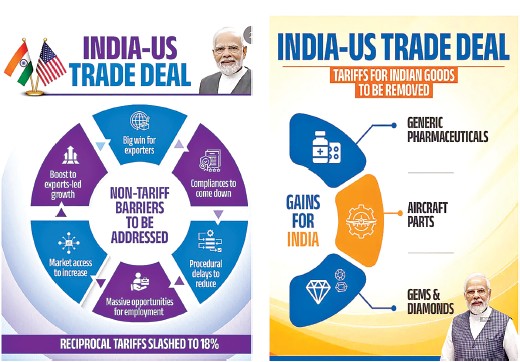
The signing of the India-US Interim Trade Framework on February 6, 2026, represents the most significant recalibration of India’s external economic policy since the landmark 1991 reforms. For decades, the bilateral relationship was trapped in a cycle of “theology over transactions,” where high-minded rhetoric about shared values was frequently undermined by prickly disputes over price controls on medical devices and tariffs on American motorcycles. That deadlock has finally been broken. By slashing effective reciprocal tariffs from a prohibitive 50% down to a standardized 18%, and outlining a roadmap for $500 billion in strategic procurement, New Delhi and Washington have moved from being “estranged democracies” to “interdependent supply-chain partners.”
The 18% Solution: A Competitive Reset
The primary catalyst for this breakthrough was the “tariff fatigue” of 2025. Following a period of aggressive reciprocal dutiesexacerbated by US penal tariffs on Indian goodsIndian exporters were effectively being “taxed out” of the world’s largest consumer market. The reset to an 18% reciprocal rate is a masterstroke of economic leveling. For India’s labor-intensive sectors, this 32-point reduction is a “competitiveness multiplier.” At 18%, Indian goods particularly in textiles, leather, and gems—now enjoy a decisive price advantage over regional competitors like Vietnam (20%) and Bangladesh (20%), and remain significantly more attractive than Chinese exports facing duties upwards of 35%. This “tariff bridge” provides the necessary breathing room for the “Make in India” initiative to scale from assembly to deep manufacturing.
Deep Provisions: The New Economic Architecture
While the $500 billion headline captures the imagination, the framework’s real strength lies in its granular provisions designed to integrate the two economies at a structural level:
* The iCET “Silicon Handshake”: Under the Initiative on Critical and Emerging Technology (iCET), the US has streamlined the export of high-end Graphics Processing Units (GPUs) and data center hardware. For India’s “National AI Mission,” this ensures a steady supply of the “silicon oxygen” required for domestic compute power, bypassing the lengthy export control cycles that previously hindered
Indian tech giants.
* Zero-Duty Clusters: In a major victory for Indian MSMEs, the agreement provides zero-duty access for specific high-value clusters including handicrafts, silk, and generic pharmaceuticals. This is a massive boost for the Hyderabad pharma hub and the traditional weaving centers of Uttar Pradesh and Tamil Nadu.
* Harmonization of Standards: Perhaps the most “Indian Express-style” nuance of this deal is the commitment to harmonize standards for medical devices and ICT goods within six months. By removing the “compliance tax”—the costly requirement for dual testing and certification—the deal allows an Indian medical startup to treat the US market as an extension of the domestic one.
* Preferential Quotas for Auto Components: Despite broader US “Section 232” national security tariffs, India has secured a preferential tariff-rate quota for auto parts. This protects India’s massive automotive engineering ecosystem while competitors remain locked behind higher barriers.
Strategic Sourcing: The $500 Billion Bet
The most debated provision remains India’s “intent to purchase” $500 billion in US energy, aircraft, and technology over the next five years. Far from being a one-sided concession, this is a strategic move to secure India’s energy and infrastructure future. By pivoting toward US LNG and coking coal, India is effectively de-risking its energy supply chains from the volatility of Eurasian geopolitics. Simultaneously, the commitment to procure hundreds of narrow and wide-body civilian aircraft will fuel the expansion of India’s aviation sector, which is projected to become the world’s third-largest by the end of the decade. This isn’t just “buying American”; it is “building Indian” with American capital goods.
Guarding the Hinterland
Critically, New Delhi has maintained its “red lines” on agriculture. While India will allow greater market access for US almonds, walnuts, and fresh fruits, the core of the rural economy—wheat, rice, pulses, and the dairy sector remains fully protected. This ensures that the trade deal drives urban industrialization without jeopardizing the food security or livelihoods of 150 million Indian farming households.
A Pragmatic Sovereignty
The 2026 framework signals that India is no longer a “rule-taker” in the global order. It is a pragmatist. By choosing to integrate deeply with the US economy, India is not compromising its sovereignty; it is exercising it to ensure that the “Silicon Valley of the East” has the hardware, the energy, and the market access it needs to thrive. The “sleeping giant” hasn’t just woken up; it has secured the tools to lead. The New Delhi-DC Trade Expressway is now open, and for the Indian economy, the road ahead looks remarkably clear.
Mumbai Police has issued a 'Leave India' notice to Bollywood superstar Aamir Khan's nephew and actor Imran Khan....

Ram Kumar Singh, a 71-year-old retired Customs officer, was shot dead outside his home in Ara’s Kanakpuri locality....

Punjab AGTF and Haryana STF arrested Gurlal Singh in connection with Ajmeet Singh’s September 11 murder in Naushera...

Uttar Pradesh Police arrested a 28-year-old alleged criminal after an encounter in Noida’s Sector 63. Police said around...

Indian equity benchmarks opened higher on Thursday, with the Sensex rising 183.91 points and the Nifty gaining 48.60...

Union Home Secretary Govind Mohan has tendered an unconditional apology to the Supreme Court over alleged non-compliance with...

Aries: The day will be auspicious...