Last Updated: October 21, 2026
Last Updated: October 21, 2026





By K SIVA PRASAD
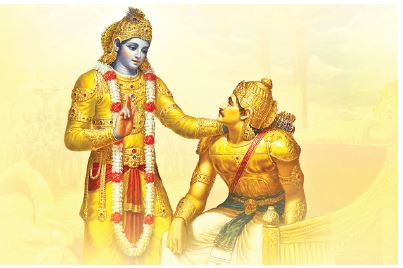
The Bhagavad Gita is a seven hundred verse conversation between Lord Krishna and the warrior Arjuna on the battlefield of Kurukshetra.
In the final moments before the war, Arjuna felt that the war would kill many of his friends and relatives. He concluded that this hasmany harmful and undesirable effects.
Arjuna’s dilemma emanated from his presumption that ‘I am doer’ (aham-karta).This is also known as ahankaar. While the reality is that we are a part of the same oneness, ahankaar keeps convincing us that we are separate from others. Though ego is usually taken as the meaning of ahankaar, but ego can be taken as one of the many manifestations of ahankaar.
The entire conversation is about ahankaar, be it directly or indirectly and Krishna gives various paths, milestones and yardsticks to get rid of it.
If we take the Kurukshetra war as a metaphor, all of us enter into situations similar to that of Arjuna in our daily lives. It may be in the family, workplace and in terms of health, wealth, relationships etc. As long as we live, such dilemmas persistuntilahankaar is understood.
The Gita is all about our being, not about our knowing or doing. No amount of theory can enable us ride a bicycle or swim. Similarly, no amount of philosophy can help us unless we experience life with awareness. The guiding principles of the Gita would help us reach the final destination of the eternal state of our inner selfwhich is free of ahankaar.
From the surface, it appears that times have changed since the Gita was given to Arjuna by Lord Krishna. Certainly, there is a lot of change brought about by developments in science in the past couple of centuries. But in reality, from an evolutionary standpoint, humans didn’t evolve any further. The internal side of the dilemma remains the same. In essence, the external appearances might look different but the inner foundation is the same oneness.
(The writer K. SIVA PRASAD is a senior IAS officer in the Punjab Government.)
State Bank of India has confirmed that 3,897 customer records containing personal information were found on the dark...

A fire in a hut in Nonapar village of Deoria district claimed three lives, including those of a...
Amit Shah paid tribute to police personnel who died in the line of duty at the National Police...
Reduced water levels at Har Ki Pauri and other Haridwar ghats have inconvenienced pilgrims during the Upper Ganga...
Six people returning from a Dussehra Mela were seriously injured when a car hit them on National Highway...
Two people were killed and ten injured after a passenger bus met with an accident at Gala Pachound...
Aries: The day will be auspicious...