


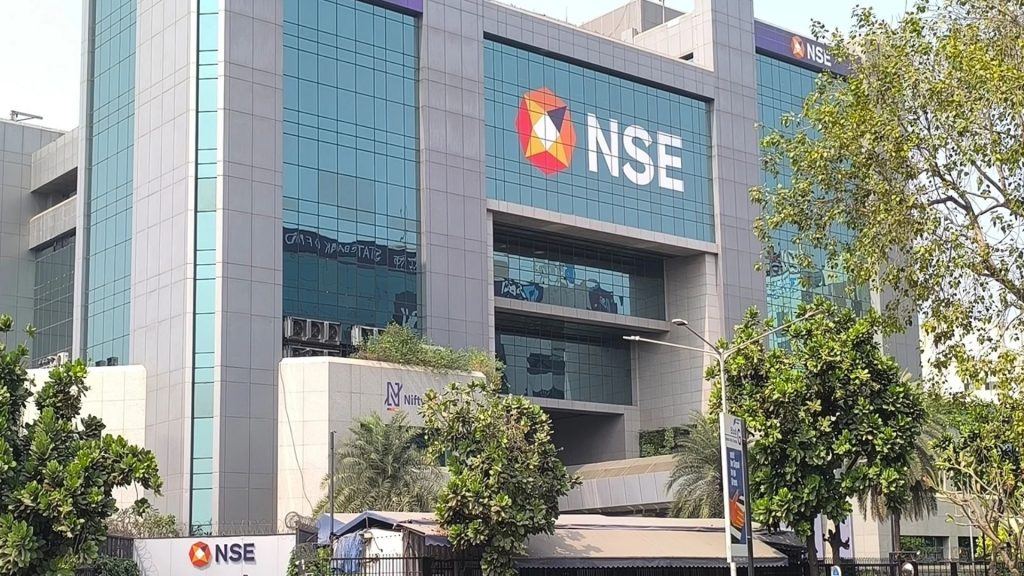
Mumbai: The Indian stock market witnessed gains for the second consecutive trading session on Tuesday. Investor confidence was boosted by improved second-quarter results, renewed buying by foreign institutional investors (FIIs), and softening crude oil prices. However, global markets remained cautious due to uncertainty surrounding the ongoing tensions between the US and Iran.
At the start of trading on Tuesday, the Nifty 50 index opened at 23,582.25, up 141.45 points or 0.60 percent. Meanwhile, the BSE Sensex rose 595.87 points or 0.79 percent to reach 76,288.65.
IT and FMCG stocks saw the biggest gains
Almost all sectoral indices on the National Stock Exchange (NSE) opened with gains. Nifty IT gained the most, rising 1.09 percent. Nifty FMCG rose 0.90 percent, and Nifty Private Bank rose 0.85 percent.
Nifty Auto rose 0.80 percent, Nifty Realty rose 0.66 percent, and Nifty PSU Bank rose 0.59 percent. Meanwhile, Nifty Media gained 0.55 percent, and Nifty Pharma gained 0.21 percent.
Market experts say the rally in the past two trading sessions has been supported by falling crude oil prices, better-than-expected corporate results, and the return of foreign investors to the Indian stock market.
VK Vijayakumar, Chief Investment Strategist at Geojit Investments, said several factors are contributing to the continued rally.
He said, “The fall in Brent crude prices to $104, further weakness in AI trade, a series of positive second-quarter results, and foreign institutional investors turning buyers could further accelerate the current rally.”
He also said that investors who practice value-based investing with patience could benefit. The market will also be closely monitoring the results of the US midterm elections and their impact on geopolitical developments.
US-Iran tensions continue to raise market concerns
However, the possibility of renewed military action between the US and Iran remains a concern for global markets.
Crude oil prices are being impacted by two developments. On the one hand, diplomatic efforts between the US, Iran, and regional mediators have raised hopes for a possible peace agreement. This led to a nearly 7 percent decline in crude oil prices on Monday.
On the other hand, reports of new military attacks on Iranian bases and warnings of retaliation from Iranian officials have renewed fears of escalating tensions. However, these attacks have not been officially confirmed by US officials.
Banking and market expert Ajay Bagga said that the markets are trying to understand the conflicting signals coming from the region.
He told ANI that in the current situation, it is difficult for the market to assess the situation amid the progress of peace talks, possible bombings, and fears of retaliation. He advised investors to remain cautious this week and avoid making hasty decisions given the risks.
Foreign investors invested ₹4,458 crore in two days
Brent crude oil prices continued their downward trend in the commodity market, although they remained at a high level of $104.72 per barrel.
According to NSDL data, foreign portfolio investors (FPIs) invested approximately ₹4,458 crore in the equity segment of the Indian stock market in the first two trading days of November.
Meanwhile, gold and silver prices continued to decline. At the start of trading on Tuesday, the price of 24-carat gold fell 0.81 percent to ₹1,38,904 per 10 grams. Meanwhile, silver prices fell by 2.22 percent to ₹1,79,697 per kilogram.
Mixed Trading in Asian Markets
Asian stock markets also witnessed mixed trends on Tuesday. Singapore’s Straits Times rose 0.31 percent to trade at 5,282, while Hong Kong’s Hang Seng rose 0.34 percent to 23,474.
In contrast, Japan’s Nikkei 225 index fell 0.33 percent to 63,081. Taiwan’s weighted index fell 1.68 percent to 44,095, and South Korea’s KOSPI fell 3.41 percent to trade at 5,659.