Last Updated: October 12, 2026
Last Updated: October 12, 2026





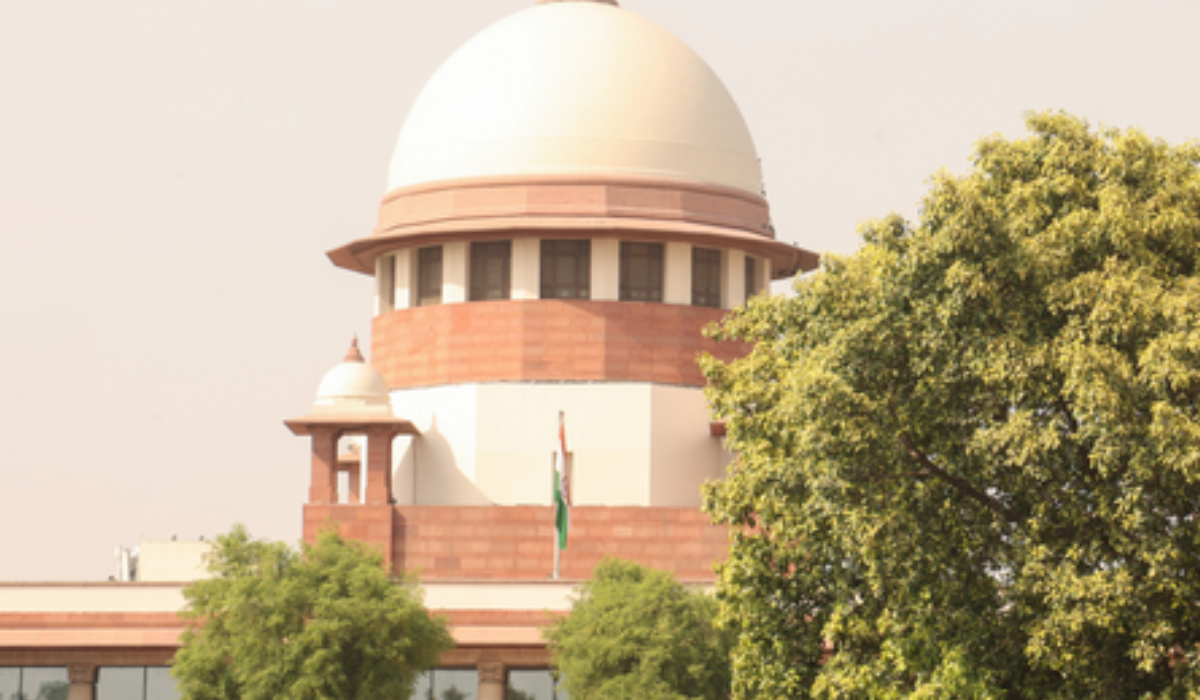
New Delhi: The Supreme Court of India on Monday issued notice to the Centre, the Election Commission of India (ECI), and the Comptroller and Auditor General of India (CAG) on a public interest litigation (PIL) seeking a ban on the announcement of “irrational freebies” by political parties before elections.
A bench of Chief Justice Surya Kant and Justice Joymalya Bagchi said the petition will be clubbed with other similar pending cases for hearing.
Petition calls freebies “bribery” and “corrupt practice”
The petition, filed by advocate Narendra Goswami, states that the promise or distribution of free goods or benefits from public funds should be considered “bribery” and “corrupt practice” under Section 123(1) of the Representation of the People Act, 1951.
The petition states, “This is not merely a petition, but a warning that the very soul of the Indian Republic should not be reduced to a means of election-by-election bargaining.” It also contends that the country could be transformed into an “auction house” where benefits are offered in exchange for votes.
Concerns over Economic Burden and Fair Elections
The petition argues that such schemes create a “transaction-based relationship” between voters and political parties, which impacts a fair election process.
Citing financial data, the petitioner states that governments are borrowing to pay for freebies, increasing the economic burden on future generations.
Furthermore, the petition seeks to direct the Election Commission of India (ECI) to issue a “Fiscal Impact Statement” of their election promises and to take action against political parties, including de-recognition, if they violate the rules.
Request for Reconsideration of the 2013 Judgment
The petition also asks the Supreme Court to reconsider and overturn the 2013 S. Subramaniam Balaji vs. State of Tamil Nadu decision. It states that the decision ignored the “transactional” nature of election promises by treating them merely as policy decisions.
Furthermore, a direction has been sought to the CAG to audit the freebie schemes and examine whether they meet the test of “public purpose” under Article 282 of the Constitution.
Notably, the broader issue of electoral freebies is already pending before the Supreme Court in another petition filed by advocate Ashwini Kumar Upadhyay.
In its 2013 judgment, the Supreme Court had held that the distribution of free televisions by the DMK government in Tamil Nadu after winning the elections could not be considered “corrupt practice” under the Representation of the People Act.
A major fire broke out at a scrap warehouse opposite the Maruti Temple in Sangameshwar, Maharashtra, around midnight....

A 48-year-old man, Pawan Sharma, died after an alleged altercation over a senior citizen seat at Delhi’s Supreme...

Shiv Sena (UBT), in its mouthpiece Saamana, has criticised the Centre over security measures and detentions during anti-government...
Former BJP MLA Attar Singh Bhedana died at Jaipur’s SMS Hospital after a violent clash at a crusher...
An eyewitness has recounted the fatal Mini Cooper crash in Nedumbassery, Kochi, claiming the driver said his father...

The Cockroach Janata Party plans to approach Parliament Street Police Station for permission to hold a peaceful protest...
Aries: The day will be auspicious...