Last Updated: October 15, 2026
Last Updated: October 15, 2026





Parth Kapole
On Monday evening in the Lok Sabha, Union Home Minister Amit Shah firmly asserted that Naxalism has come to an end in the country. The Central Government, led by Prime Minister Narendra Modi, had set the goal of eradicating Naxalism as early as 2014.
Upon assuming the office of Union Home Minister, Amit Shah, too, had declared that “Naxalism will be eliminated from the country by March 31, 2026.” Many people did not take this declaration seriously. The ecosystem—nurtured on the style of declarations made by the Gandhi-Nehru family, such as “Garibi Hatao” (Eradicate Poverty)—went so far as to mock this announcement. However, in doing so, this ecosystem failed to realize that those currently in power are no longer the patrons of Naxalites. Consequently, the ecosystem remained engrossed in its own world.
Meanwhile, the Central Government had already formulated a strategy for the eradication of Naxalism and had commenced work on it. In his speech, Union Home Minister Amit Shah explicitly statedwithout any hesitation that Naxalism has now been completely eliminated from India.
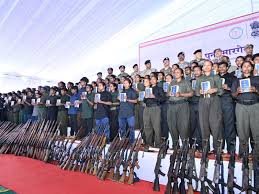
A study of India’s struggle against Naxalism reveals a distinct characteristic: the priority accorded to rehabilitation. The Naxalites had taken up arms and waged war against India itself. Yet, while countering them, they were first offered an opportunity to surrender. Various schemes were implemented to facilitate this process. The schemes initiated by the Central Government, as well as the governments of Maharashtra, Chhattisgarh, and Odisha, have played a pivotal role in this regard.
Maharashtra’s approach to countering Naxalism is coordinated and multi-dimensional, aligning perfectly with the policy of surrender and rehabilitation. Thanks to the state’s policy being integrated with the Central Government’s scheme, uniformity has been maintained in both the distribution of benefits and the implementation of measures. Furthermore, the central funds received under the SRE (Security Related Expenditure) and SCA (Special Central Assistance) schemes have enabled the state to effectively advance its rehabilitation efforts while simultaneously undertaking rigorous security operations. Maharashtra plays an active role in joint tri-state operations with Chhattisgarh and Odisha, where surrender policies serve to complement operational efforts. Thanks to standardized central rehabilitation packages, surrendering Naxalites have gained equal access to financial assistance and skill training opportunities.
Due to mounting pressure and the availability of credible rehabilitation options, safe havens for Naxalites have all but vanished, compelling them to opt for the path of surrender. Projects implemented under the District Mineral Foundation (DMF) have significantly boosted infrastructure development, education, and job creation—particularly in regions like Gadchiroli. Improved road connectivity, the expansion of mobile networks, and employment opportunities generated by mining and industrial projects have reduced the local population’s reliance on insurgent networks. Furthermore, skill development programs and police recruitment drives—such as those for the C-60 force—have opened up new avenues for the youth to integrate into the mainstream and participate in governance. The leadership of Maharashtra’s Chief Minister and Home Minister, Devendra Fadnavis, has been pivotal in this regard.
Overall, Maharashtra’s model represents a balanced synthesis of three key elements: development-centric confidence-building, maintaining sustained pressure through security mechanisms, and offering incentives for rehabilitation. The institutionalization of rehabilitation policies—built upon a robust foundation of development and local initiatives—is transforming the situation at the grassroots level. Consequently, hardline Maoists are gradually becoming isolated, while an increasing number of cadres are seen returning to the mainstream.
In its fight against Naxalism, Chhattisgarh has formulated an effective, incentive-based policy that places surrender and rehabilitation at its very core. The revised policy introduced in 2024 has led to a surge in surrenders; it promotes disarmament by offering immediate assistance of Rs 50,000, rewards ranging from Rs 3 lakh to Rs 12 lakh (depending on rank), and substantial financial incentives for the surrender of weapons. For high-value cadres, the provision of Rs 10 lakh in assistance or the opportunity for a government job—along with aid for acquiring land and housing—ensures long-term stability. Rehabilitation efforts have been significantly strengthened through a focus on employment, skill development, private sector participation, and the provision of educational and social amenities. Initiatives such as the ‘Bastar Olympics,’ ‘Bastar Pandum,’ ‘Poona Margam,’ and ‘Niyad Nellanar’ have fostered social inclusion and garnered local support, thereby establishing Chhattisgarh as an attractive hub for voluntary surrender.Odisha, too, has accelerated the process of voluntary surrender through a structured and incentive-based model.
Disarmament has been actively promoted through financial assistance ranging from Rs 2.5 lakh to Rs 5 lakh, behavior-linked phased payments, incentives of Rs 10 lakh for high-ranking cadres, and graded monetary rewards for the surrender of weapons. Rehabilitation has been rendered more effective through the provision of a monthly stipend for 36 months, along with housing, healthcare services, skill development opportunities, and social security schemes. This policy—premised on conditions of cooperation—bolsters the intelligence apparatus; by striking a balance between control and incentives, Odisha has successfully fortified its voluntary surrender framework.
Viewed in its entirety, the struggle against Naxalism is no longer merely a matter of security operations; rather, it has evolved into a confluence of development, good governance, and ideological clarity. While states such as Chhattisgarh, Maharashtra, and Odisha have paved the way for integrating Naxals into the mainstream through effective surrender and rehabilitation policies, the Central Government has steered this conflict toward a decisive turning point through unwavering political will and coordinated action. The expansion of infrastructure, education, healthcare, employment, and digital connectivity.
The Transformation
• Over the last 11 years, 596 fortified police stations have been constructed.
• The number of Naxal-affected districts, which stood at 126 in 2014, has now dropped to just 2.
• The number of ‘Most Affected’ districts, which was 35 in 2014, currently stands at zero.
• The number of police stations reporting Naxal-related incidents has declined from 350 to 60.
During the 2024–2026 period (up to March 2026):
• 706 Naxals were killed in encounters.
• 2,218 Naxals were arrested.
• 4,839 Naxals surrendered.
Operations:
• Operation Octopus (2022): Conducted in the Budha Pahad region of Bihar.
• Operation Double Bull (February 8–25, 2022): Conducted in the Gumla, Lohardaga, and Latehar districts of Jharkhand; all three districts are now Naxal-free.
• Operation Thunderstorm (September 1–3, 2022): Conducted in the Seraikela, West Singhbhum, and Khunti districts of Jharkhand; the region is now Naxal-free.
• Operation Bhimbandh (June–July 2022): Conducted in the Munger district of Bihar.
• Operation Chakrabandha (2022): Conducted in the Gaya and Aurangabad districts of Bihar; the region is now Naxal-free. • Operation Black Forest:
• Operation conducted in a hilly terrain spanning 50 km in length and 37 km in width along the Telangana-Chhattisgarh border.
• Discovery of a permanent Naxalite camp containing supplies sufficient for 5 years (food, weapons, solar power systems).
• Presence of 400–500 cadres.
• The operation lasted for 21 days.
• 30+ Naxalites were killed; the remaining were either killed or surrendered.
Action Taken Against Key Naxalite Leaders:
• Basavaraju (General Secretary) – Killed
• Hidma – Killed
• Gajuralla Ravi – Killed
• Kadari Satyanarayana Reddy – Killed
• Ganesh Uike – Killed
• Venugopal – Surrendered
• Vasudev – Surrendered
• Palluri Prasad Rao – Surrendered
• Ramdev Manjhi – Surrendered
• Tipri Tirupati – Surrendered
Singapore: Two Singapore-registered container vessels were reportedly struck by unknown projectiles while transiting the Strait of Hormuz on...

Shimla: The Himachal Pradesh government has constituted a four-member commission to examine the reorganisation of administrative units in...

New Delhi: The Supreme Court on Wednesday listed for November 17 the appeal filed by self-styled godman Asaram...

Ranchi: Doctors in Jharkhand launched a protest on Wednesday over a slew of demands concerning their safety and...

Greater Noida: Police and Anti-Narcotics Team in Uttar Pradesh’s Greater Noida have seized ‘ganja’ worth Rs 1 crore...

New Delhi: The Enforcement Directorate (ED) has attached assets worth Rs 2,032.81 crore belonging to Reliance Power Ltd...
