Last Updated: October 21, 2026
Last Updated: October 21, 2026





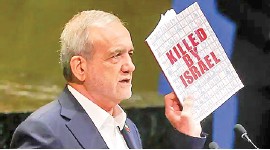
Iran’s president Masoud Pezeshkian has openly declared that his country is in what he calls a full-scale war with the United States, Israel, and Europe, saying the pressure campaign against Tehran is deeper and more complex than any conflict in decades. He made these comments in an interview published on the official website of Iran’s Supreme Leader, framing this confrontation not as a conventional battlefield clash but as a multifaceted struggle spanning military, economic, political, and cultural spheres.
Pezeshkian’s choice of words is significant because it came right before a planned meeting between Israeli Prime Minister Benjamin Netanyahu and US President Donald Trump, where Iran was expected to be a major talking point. By characterizing the situation as “war,” he’s signaling that Tehran views the cumulative actions by Western powers as coordinated and hostile rather than isolated diplomatic or military incidents.
At the heart of his argument is the idea that recent history — including military strikes and sanctions — has pushed Iran into a confrontation that goes far beyond simple disagreement or rivalry. He directly compared today’s tensions to the long and bloody Iran-Iraq War of the 1980s, saying that the current pressures are “more difficult and more complex” because they aren’t limited to missiles and tanks but also take place across systems that shape everyday life in Iran. “In the war with Iraq,” he said, “they fired missiles and it was clear where to respond. But now they surround us from every angle,” affecting trade, livelihoods, society, and security.
Pezeshkian accused the US, Israel, and Europe of trying to “bring our country to its knees,” arguing that sanctions and diplomatic isolation are designed to weaken Iran economically and socially. European nations such as France, Germany, and the United Kingdom have reimposed sanctions on Tehran over its nuclear program, moves that have intensified economic challenges including inflation and currency instability.
The president’s comments reflect a broader shift in rhetoric from Tehran toward more confrontational language. He said Iran’s military is stronger now than at previous points of crisis, claiming that both equipment and personnel readiness have improved despite the external pressures. “If they choose to strike, they will naturally face a more decisive response,” he warned, reiterating Tehran’s readiness to defend itself against any new attacks.
That sense of heightened threat is rooted in the June 2025 conflict between Iran and Israel, which lasted 12 days and saw Israeli strikes on Iranian military, nuclear, and civilian sites. Tehran reported more than 1,000 casualties from those strikes, including senior military officials and nuclear scientists, while Iran’s missile and drone barrage into Israel killed dozens. The United States joined the operation by hitting three Iranian nuclear facilities, further deepening the hostility and stalling diplomatic engagement over nuclear negotiations.
Western nations have justified their actions by pointing to Iran’s nuclear activities and alleged ambitions to develop nuclear weapons, a claim Tehran denies, insisting its program is peaceful. The reimposition of sanctions and renewed pressure have widened the rift, making it harder for both sides to return to serious negotiations. A fight over uranium enrichment and how to verify Iran’s compliance under international norms continues to be a major sticking point at forums such as the United Nations. Pezeshkian’s declaration also highlights internal dynamics within Iran. The leadership is under pressure from both domestic economic strains and external threats, and casting the situation as a war can be a way to rally national unity and justify tough policies. By invoking memories of the brutal Iran-Iraq War — a conflict that cost hundreds of thousands of lives over eight years — he’s tapping into deep emotional and historical resonance to frame contemporary geopolitics as a continuation of a long struggle for national survival.
While Western leaders strongly deny any intention to destroy Iran, they have maintained a hardline stance aimed at curbing Tehran’s nuclear and missile programs and limiting its influence in the Middle East. Israel and the US have said they want to prevent Iran from obtaining nuclear weapons and have used sanctions and military posturing as tools to enforce that goal.
Critics of Pezeshkian’s framing argue that calling it a “full-scale war” blurs the line between conventional war and a complex mix of geopolitical tensions, sanctions, proxy conflicts, and limited military engagements. They say that while hostilities are serious, they haven’t reached the level of global wars characterized by widespread mobilization and formal declarations between nation states. Still, using the language of war changes how both Tehran and its opponents talk about the conflict, making diplomatic breakthroughs harder without significant compromise or risk. In the end, Pezeshkian’s statement is both a reflection of real tensions and a strategic message. It tells the world that Iran feels under siege from major powers, and it tells Iranians that their government perceives no simple escape from the pressures facing the country. Whether this narrative leads to escalation or becomes a bargaining chip in international talks remains to be seen, but it’s clear that Tehran wants to shape how this moment is remembered and responded to around the glob
Nearly 100 new cases of dengue have been reported in Pakistan's Khyber Pakhtunkhwa province in the last 24...
Following violent protests and looting in France, the government has decided to impose new curfews in different areas...
North Korea on Tuesday strongly criticized the ongoing joint military exercises between South Korea and the United States,...
US Secretary of State Marco Rubio said on Tuesday that India and the US are very close to...
US Secretary of State Marco Rubio arrived in Mumbai on Tuesday for his second visit to India. During...
Defense Minister Rajnath Singh on Tuesday described terrorism as one of the most serious threats to peace and...
Aries: The day will be auspicious...