Last Updated: October 21, 2026
Last Updated: October 21, 2026





Parneet Sachdev
Chairman of Real Estate Regulatory Authority and a leading author
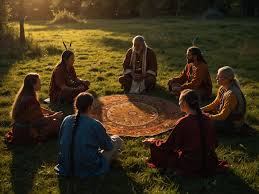
A woman in obstructed labour lay exhausted among the Guna (Kuna) people of Panama’s Caribbean coast. Her pain was beyond unbearable. Maybe death was at the doorstep. At that edge, the community did not merely “comfort” her. They called a ritual specialist, a healer known as Nele. These are traditional healers, not medicine specialist. They work through chanting, trance, and collective focus.
The Guna shaman (nele) began an extended curing chant. In great detail, his words described a perilous inner landscape of the woman’s body. The shaman narrated a journey through the lady’s physique as though it were a cosmic geography, confronting obstacles, naming forces that blocked passage, and re-ordering the world through sound and story. Miraculously, the obstacles untangled and the baby was born. The woman also recovered. The French anthropologist Claude Lévi-Strauss made this episode one of the most famous case studies in medical anthropology, arguing that the chant’s efficacy lay in how it gave structure to overwhelming sensation and restored coherence to experience. This was not “placebo” in the trivial sense; it was symbolic engineering applied to the body’s crisis response (Amherst.edu). In essays like “The Effectiveness of Symbols,” he argues that shamans heal by using myth and language to structure the patient’s chaotic experience, relying on social consensus and cultural narratives rather than purely individual insight.
Variants of the same logic appear across continents: the healer induces an altered state, dramatizes the illness in a culturally intelligible form, recruits community helpers, and aims to restore harmony between the person and the world. Thousands of years ago, the traditional healers had understood the oneness of all beings, the oneness of nature. It is this harmony they seek to restore in their healing.
In the Diné (Navajo) tradition, healing ceremonies known as Chantways—including the famous Nightway (Night Chant)—are explicitly oriented toward restoring Hózhó, often translated as balance, harmony, or beauty.
In Amazonian Peru, among groups such as the Shipibo-Konibo, healing is often mediated through ritual diets, plant knowledge, and icaros—medicine songs—within a broader shamanic medical system sometimes described as vegetalismo. Here too, the emphasis is not simply on “chemical effect” but on song, attention, and the social container of ritual. Scholarly work on Shipibo healing and icaros is substantial, and Peru’s state itself has treated these ritual practices as culturally significant: in 2008, the Peruvian government declared the “knowledge and traditional uses of ayahuasca practiced by native Amazonian communities” to be National Cultural Heritage, in part to protect ritual use within indigenous contexts.
THE MECHANISM BENEATH THE MYTH: RHYTHM, TRANCE, AND THE NERVOUS SYSTEM
Shamanic healing rituals rely on rhythm, attention, suggestibility, and social synchrony the very ingredients modern neuroscience increasingly recognizes as capable of shifting brain and body states.
A large body of work has examined how rhythmic stimulation alters consciousness. The classic physiological hypothesis argued that repetitive drumming can drive changes in the central nervous system and produce unusual behavioural and experiential states.
Even more directly, a high-density EEG study examining shamanic trance in experienced practitioners reported measurable neural changes during drumming conditions, alongside robust altered-state reports. The key point is empirical: trance corresponds to detectable shifts in brain dynamics.
This matters because when the nervous system remains locked in hyper-vigilance, pain perception changes, digestion changes, sleep changes, and immune signalling changes. Rituals that reliably downshift arousal or reorganize attention can therefore have real downstream bodily effects, even if the ritual language speaks of spirits or soul loss.
THE MISSING INGREDIENT IN MODERN HEALING: COMMUNITY AS MEDICINE
Shamanic rituals are commonly performed in the presence of family, elders, or the whole community. The patient’s suffering is witnessed. The community’s fear is named. The group participates through song, rhythm, offerings, or attentive silence. One widely cited study found that synchrony and exertion during dance independently raised pain thresholds and increased social bonding. Shamanic healing often treated illness as partly a fracture in belonging. Modern medicine, for all its brilliance, often leaves belonging untouched.
SYMBOLIC EFFICACY: HOW A STORY CAN ALTER BODILY EXPERIENCE
The third feature is the most intellectually interesting, and Lévi-Strauss saw it clearly in the Guna childbirth case: shamanic healing often works by creating a story that the body can obey.
In crises, the mind seeks interpretation. If pain is meaningless, it amplifies pain. The Guna curing chant gave the woman a coherent symbolic map of what she was enduring. Lévi-Strauss argued that the chant translated raw sensation into a structured narrative, which could reorganize experience and thereby alter physiological response.
The issue of story finds resonance with José Silva, who has been one of the greatest proponents of the healing power of the mind. He often created stories about the body of the person and visualised healing. According to Silva, scientists recognize four brainwave states: Beta, Alpha, Theta, and Delta. Beta is the most alert state—the state in which you spend most of your waking hours (Katie Doll, shortform). Silva argues that the Alpha state is a powerful and underutilized tool that anyone can learn to use. Your brain is capable of different skills in Alpha than it is in Beta, so the first step to accomplishing the skills Silva teaches is to learn to reliably and intentionally access the Alpha brain state. In a state of relaxation, as we create a story and visualise, healing begins.
WHERE SHAMANIC HEALING IS PRACTICED TODAY
“Shamanism” is not a single religion. It is an umbrella term outsiders often impose on diverse indigenous systems. In Guna Yala (Panama), traditional specialists such as neles remain culturally significant in many communities, even as modern healthcare coexists with indigenous healing and as migration reshapes practice. Among the Diné (Navajo) in the American Southwest, ceremonial healing traditions such as Blessing Way (Hózhóóji) and other Chantways continue as living practices, discussed not merely as heritage but as restorative frameworks that address wellness, identity, and balance. In the Peruvian Amazon, Shipibo-Konibo and other indigenous and mestizo lineages continue plant-based ceremonial healing, and the state’s recognition of traditional ayahuasca use as cultural heritage underscores the ongoing presence and contested modern context of these practices.
WHAT THE MODERN READER CAN PRACTISE, SAFELY, WITHOUT BORROWING SOMEONE ELSE’S RITUAL
A reader in Ludhiana or London does not need to imitate a Guna curing chant or a Diné sandpainting ceremony. That would be both inappropriate and ineffective outside the culture that gives it meaning. But one can translate the underlying therapeutic principles into a simple, secular healing practice.
THE PRACTICE
Choose a quiet time. Sit upright. For ten minutes, use a steady rhythm—either gentle tapping with your fingers on your thigh or a soft metronome-like beat. Keep it unforced. Some people use words like Ram or Waheguru subliminally.
Then do something that Lévi-Strauss would recognize: give your suffering a coherent form. Write a single page that answers one question only: “If my distress were a landscape, what would it look like?” Do not analyse. Describe. Name obstacles. Name the weather.
Name the blocked passages. This converts raw sensation into symbol—often the first step in restoring agency. Finally, add the element modern life often lacks: witnessing. Either share e that page once, with one trusted person, or read it aloud to yourself with full attention. You can be the witness too. Then visualise healing in the story that you have created.That, in essence, is the shamanic insight translated into modern terms: regulate the nervous system, restore meaning, and re-enter belonging. The idea of this writing is to provide information about shamanism- not to make you practitioners today! Therefore, I would suggest the readers to delve deeper before embarking upon any practice.
(Views expressed are the author’s own)
Start your day with The Savera Morning Brief, bringing you the latest news from India and around the...

Union Home Minister Amit Shah will pay tribute to police martyrs at the National Police Memorial in New...
Four more people, including two women, have been arrested in the Tiger Shroff firing case. Delhi Police are...
We are very proud that at present India is the number one country in the world by surpassing...
Every investor wants the wealth-creating power of equity and the reassuring stability of debt. Balanced Advantage Funds attempt...
Tourism is a major source of government revenue in our country. There are different types of tourism. Scenic...
Aries: The day will be auspicious...