Last Updated: October 21, 2026
Last Updated: October 21, 2026





Sheena Sandhu
A retired civil servant
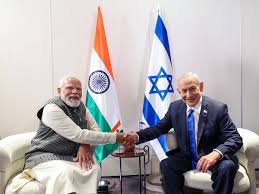
When Prime Minister Narendra Modi first stepped onto Israeli soil in 2017, the optics were historic a “de-hyphenated” foreign policy finally coming up for air. But while the world focused on the Haifa cemetery and Red Sea diplomacy, a quieter, more tectonic shift was taking root in the black soil of Maharashtra and the arid plains of Rajasthan. Following the February 2026 state visit, this narrative has matured from a tentative handshake to a deep-rooted “Special Strategic Partnership” that places the Indian farmer at the very center of the bilateral map. The 2026 visit is not merely another diplomatic milestone; it is the moment India moved from “importing” Israeli solutions to “intermingling” them with Indian scale. For a nation grappling with the pincer grip of climate change and a burgeoning population, the agreements signed in Jerusalem this week are not mere MoUs—they are a survival blueprint for a water-stressed century.
From Demonstration to Saturation: The Village of Excellence
The centrepiece of this visit is the radical scaling of the Indo-Israel Agricultural Project (IIAP). Since its inception, the IIAP has been the quiet workhorse of this relationship, establishing nearly 43 Centres of Excellence (CoE) across 13 states. These hubs specializing in high-tech nurseries and canopy management have already trained over half a million farmers, reportedly boosting yields by 20% while slashing water consumption. However, the 2026 mandate shifts the goalposts from “demonstration” to “saturation.” The commitment to expand these centers to 100 by 2028 is ambitious, but the real breakthrough lies in the new “Villages of Excellence” (VoE) model. This transition acknowledges a hard truth: a farmer might visit a center once, but they live in a village forever. By embedding Israeli “plug-and-play” technology—solar-powered drip systems and real-time soil sensors—directly into the village ecosystem, the partnership is finally crossing the “last mile.” It is no longer about teaching the teacher; it is about empowering the field itself.
The IINCA: A Laboratory for the Anthropocene
Perhaps the most forward-looking document to emerge from the Jerusalem summit is the agreement between the Indian Council of Agricultural Research (ICAR) and MASHAV to establish the India-Israel Innovation Centre for Agriculture (IINCA).
IINCA is not designed to sell off-the-shelf hardware; it is designed to co-create “future-proof” biology. The focus is three-pronged:
Genomic Resilience: Developing germplasm for heat-tolerant wheat and salt-resistant rice a necessity as the Indian monsoon becomes increasingly erratic. Precision Data: Using satellite-based “Big Data” to move from blanket fertilization to “per-plant” precision, ensuring not a drop of chemical or water is wasted. Post-Harvest Valorization: India loses nearly 15-20% of its horticultural produce to a broken cold chain. The IINCA’s focus on Israeli “controlled atmosphere” storage aims to turn this systemic waste into rural wealth.
Blue Economy: The New Frontier
While the 2017 visit was about “Green,” 2026 is decidedly “Blue.” The new Declaration of Intent on Fisheries and Aquaculture marks a significant pivot. Israel, a nation that successfully grows fish in the middle of the Negev desert, offers a masterclass in intensive recirculating aquaculture systems (RAS).For India, with its 7,500-km coastline and vast inland water bodies, the potential for a “Blue Revolution” is staggering. The agreement seeks to replicate Israeli success in desert mariculture in states like Haryana and Punjab, where rising salinity has rendered traditional farming difficult. By turning “saline wasteland” into “shrimp goldmines,” the partnership is solving a land-use crisis with a technology-first approach.
The Geopolitics of the Dinner Plate
Beyond the technicalities, there is a hard-nosed economic reality. As India and Israel push toward a Comprehensive Free Trade Agreement (FTA), the agricultural sector stands to be the primary beneficiary. The “Jerusalem Harvest” isn’t just about growing more; it’s about growing better meeting the stringent phytosanitary standards of global markets. By adopting Israeli post-harvest tech,
Indian mangoes and pomegranates can finally compete in high-value markets without the fear of “rejection at the port.”
Furthermore, the collaboration on wastewater recycling where Israel is the undisputed world leader, recycling nearly 90% of its urban sewage is no longer a luxury for India; it is a demographic necessity.
As our cities swell, the ability to turn urban waste into rural water will be the difference between social stability and water scarcity. The persistent skepticism regarding Indo-Israeli ties is that the technology remains “too expensive” for the smallholder Indian farmer. The 2026 agreements address this head-on through the “Frugal Innovation” clause, which encourages the local manufacturing of Israeli designs under the ‘Make in India’ initiative.
The true metric of success for PM Modi’s 2026 visit won’t be the joint statements issued from the King David Hotel; it will be the “More Crop Per Drop” efficiency in a small farm in Vidarbha or the “Blue Revolution” in a pond in Rohtak. The desert and the Deccan have finally found common ground. We have moved beyond the era of buyers and sellers; we are now co-creators of a shared food future
The family of 5-year-old Fabiana Cabello in New York City, USA, is in deep shock after her death....

The Delhi High Court on Wednesday posed several questions to Cockroach Janata Party (CJP) leaders Sourav Das and...

Cockroach Janata Party (CJP) leaders Sourav Das and Ashutosh Ranka withdrew their petition from the Delhi High Court...
A suspicious explosion occurred on Tuesday at a building under construction on Jermiah Road in the Pulikesi Nagar...

The Ayushman Bharat Pradhan Mantri Jan Arogya Yojana (PMJAY) is proving to be a significant relief for poor...
Rescue teams recovered the bodies of four youths from the Kotri canal in Kota on Wednesday morning, after...

Aries: The day will be auspicious...