Last Updated: October 21, 2026
Last Updated: October 21, 2026





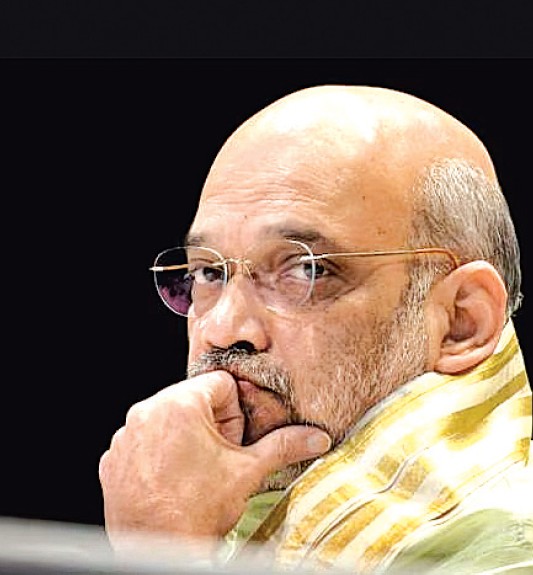
For years, the Maoist insurgency was seen as India’s most unyielding internal conflict, a shadow war spread across forests, hills and remote tribal regions. That landscape has changed decisively. The killing of Madvi Hidma, one of the most feared Maoist commanders, on November 18, 2025, followed by another encounter the next day that left seven Maoists dead in Andhra Pradesh’s Alluri Sitarama Raju district, has become a symbolic moment. These back-to-back blows capture the state of a movement that once claimed entire districts but is now fighting for survival.
A decade ago, Left-Wing Extremism was described as the country’s toughest security test. Today, the centre of gravity of that conflict has shrunk to pockets of Bastar and Abujhmad in Chhattisgarh. The shift has not been accidental. It reflects a coordinated, long-haul push led by Prime Minister Narendra Modi, and a firm, time-bound campaign shaped by Home Minister Amit Shah. Together, their approach has created the most sustained pressure the Maoists have ever faced.
The numbers tell the story. Nearly 300 Maoists neutralised in 2025 alone. More than 1,100 arrested. Over 900 surrendered. The list of affected districts, once around 180, now down to only 18. States like Maharashtra, Odisha, Andhra Pradesh, Jharkhand and Bihar, which earlier struggled with frequent attacks, are now practically free of Maoist influence. Even the Bihar elections, once clouded by the threat of violence, were conducted peacefully and efficiently. What once seemed impossible has become routine.
A crucial part of this shift has been Amit Shah’s insistence on ending the insurgency, not simply containing it. He set a clear deadline for eliminating Maoist violence by March 31, 2026, and pushed the security establishment to act with urgency. Hidma’s killing, days ahead of a scheduled operational target, shows how closely the state’s response now matches its intent. Shah also drew a clear line: there would be no talks without disarmament. The rebels must surrender first and unconditionally. Dialogue is not a bargaining chip; the authority of the state is non-negotiable.
This clarity marks a break from the past. For decades, the Maoist insurgency was cushioned by an ideological narrative that romanticised it as a rebellion of the poor. Writers and activists shaped a storyline in which Maoists represented landless labourers rising against caste oppression and state indifference. Violence was recast as resistance. But the deeper facts never supported this version.
If the conflict were actually a battle between landlords and the landless, the insurgency would have grown in regions dominated by big landholdings. Yet the Lalu Prasad Yadav government’s 1991 list of 157 “landlords” did not include a single name from central Bihar, the heart of Maoist activity. Most so-called landlords were from north Bihar, a region that remained stable. This contrast exposed a gap between rhetoric and reality.
A closer look reveals a different pattern. Maoist violence often triggered the emergence of upper-caste armed groups, not the other way around. Organisations such as the Ranvir Sena were formed after sustained attacks on local farmers, many of whom were small landholders, not the feudal elite. Claims of a class war masked a harsher truth: nearly 90 percent of those killed by Maoists were poor, and mostly from Dalit, Adivasi or Backward Class communities. Villagers and labourers became the primary victims of a movement that claimed to fight in their name.
The disconnect extended to the Maoists’ loudest champions. Many intellectual supporters lived in cities, protected by the state they criticise, enjoying the comforts they deny to those they urge into revolution. The contrast brings to mind Nicaraguan writer Pablo Antonio Cuadra, who questioned how Günter Grass could defend institutions abroad that he would never accept at home. The parallel is hard to miss.
The Modi government directly challenged this ideological shield. It called out the inconsistencies, dismantled the romantic aura around the insurgency and refused to treat violence as social commentary. At the same time, it brought consistency to policy. Previous governments frequently oscillated between negotiation and crackdown. The current approach combines decisive security measures with sustained development, delivered simultaneously rather than in isolated phases.
Under this strategy, the state first secures territory and then extends development. Roads, communication networks, banking access, schools and fortified police stations have become markers of a renewed state presence. Between 2014 and 2024, thousands of kilometres of roads were built in LWE zones, mobile towers installed in remote forests, bank branches opened, and new schools established. By 2025, these gains had accelerated. Over 14,000 kilometres of roads were completed, more than 7,700 mobile towers activated, and nearly 1,000 bank branches opened. The number of fortified police stations rose from 66 a decade earlier to more than 600. Security camps expanded into areas once entirely controlled by Maoists.
This model has changed the balance. Security forces now operate from permanent bases deep inside former Maoist strongholds, and development follows closely. Villagers gain access to schools, markets, banking and transport. For many communities, this is the first sustained contact with the state. The design is deliberate: bring security and services together, and reduce the space in which insurgency draws strength.
The broader lesson extends beyond this conflict. The Modi-Shah approach lays down a framework for resolving future insurgencies. Development cannot replace the authority of the state, but it can reinforce it. Insurgencies fade when the state combines firmness with inclusion, strength with opportunity. India’s experience with Left-Wing Extremism now offers a model for addressing long-running internal challenges with clarity, discipline and long-term commitment.
Good Evening Viewers! Get the latest updates from India and around the world with The Savera Times Evening...

Bharatiya Janata Party (BJP) National General Secretary Smriti Zubin Irani launched a scathing attack on Congress MP and...
New Delhi: Cockroach Janata Party (CJP) leaders Saurav Das and Ashutosh Ranka will be released from judicial custody...
According to police, three suspicious young men are seen in CCTV footage. Efforts are underway to identify them....
A video has surfaced of an alleged attempted assault on Jan Suraj Party's Bihar president Manoj Bharti. The...
Two accused have been convicted and sentenced to 10 years of rigorous imprisonment in a 2017 drug trafficking...
Aries: The day will be auspicious...