Last Updated: October 21, 2026
Last Updated: October 21, 2026





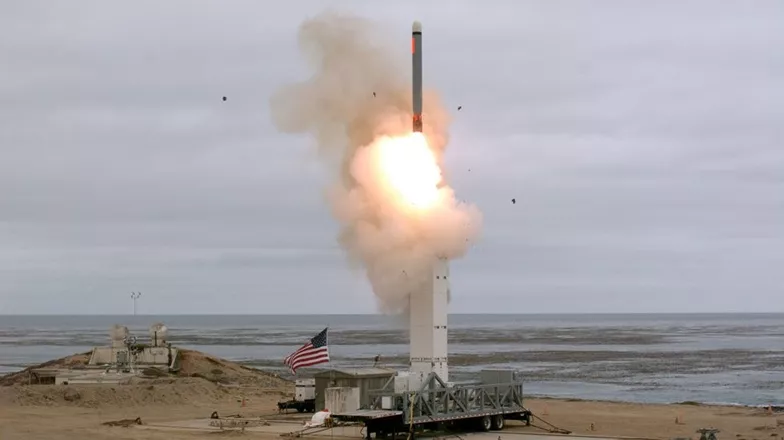
Ukrainian President Volodymyr Zelenskyy has sought US-made Tomahawk cruise missiles to extend Kyiv’s strike reach deep inside Russia. The request has prompted debate about whether Ukraine can actually use such weapons. The technical obstacle is straightforward. Tomahawks are traditionally launched from ships and submarines, and Ukraine does not have a functional navy capable of deploying them.
On the face of it, that limitation would make any supply of Tomahawks to Ukraine difficult to operationalise. That apparent impasse does not end the conversation. There are land-based launchers for Tomahawks. The United States has already adapted land launch configurations for the missile for service with the US Army and the US Marine Corps. Industry has also moved quickly to offer new solutions. This week the defence manufacturer Oshkosh unveiled a ground launch vehicle, called X-MAV, capable of carrying and launching four Tomahawks. While X-MAV remains unproven in combat conditions, it offers a direct route for land deployment if it enters production and can be supplied.
Practical options for Ukraine include receiving existing land-based launcher batteries from US forces or acquiring production launchers such as X-MAV from manufacturers. Media reporting has suggested there are two unused US Marine Corps batteries, each with four land launchers, that could be made available. If political will in Washington aligns with such transfers, those assets would provide Ukraine with immediate launcher capacity. If manufacturing lines for X-MAV or similar vehicles are operating, Ukraine might buy those systems directly. Either route would hinge on diplomatic and logistical decisions in Washington as well as the ability to train crews and protect launch sites.
If launchers are arranged, Ukraine could field Tomahawks on land within weeks or months depending on the availability of hardware, training timelines and security arrangements. The missiles themselves are long range. Tomahawks fly at low altitude and can cover distances typically stated at between 1,250 and 2,500 kilometres depending on variant and mission profile. They are designed for precision strikes and low observability, hugging terrain to reduce radar detection. Analysts and Ukrainian officials have pointed to the missile’s track record in operations such as Syria to argue that Tomahawks can evade or complicate air defence responses.
Ukraine has shown a capacity for improvisation since the full scale invasion began, adapting and combining weapons systems to local needs. That adaptive mindset would be necessary to integrate Tomahawks into Kyiv’s existing strike campaigns. The likely operational concept would see Tomahawks used in concert with Ukraine’s own drones, ballistic or cruise missiles, and manned strike platforms. Commanders would aim Tomahawks at high-value, deep targets such as weapons manufacturing sites, energy infrastructure, rail nodes and command and control facilities that lie beyond the reach of many of Ukraine’s current systems.
The strategic logic is that Tomahawks add a long reach, high precision capability that can complement existing Ukrainian tools. They are most potent when launched in salvos, because multiple simultaneous threats can overwhelm or saturate defences. Ukrainian analysts have argued that Russian air defence systems such as S-400 or Pantsir have vulnerabilities and that Tomahawks, used in coordinated strikes, can achieve effects that shorter range systems cannot.
One expert from Ukraine’s Center for Countering Disinformation was cited noting the missile’s effectiveness in past conflicts. Those assessments still depend on many variables including defender readiness, warning times and the integration of electronic warfare. Operational use of Tomahawks by Ukraine would not be a silver bullet. The missiles are expensive and limited in number. Reporting has suggested that a potential supply could be up to 200 missiles, and open source reporting has placed an estimated unit cost in the region of a few million dollars per missile. At suggested prices, even a package of several dozen Tomahawks would represent a significant investment in Western materiel. For Kyiv, each missile would be allocated to a target where precision and stand o� are essential. The impact on Russia’s infrastructure is already visible in other forms. Ukraine has mounted sustained strikes on Russian energy facilities in recent months, with claims of damage to major refineries. Those operations have been credited with straining Russian fuel supplies and prompting export restrictions.
Tomahawks would extend the range and precision of those efforts, potentially increasing pressure on critical industrial and logistical nodes. Whether that pressure can be translated into political leverage remains uncertain. Moscow’s resilience and ability to absorb damage have shaped the conflict dynamics so far. Any decision to supply Tomahawks would also carry political and legal dimensions. Washington would have to weigh escalation risks, the optics of transferring a long range strike missile, and the broader strategic calculus with respect to Russia. Kyiv would need to ensure secure basing and operational secrecy to avoid easy retaliation.
Training, logistics and command and control systems would have to be established swiftly. In short, technical barriers to Ukrainian use of Tomahawks are surmountable if land launchers can be sourced or provided. The outcome would depend on political choices, industrial capacity and operational preparations. Were Kyiv to receive both missiles and launchers, the Tomahawk could extend Ukraine’s ability to strike deep targets with high precision. That capability would be a notable addition to Ukraine’s toolkit, but it would come with high cost, complex logistics and significant strategic implications for the wider conflict.
Protests in Jakarta, Yogyakarta and Bandung brought students onto the streets over rising costs, forest fires and civil...

Organisations linked to Neville Roy Singham are under US congressional scrutiny over funding. Their coverage of protests in...

US President Donald Trump says Washington and New Delhi are close to a trade agreement that will differ...
Iran has ruled out transferring its enriched uranium stockpile outside the country, with security official Mohsen Rezaei reiterating...
Donald Trump has urged Volodymyr Zelensky to pursue a peace deal with Russia, warning that Ukraine could face...
Pakistan, battling insurgencies at home and tensions along multiple borders, is too overstretched to offer meaningful military support...
Aries: The day will be auspicious...