Last Updated: October 20, 2026
Last Updated: October 20, 2026





Akshay Bansal, BJYM (NEC)
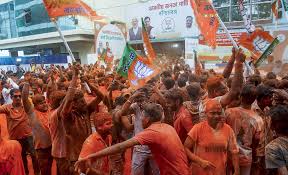
The results of the recent elections across five states have been declared, and among them, the BJP’s victory in Bengal stands out as particularly historic. There was a time when Atal Bihari Vajpayee would express his anguish over the fact that his party—the BJP—held no presence whatsoever in the birthplace of its founding father, Syama Prasad Mookerjee.
Today, by securing 206 seats, the BJP has made history. This victory holds special significance for the BJP across multiple dimensions. For anyone who has witnessed Bengal under the rule of the Left and the Trinamool, this is not merely the triumph of a single political party; rather, it represents a beacon of hope for change and for the resurgence of Hindutva. Furthermore, this shift in power presents a historic opportunity to bridge the profound socio-economic divide that has long existed between India’s East and West. People often speak of a North-South divide, yet that distinction is not truly substantive; the real divide lies between the East and the West.
In the post-independence era, the economic engine of the East—and of Bengal in particular—seemed to grind to a halt. Policies such as the Freight Equalization Policy effectively stifled industrialization in Bengal. Bengal’s successive governments turned against their own people—whether through controversies such as the Tata plant dispute or their refusal to implement schemes like the Ayushman Bharat Yojana. The Trinamool Congress government not only pursued a policy of Muslim appeasement but also failed to address the concerns of the Hindu community regarding demographic shifts within the state, as well as issues of misgovernance, the insecurity of women, the breakdown of law and order, and the exodus of people from the region.
Moreover, the government made every effort to politicize even critical national security issues—such as the porous eastern border (SER)—but the people of Bengal, having learned bitter lessons from the violence witnessed in neighboring Bangladesh, effectively thwarted these attempts. Simultaneously, by slavishly adopting the modus operandi of the Left—characterized by the “Syndicate Raj”—the administration caused investment and job creation within the state to come to a virtual standstill. The BJP’s victory will pave the way for the formation of a “Double Engine” government, thereby directly aligning the state’s policies with New Delhi’s economic agenda.
This political alignment is expected to expedite the flow of central funds, thereby accelerating stalled infrastructure projects, highway networks, and urban development initiatives across the state. It is anticipated that this will lead to the implementation of policies more favorable to investors, as well as reforms aimed at enhancing the ease of doing business—measures expected to attract large-scale manufacturing units back to the region. As articulated by the Prime Minister, the vision of Bengal becoming ‘unfettered’ and realizing its full potential will manifest not merely as a slogan, but as a tangible political objective
Good Evening Viewers! Catch up on the day's biggest stories with The Savera Times Evening Bulletin. Get the...

Congress leaders continued their protest outside the Jaipur Police Commissionerate on Tuesday, demanding the registration of a zero...
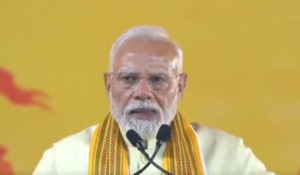
On the auspicious occasion of Vijayadashami, Prime Minister Narendra Modi on Tuesday called on the countrymen to unite...
A historic milestone was achieved on Tuesday in the expansion of Chhattisgarh's rail networkA historic milestone was achieved...

Model Shraddha Dubey, one of the main accused in the death of Lucknow businessman Shiv Sharma, has been...

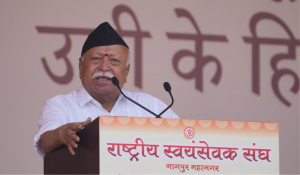
Rashtriya Swayamsevak Sangh (RSS) chief Mohan Bhagwat on Tuesday called for strengthening national unity, social harmony, indigenous practices...
Aries: The day will be auspicious...