Last Updated: October 21, 2026
Last Updated: October 21, 2026






The quiet, tree-lined streets of LaSalle, Montreal, were never meant to be a battlefield. Yet, the brutal killing of Nancy Grewal—a 45-year-old personal support worker and outspoken critic of Khalistani extremism—has transformed a peaceful Canadian suburb into a scene of primal, ideological savagery. Stabbed 18 times outside a client’s home in March, Grewal did not just fall victim to a random act of violence. Her death is the logical, albeit horrific, conclusion of a systemic failure by the Canadian state to recognize a burgeoning “gangster-extremist nexus” that is now consuming the Indo-Canadian diaspora from within.
For years, the “saner elements” of the Punjabi diaspora have watched with growing dread as a vocal, radicalized fringe hijacked the community’s narrative. Nancy Grewal was one of the few who refused to look away. Through her social media platforms, she challenged the rhetoric of secessionism and identified the toxic overlap between ideological radicalism and organized crime. Her reward for this civic courage was a campaign of intimidation that included 40 death threats and a literal arson attack on her home last November. Despite her desperate pleas to the police—famously captured in a CBC interview just days before her death where she stated, “I don’t feel safe here”—the Canadian security apparatus failed her.
The Myth of the ‘Isolated Incident’
The initial response from local law enforcement, labeling Grewal’s murder an “isolated incident,” is not just a failure of investigation; it is a failure of imagination. In Canada’s current climate, no killing of a political critic can be viewed in isolation. We are witnessing a pattern where the lines between international geopolitics, domestic extremism, and street-level gang warfare have blurred into a single, lethal spectrum.
From the assassination of Hardeep Singh Nijjar to the targeted killings of critics like Grewal, Canadian soil is being used as a staging ground for a conflict that the federal government seems either unwilling or unable to comprehend. When gangsters and “activists” share the same platforms, the same funding networks, and the same enemies, the distinction between a “criminal” and a “terrorist” becomes academic. For the victim bleeding out on a LaSalle driveway, the semantics of the Canadian Criminal Code offer no comfort.
The Hostage Diaspora
The Indo-Canadian community is one of the most successful immigrant groups in the world, yet they are increasingly living under a “double-bind” of fear. On one side, they are targets for radical recruiters who use religious and ethnic identity as a cudgel; on the other, they are marginalized by a Canadian political establishment that views the community through the lens of vote-bank politics.
The “saner majority”—the doctors, engineers, and workers like Grewal who simply want to build a life in their adopted home—feel abandoned. They see pro-Khalistani elements openly glorifying violence, displaying posters of “martyred” terrorists, and threatening anyone who dares to speak for a united India or even a moderate Sikhism. When the state fails to prosecute those who incite violence under the guise of “freedom of speech,” it effectively grants a heckler’s veto to the most radical voices. This silence is a message to the moderate majority: You are on your own.
Institutional Paralysis and Global Reputation
Canada’s reputation as a safe, rule-of-law democracy is currently in freefall. The RCMP and CSIS appear to be caught in a loop of reactive surveillance rather than proactive enforcement. The dossiers shared by Indian intelligence—detailing the presence of fugitives and organized crime bosses operating from Canadian cities—are often dismissed as “foreign interference.” Yet, the bodies on Canadian streets suggest that the real interference is the one occurring in the shadows of Brampton and Surrey, where gangs and extremists operate with a sense of total impunity.
If Canada is to restore its internal security, it must stop treating these incidents as PR crises to be managed and start treating them as national security threats to be dismantled.
This requires:
1. Dismantling the Financial Pipeline: Following the money that flows from legitimate businesses into the coffers of extremist organizations.
2. Zero-Tolerance for Intimidation: Criminalizing the digital and physical harassment of community critics, ensuring that a “Nancy Grewal” never has to report 40 threats without a single arrest being made.
3. Ending the Political Flirtation: Federal and provincial leaders must unequivocally distance themselves from groups that advocate for the balkanization of foreign nations through violent means.
The High Cost of Apathy
The tragedy of Nancy Grewal is that her death was preventable. She provided the names, she provided the footage of the arson, and she provided the warning. Her murder is a stain on the Canadian promise of “Peace, Order, and Good Government.”
As Indo-Canadian groups across the country voice their mounting safety fears, the Trudeau administration must realize that the Maple Leaf cannot continue to provide shade for those who sharpen their knives in its shadow. The “saner elements” of the diaspora are ready to reclaim their community, but they cannot do it while looking over their shoulders.
The time for diplomatic platitudes and “isolated incident” labels is over. Canada must bring the killers of Nancy Grewal to book, and more importantly, it must break the back of the extremist infrastructure that emboldened them. To do anything less is to admit that in the world’s most famous multicultural haven, the gun has become more powerful than the law.
Good Evening Viewers! Catch up on the day's biggest stories with The Savera Times Evening Bulletin. Get the...

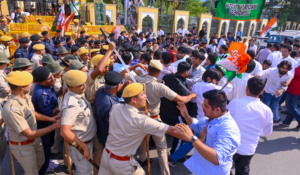
Congress leaders continued their protest outside the Jaipur Police Commissionerate on Tuesday, demanding the registration of a zero...
On the auspicious occasion of Vijayadashami, Prime Minister Narendra Modi on Tuesday called on the countrymen to unite...
A historic milestone was achieved on Tuesday in the expansion of Chhattisgarh's rail networkA historic milestone was achieved...

Model Shraddha Dubey, one of the main accused in the death of Lucknow businessman Shiv Sharma, has been...
Rashtriya Swayamsevak Sangh (RSS) chief Mohan Bhagwat on Tuesday called for strengthening national unity, social harmony, indigenous practices...
Aries: The day will be auspicious...