Last Updated: October 21, 2026
Last Updated: October 21, 2026





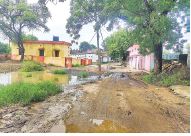
In Madhya Pradesh’s Singrauli district, millions have been forced to leave their homes due to mining, power generation, and dam projects, a trend that continues today. Chandawal village, visited by Down To Earth, illustrates the human cost of this displacement. The village has no native residents and is home entirely to people uprooted from other parts of the district.
At the village entrance, 71-year-old Chandrika Prasad struggles to operate his sewing machine to sustain himself. He explained that government compensation is insufficient to build a livelihood or support his family. “If we don’t work hard, how will we fill our stomachs?” he said, adding that residents live in constant fear of eviction.
Chandrika Prasad’s experience spans decades. His first displacement occurred in 1960 during the construction of the Rihand Dam, which forced nearly 40,000 families from their land. At that time, he owned an acre of land, enough to sustain his family. After moving near the Shaktinagar Canal, he was displaced again in 1980, receiving Rs 6,000 in compensation. Mining activities led to another displacement in 1982, with compensation of Rs 12,000, followed by a fourth displacement in 1988, for which he received Rs 6,000.
Prasad has lived in Chandawal for 37 years and hopes it will be his final home. Yet, with the village adjacent to an NTPC power plant, he fears further displacement. He summarized his life as “caught between two crises — the struggle for livelihood and the fear of displacement.”
Similarly, 80-year-old Deendayan has been displaced four times over 65 years. Once a farmer, he now works as a labourer, receiving only small sums in compensation each time, insufficient to rebuild a stable life. Most residents of Chandawal still lack basic amenities and depend on nearby towns for work.
Experts note the problem of repeated displacement has been overlooked historically. Shashi Singh, a research fellow at Cambridge University who has studied Singrauli for four decades, said the new Land Acquisition Act acknowledges multiple displacements. Section 40 of the law aims to prevent repeated displacement and mandates higher compensation where it occurs.
Singrauli’s experience highlights the human cost of India’s industrial development. Families like Chandrika Prasad’s have endured decades of uncertainty, moving multiple times with minimal support, illustrating the urgent need for policies that not only provide fair compensation but also prevent repeated displacement.
Reduced water levels at Har Ki Pauri and other Haridwar ghats have inconvenienced pilgrims during the Upper Ganga...

Six people returning from a Dussehra Mela were seriously injured when a car hit them on National Highway...

A bus travelling from Pachiound to Ramnagar fell into a gorge at Gulli Gula in Udhampur district. Nine...
Start your day with The Savera Morning Brief, bringing you the latest news from India and around the...

Union Home Minister Amit Shah will pay tribute to police martyrs at the National Police Memorial in New...

Four more people, including two women, have been arrested in the Tiger Shroff firing case. Delhi Police are...
Aries: The day will be auspicious...