Last Updated: October 21, 2026
Last Updated: October 21, 2026





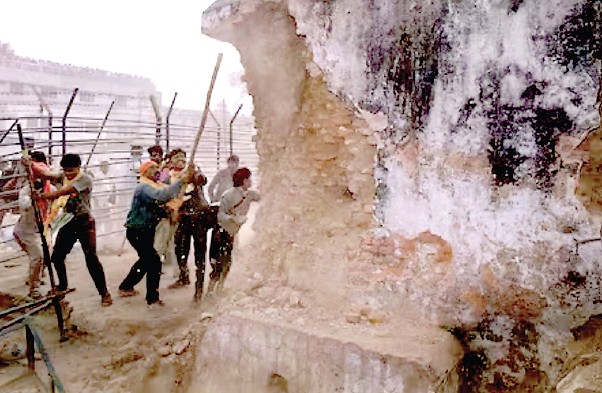
The demolition of the Babri Masjid on 6 December 1992 became one of the most defining and contentious moments in modern India. What unfolded in Ayodhya that afternoon reshaped political narratives, social relations, and public discourse for decades to come. It was the culmination of a long, organised mobilisation by groups that believed the sixteenth-century mosque stood on the birthplace of Lord Ram, on the site of a temple allegedly destroyed by medieval rulers. This belief had gained political momentum throughout the late 1980s and early 1990s, creating an atmosphere charged with religious symbolism and mass mobilisation.
In the days leading up to the demolition, tens of thousands of karsevaks travelled from across the country to Ayodhya. Estimates suggest that between 70,000 and 150,000 people gathered near the disputed site on the morning of 6 December. Senior political leaders associated with the movement, including LK Advani, Murli Manohar Joshi and Uma Bharti, were present. The Uttar Pradesh government, led by Chief Minister Kalyan Singh, had assured the Supreme Court that the structure would not be harmed, even as preparations for the kar seva intensified.
On the morning of the demolition, speeches were delivered from a raised platform. Chants echoed across the crowd. Moments later, the situation turned volatile. A group broke through the first police barrier, prompting chaos on the ground. Stones were reported to have been thrown at security personnel. Soon after, large groups of karsevaks swarmed the mosque’s domes. Equipped with hammers, iron rods, pickaxes and ropes, they began pulling down the structure.
The first dome collapsed at around 2:55 pm. The second followed between 3:50 pm and 4:45 pm. The third and final dome fell soon after, reducing the mosque to rubble. Journalists covering the event faced attacks on their equipment, with several cameras damaged. Numerous FIRs were filed against unidentified participants, though the scale of the crowd made identification difficult.
The demolition triggered some of the worst communal violence India had seen in decades. Clashes erupted across several states, leading to large-scale loss of life and property. The social and political impact was immediate and long-lasting. Ayodhya, which had been a symbol of a disputed past, now became the centre of an intensified national debate, influencing electoral politics and public sentiment in a way few events had before.
The legal battle over the site continued for years. In 2010, the Allahabad High Court ruled that the land should be divided into three parts, allocated to the Sunni Waqf Board, the Nirmohi Akhara and the Ram Lalla deity. The verdict, however, left many questions unresolved and was challenged in the Supreme Court.
In 2019, the Supreme Court delivered a historic judgment. It granted the entire disputed land to the Ram Lalla deity for the construction of a temple and directed that an alternative plot be provided to the Sunni Waqf Board for building a mosque. The ruling closed one chapter of the dispute while cementing the demolition as an event whose reverberations reshaped contemporary India.
Three decades later, the date continues to evoke memories, debates and reflections, marking a turning point that profoundly influenced India’s political and social trajectory.
State Bank of India has confirmed that 3,897 customer records containing personal information were found on the dark...

A fire in a hut in Nonapar village of Deoria district claimed three lives, including those of a...
Amit Shah paid tribute to police personnel who died in the line of duty at the National Police...
Reduced water levels at Har Ki Pauri and other Haridwar ghats have inconvenienced pilgrims during the Upper Ganga...
Six people returning from a Dussehra Mela were seriously injured when a car hit them on National Highway...

Two people were killed and ten injured after a passenger bus met with an accident at Gala Pachound...
Aries: The day will be auspicious...