Last Updated: October 26, 2026
Last Updated: October 26, 2026





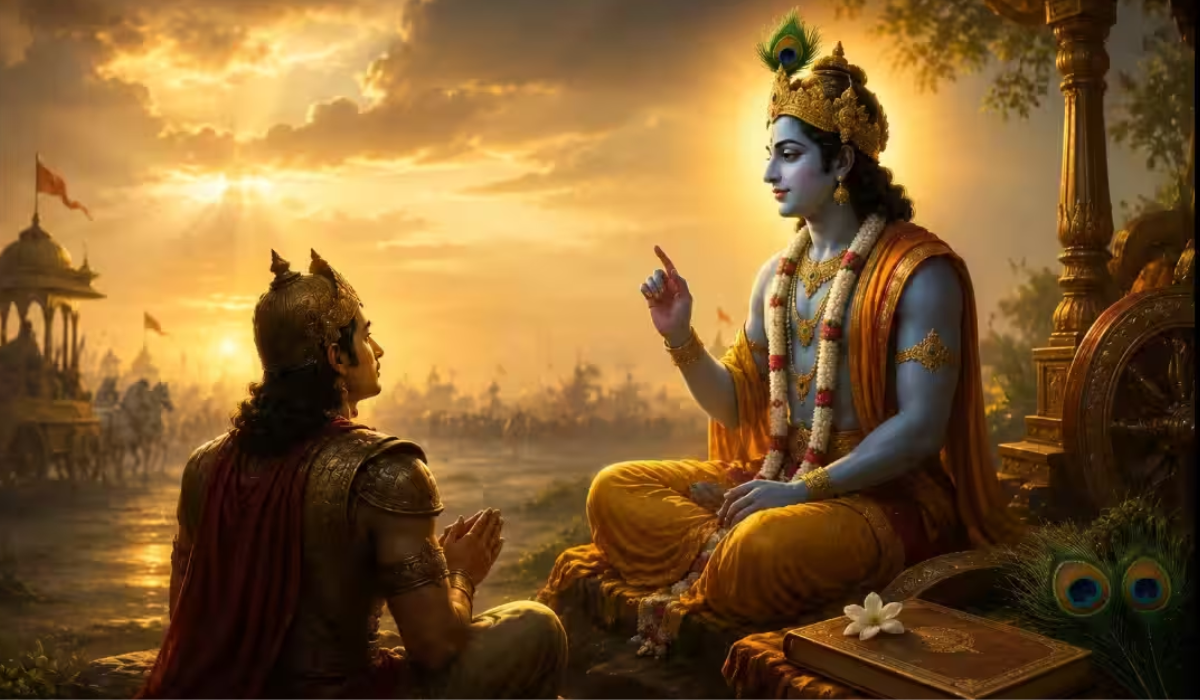
Arjuna asks, “O Krishna, you praise the renunciation of action and yet you also advise its execution. Tell me with certainty which is the better path (5.1).” Once before, Arjuna had sought certainty between the paths of Samkhya (3.1) and Karma (3.2). Sri Krishna, however, does not recommend renunciation of action and instead states that renunciation of action does not lead to perfection (3.4). One is compelled to perform actions according to one’s qualities (3.5). In fact, even the maintenance of the human body is not possible without action (3.8). Sri Krishna’s answer makes it clear that renunciation of action is a part of Sankhya Yoga. Karma basically has two aspects. One is the doer and the other is the fruit of action. Relinquishing the sense of doership, realizing that the gunas are the real doers, is what Arjuna refers to as karma-sannyasa. He later refers to performing actions without expecting the fruit of action as the performance of karma. In essence, Arjuna was asking whether to give up doership or the fruit of action. Sri Krishna replies that liberation is attained through both renunciation of actions and performance of actions. But of these, Karmayoga is superior to renunciation of actions (5.2). It is worth noting that this answer is for Arjuna, who is concerned about the consequences of his actions, namely the death of his teachers, family, and friends in the Battle of Kurukshetra. Broadly speaking, it applies to many of us who, like Arjuna, are mind-oriented. Sri Krishna explains that only children, not the wise, consider Sankhya and Karma Yoga to be distinct. He who is established in one attains the fruits of both (5.4). In short, these two paths may be different, but the destination is the same.
For Anindita Shrivastava, architecture is more than a physical object: it is a framework for living.

elieve it or not, but at least 10 crore Indians, a majority of whom are based in the...

There are some conversations that stay with you long after they are over. A few days ago, I...

As is the tradition in our country full of faith and festivals, Dussehra was celebrated with great pomp...
Praise the Lord! Hello, readers! I am Sandhya Masih, a psychologist who loves exploring the mysteries of the...
Imagine a universe where stars still shine, planets still form and water exists, but liquids are so thick...

Aries: The day will be auspicious...