Last Updated: October 26, 2026
Last Updated: October 26, 2026





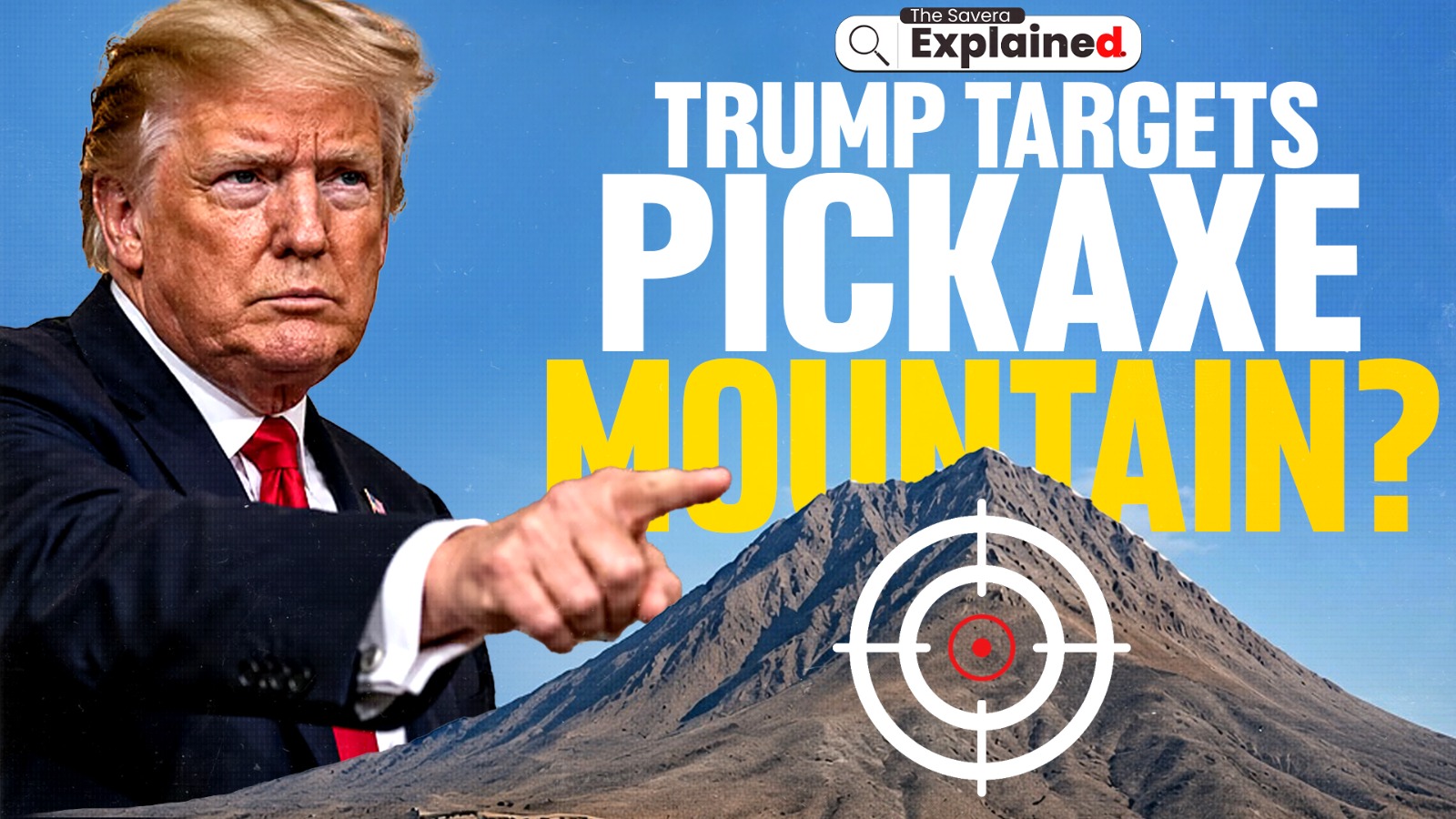
US President Donald Trump has once again put one of Iran’s most secretive underground sites in the spotlight. On Friday, Trump said the United States could hit Iran’s Pickaxe Mountain “very soon” — raising a bigger question: what exactly is hidden inside this mountain, and what could happen if the US actually strikes it?
What is Pickaxe Mountain?
Pickaxe Mountain, officially known as Kuh-e Kolang Gaz La, is a heavily fortified underground complex in central Iran. It is located about 220 kilometres south of Tehran and roughly 2 kilometres from Iran’s Natanz nuclear facility.
The site is built deep inside a mountain, with satellite images showing multiple tunnel entrances and continuing construction and reinforcement work.
The exact purpose of the facility remains unclear because international nuclear inspectors have not been allowed to inspect it. Iran has said the facility was intended for a plant to produce or assemble centrifuges — machines used to enrich uranium. But experts have also warned that its size, depth and security could allow it to support other nuclear-related activities.
Why is Trump threatening to strike it?
The reason is closely linked to Iran’s nuclear programme.
The United States and Israel have already attacked several major Iranian nuclear facilities during the conflict, such as Operation Midnight Hammer—the U.S. and Israel successfully hit primary, established nuclear sites like Natanz, Fordow, and Isfahan. However, Pickaxe Mountain emerged largely intact and was avoided in those initial rounds.
That makes it particularly important because the facility could provide Iran with a protected location to rebuild parts of its nuclear infrastructure. Even experts agree that Pickaxe Mountain’s deep tunnels serve as a critical “strategic hedge” where Iran can safely rebuild its centrifuge-manufacturing capability away from conventional airstrikes.
There have also been reports that Iran may have moved centrifuges or related equipment into the complex. However, this has not been independently confirmed, and Trump himself previously said Washington did not have the information “on record”.
Iran, meanwhile, denies that the site is being used for nuclear activities and says it does not seek nuclear weapons.
Why is Pickaxe Mountain so difficult to destroy?
This is where the mountain itself becomes the biggest defence.
The underground complex is estimated to be around 100 metres below the surface in parts of the facility. That is deeper than some of Iran’s other nuclear sites targeted previously.
The United States has powerful bunker-busting weapons, but attacking a facility this deep does not guarantee that the underground areas will be destroyed.
Experts say a strike could damage entrances, power supplies or other infrastructure without necessarily eliminating the deeper tunnels themselves.
So, bombing the mountain and destroying the facility are not necessarily the same thing.
What happens if Trump actually bombs it?
The first impact would be military. A US strike could damage tunnel entrances and supporting infrastructure and potentially prevent access to parts of the complex.
But the bigger issue would be what is actually inside.
If the facility contains nuclear equipment but no significant nuclear material, the immediate risk of radioactive contamination could be limited. If nuclear material is present and a strike disperses it, however, there could be a serious contamination risk.
There is another major concern: escalation.
A strike on Pickaxe Mountain would likely be seen by Iran as another attack on its nuclear infrastructure. Tehran could respond against US forces or regional interests, potentially widening the conflict.
And there is a strategic problem too. If the facility survives underground, Iran could attempt to repair or rebuild it. Experts have warned that repeated attacks could push sensitive nuclear activities even further underground rather than permanently ending them.
The bigger question
Trump says the US campaign is aimed at preventing Iran from obtaining a nuclear weapon. But Pickaxe Mountain highlights the difficulty of achieving that through airstrikes alone.
The facility’s exact contents remain uncertain. Its underground design makes it difficult to destroy completely. And any attack could carry the risk of a wider regional escalation.
So if Trump does order a strike, the question will not simply be whether the mountain is hit.
The real question will be: did the strike actually eliminate what is underneath — or did it push Iran’s nuclear programme even deeper underground?
Leader of the Opposition in the Lok Sabha, Rahul Gandhi, will visit Punjab's Sangrur district on November 4....

Good Evening Viewers! Stay updated with The Savera Times Evening Bulletin, bringing you the latest news and top...

The weather system forming in the Bay of Bengal is steadily strengthening. In view of this, Cyclone Warning...
A major road accident occurred in southeastern Kenya on Sunday morning. At least 22 people were killed and...
Hereditary Prince Alois of Liechtenstein will be on a four-day state visit from October 25 to 28 at...

Prime Minister Narendra Modi inaugurated the Reserve Bank of India’s new data centre and Cybersecurity Training Institute in...

Aries: The day will be auspicious...