Last Updated: November 22, 2026
Last Updated: November 22, 2026





-Abhishek Vij
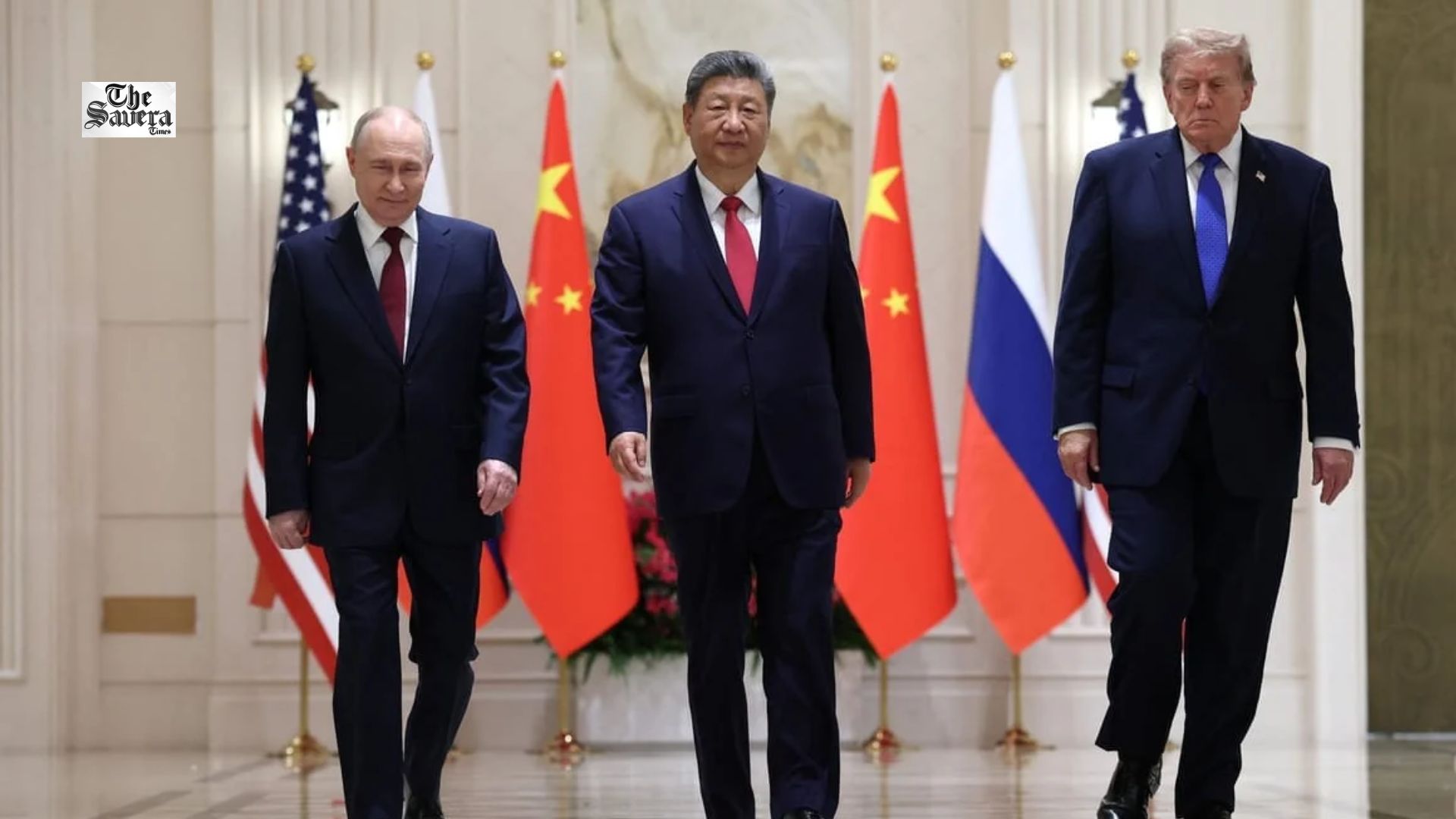
On Thursday, in the Chinese city of Shenzhen, the heads of state of three superpowers held a major summit. Following a 90-minute meeting between U.S. President Donald Trump, Russian President Vladimir Putin, and Chinese President Xi Jinping, a “major peace deal” was announced—though it is unlikely to yield any immediate, miraculous outcomes. In front of the media, Trump insisted that the next such meeting be held in the United States, but Xi Jinping did not commit to this.
Putin also remarked that it would be premature to make any announcements on that front. Many nations had pinned their hopes on this meeting. They hoped, firstly, for a de-escalation of the conflicts involving Russia-Ukraine and the United States-Iran; secondly, for progress toward nuclear disarmament; and thirdly, for discussions on normalizing the supply of oil and gas. While announcements were made, they lacked substance.
The three leaders spoke of the phased elimination of nuclear weapons globally—a notable point, given that these three superpowers collectively possess 91 percent of the world’s nuclear arsenal. Russia holds 5,420, the United States 5,042, and China 620 active nuclear warheads. (For context, India possesses 190.) During the meeting, nuclear weapons were described as a “sword of Damocles” hanging over the world. Putin noted that since the allied nations emerged victorious in the Second World War, they now bear the responsibility for maintaining global peace and security.
Although all three nations speak of dismantling their nuclear arsenals, it is futile to expect any genuine initiative from them. Such expectations are typically directed only at smaller nations—urging them to eliminate their limited nuclear stockpiles and refrain from sharing nuclear technology with others. During this high-level summit, Trump appeared to advocate for peace—a stance likely influenced by his party’s defeat in the U.S. midterm elections.
At one point during the discussions, Trump dozed off, a moment captured and broadcast by Chinese state television. Following the main summit, after Trump’s departure, Putin and Xi Jinping held a separate, closed-door meeting. Emerging from the talks, Putin stated that any attacks by Ukraine on Russian territory would be met with a firm response.
The meeting further underscored the growing closeness between China and Russia. A positive development for India was the discussion on increasing Russian oil supplies—a move from which India, a major importer of Russian oil, stands to benefit. Given this, on what grounds could the U.S. now justify imposing penalties on India for purchasing Russian oil? The three nations also reached an agreement regarding the expansion of the United Nations; this consensus strengthens India’s case for a permanent seat on the UN Security Council. The International Criminal Court (ICC) was also mentioned—an institution both Russia and the U.S. oppose, as the ICC has issued warrants involving individuals from both nations.
While life on Mars (and Venus) has long been an obsession for those wondering if we’re alone, there...
Two passengers were detained by masked ICE officers at Seattle-Tacoma International Airport during the boarding of an Alaska...

Benjamin Netanyahu's Likud party has outlined conditions for joining a possible unity government, including retaining security zones in...
Nepal Prime Minister Balendra Shah begins his first state visit to India on Sunday. He will meet PM...

Saudi airstrikes reportedly hit Yemen's Hodeidah amid escalating cross-border attacks, as the Houthis claimed 71 strikes across eight...
London: Two incidents involving outbound tankers struck by unidentified projectiles were reported near Khasab, Oman, while transiting the...

Aries: The day will be auspicious...