Last Updated: October 10, 2026
Last Updated: October 10, 2026





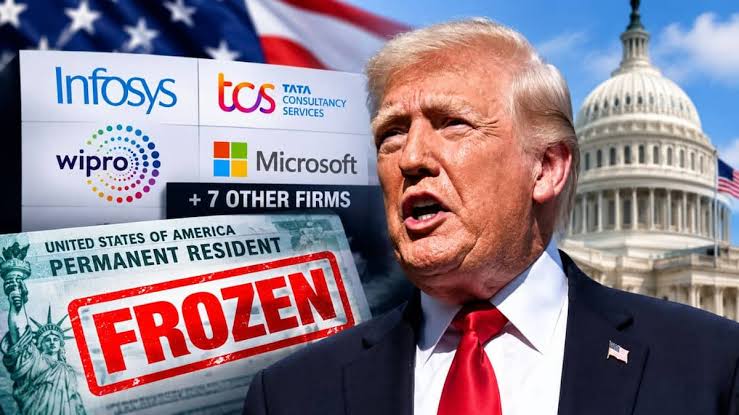
For thousands of Indian tech workers in the United States, a job offer is only the beginning of a much longer journey. Many spend years working in America, hoping to eventually secure a Green Card and settle there permanently. But now, that journey could become even more uncertain.
The Donald Trump administration has suspended eight major technology companies from a key employment-based Green Card programme. The list includes Indian IT giants such as TCS, Infosys, Wipro, HCLTech and Cognizant, along with Microsoft, Adobe and Capgemini.
The move, announced on October 8, has raised concerns among Indian professionals about their future, their families and their long-term careers in America.
What Does The Suspension Mean For Indian Workers?
The immediate concern is for employees whose employers were planning to sponsor their Green Card applications.
The suspension prevents the affected companies from filing new applications or processing pending applications under the PERM programme. This could delay the permanent-residency process for eligible employees.
However, this does not mean every Indian employee working at these companies will be affected in the same way. The impact depends on the employee’s immigration status and the stage their application has reached.
Most importantly, the suspension does not automatically cancel existing H-1B visas or require their holders to leave the United States.
Why Is The Green Card So Important?
For many Indian professionals, getting a job in America is only the first step towards building a long-term future there.
An H-1B visa allows eligible foreign professionals to work in specialised occupations in the US. It is generally granted for up to three years initially and can usually be extended to six years, subject to applicable rules and exceptions.
A Green Card, on the other hand, provides permanent-resident status.
Without permanent residency, workers may face uncertainty when planning their future, particularly when their temporary visa approaches its time limit. Certain workers pursuing employment-based Green Cards may qualify for H-1B extensions beyond six years, depending on their circumstances.
Why Is The Trump Administration Targeting These Companies?
The US administration says the action is intended to protect American workers and prevent the misuse of employment-based immigration programmes.
Vice President JD Vance accused Microsoft of laying off American employees while benefiting from foreign-worker visas and Green Cards. The administration has argued that companies should prioritise qualified American workers.
Microsoft disputed the suggestion that its H-1B applications mainly represented new foreign recruitment. It said around 80 per cent of its applications in the previous fiscal year were intended to extend or change the status of existing employees.
These are competing claims, and the allegations should not be treated as proof that every affected company has violated immigration rules.
The move is also part of a wider tightening of US immigration policy, increasing uncertainty for skilled foreign workers.
Why Indian Professionals Face A Bigger Challenge
Indian workers already face long waits for employment-based Green Cards because demand from India exceeds the number of visas available.
For affected employees who have not yet begun the PERM process, the suspension could delay the start of their employer-sponsored permanent-residency applications.
For those already waiting in the system, the consequences depend on their individual circumstances and whether their applications fall within the suspension.
The uncertainty could also influence decisions about changing jobs, buying property, raising children and planning a permanent future in the US.
What Has India Said?
On October 9, India’s Ministry of External Affairs said the US decision did not advance the shared ambitions of the two countries.
New Delhi clarified that PERM and H-1B are separate programmes. While the suspension could affect the Green Card prospects of eligible employees, it does not automatically affect existing H-1B visas or the status of their holders and dependants.
India also defended the contribution of Indian professionals to America’s technology sector, research, innovation and economic growth.
TCS, meanwhile, said it did not expect the suspension to affect its workforce strategy or client engagements, highlighting its focus on local hiring in the US.
What Happens Next?
The immediate impact will vary from worker to worker, but the uncertainty is significant for those hoping to settle permanently in America.
The suspension does not shut down every route to a Green Card, and some employment-based categories do not require PERM. However, alternative routes depend on individual eligibility and are not guaranteed solutions.
Indian tech workers with valid H-1B status are not automatically losing their right to work in the US. But for employees relying on these eight companies to sponsor their Green Cards, the path to permanent residency has become more uncertain.
Mumbai: Mumbai Police’s Crime Branch Unit-12 has busted a racket involved in the illegal sale of call detail...

New Delhi: Delhi Traffic Police has issued a traffic advisory for October 10, 2026, warning commuters of possible...

New Delhi: Stepping up preparations for the upcoming Assembly elections, Bharatiya Janata Party (BJP) President Nitin Nabin on...

New Delhi: Two days after a four-story building collapsed in north Delhi’s Seemapuri, claiming at least five lives,...

Deoghar: Vice-President C.P. Radhakrishnan will visit Deoghar in Jharkhand on Saturday to address the second convocation of the...
New Delhi: Reiterating its concern over Indian nationals recruited in Russian Army, the Ministry of External Affairs (MEA)...