Last Updated: October 17, 2026
Last Updated: October 17, 2026





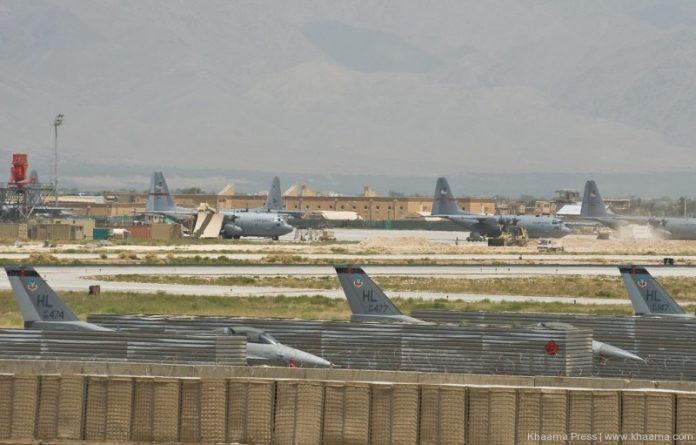
President Donald Trump has renewed a controversial demand to regain control of Bagram air base, the sprawling facility that for two decades anchored United States and NATO operations in Afghanistan. Once the region’s most important military hub, Bagram was abandoned during the chaotic US withdrawal in 2021 and is now under Taliban control. Trump’s public insistence on retaking the base has renewed debate over whether such a move would be strategically justified or practically feasible.
Trump framed Bagram as vital to American national security during a recent joint press appearance in London with British Prime Minister Keir Starmer. “We’re trying to get it back,” he said, adding that the base’s geographic p rox i m i ty t o we s t e r n China made it especially important. Trump argued that Bagram sits within range of facilities associated with China’s nuclear and missile programmes. The claim underlines the strategic argument driving his proposal: a forward presence in Afghanistan could, in his view, provide a platform for surveillance and deterrence in Central and South Asia. Bagram’s location lends weight to that argument.
The base lies roughly 40 kilometres north of Kabul in Parwan province, at an elevation of about 1,492 metres. Its two hardened concrete runways can accommodate large transport and combat aircraft. At its height under US control, Bagram included extensive aviation infrastructure, hangars, fortified dispersal revetments, a modern control tower, substantial ramp space and comprehensive logistics and housing facilities.
The base also hosted a 50-bed hospital and the Parwan Detention Facility, a prison complex that held high value Taliban and al Qaeda detainees and that later became a focal point in the 2021 collapse. Bagram’s history reaches back to the Cold War era when the Soviet Union developed the site in the 1950s. It later became the centerpiece of US counterterror operations after the September 11, 2001 attacks. For many years the base functioned as a small city, complete with amenities and tens of thousands of personnel rotating through its compounds.
The facility also carried political baggage, notably over allegations concerning detention and interrogation practices. The base’s fall unfolded rapidly in 2021. The February 2020 Doha Agreement set the terms for withdrawal of foreign troops from Afghanistan. By mid-2021, the process of exit accelerated. On the night of July 1, 2021, US forces vacated Bagram in a quiet operation, cutting power and departing without formal notification to Afghan counterparts.
Afghan forces briefly assumed control but the facility was looted. Six weeks later, as the Taliban swept into Kabul on August 15, 2021, Bagram fell and the detention facility was opened, releasing thousands of prisoners.
Those events have been the subject of intense scrutiny and criticism in Washington. Trump and others have argued that the withdrawal left behind billions of dollars of equipment and ceded a strategic asset. Critics counter that the Doha Agreement and the political context of 2021 constricted American options. Practical obstacles to retaking Bagram are formidable. A US official, speaking anonymously to Reuters, warned that the operation would require tens of thousands of troops to secure and hold the site. Even if entry were possible, the base’s infrastructure has deteriorated since 2021 and would need significant repair.
Defense planners caution that sustaining a remote, landlocked enclave would demand secure supply lines, robust perimeter defence and persistent intelligence and surveillance capability. Security threats would be persistent. The base would be vulnerable to attack by ISIS, al Qaeda affiliates and other militant groups that operate inside Afghanistan. Regional dynamics complicate the picture. The prompt noted an example of regional risk in June this year, when Iranian forces struck a major US base in Qatar after American strikes on Iranian nuclear facilities. Such incidents underscore how quickly a fixed installation can be drawn into wider regional conflict. There are also diplomatic and legal obstacles. The Taliban government has categorically rejected any renewed foreign military presence.
The Doha Agreement envisaged a full withdrawal of foreign troops, and any attempt to re-establish a base would face intense international scrutiny and require some form of host-nation consent that is unlikely under current conditions.
Analysts debate whether the base’s strategic payoff would justify the cost and risk. Some former officials question whether Bagram’s proximity to Chinese facilities equates to decisive military advantage, given the improvements in long-range surveillance, satellite intelligence and other technologies.
Others warn that reoccupation could embroil the United States in another prolonged, highcost commitment without guaranteed security returns. Retaking Bagram would thus be more than a military operation. It would be a political decision with wide regional and global ramifications. The base’s past symbolism as a hub of Western military power, its practical military assets and its location at the crossroads of Central and South Asia make it tempting as a strategic objective. Yet the human, logistical and diplomatic challenges are substantial.
For now, Bagram remains under Afghan Taliban control, a potent reminder of the abrupt limits of foreign military presence in Afghanistan. Whether it ever returns to American hands will depend on choices that blend strategy, diplomacy and domestic politics, and on an assessment of whether a forward base in central Afghanistan can be defended, sustained and justified in a complex and contested region
Air India and Air India Express have suspended flights to Riyadh, Jeddah and Dammam until October 20. IndiGo...

Manjit Singh Bedi, 64, has been returned to the United States after being arrested in India. He faces...

A Houthi attack on the al-Maashiq Presidential Palace in Aden killed five people and injured 16, amid intensifying...
A shooting at Silver Rail Elementary School in Bend, Oregon, left three children and a teacher dead. The...
Prime Minister Narendra Modi will visit Canada on December 11-12, 2026, with both countries aiming to strengthen strategic...

US Vice President JD Vance has warned that anyone found selling access to the White House should face...

Aries: The day will be auspicious...