Last Updated: October 26, 2026
Last Updated: October 26, 2026





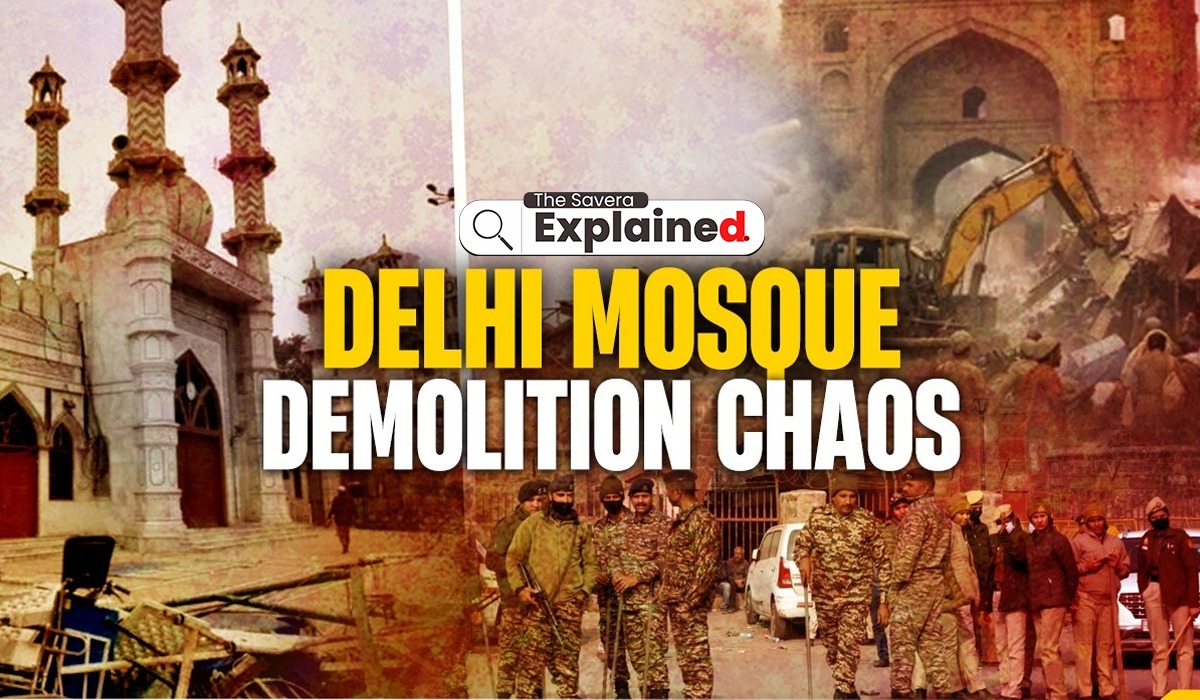
New Delhi: The 18th-century Faiz-e-Ilahi Mosque in Delhi’s Turkman Gate area has come under sharp public and political focus after clashes broke out between local residents and police during a court-ordered demolition drive on land adjoining the mosque.
The incident, which unfolded on the intervening night of Tuesday and Wednesday, led to the arrest of five people, detention of 10–15 others, and injuries to at least five police personnel.
According to the Municipal Corporation of Delhi (MCD), the mosque structure itself was not damaged during the operation, which targeted alleged encroachments on adjacent land.
The episode has reopened long-standing questions around land ownership, civic authority, and the protection of heritage religious sites in Old Delhi—an area with a deeply layered and often contentious urban history.
The Immediate Trigger: Demolition and Clashes
Officials say the demolition drive was carried out in compliance with court directions to remove unauthorised constructions on land next to the mosque. Locals, however, resisted the action, claiming the move threatened a historic religious site and its associated spaces. The situation escalated into clashes, prompting police intervention and arrests. Authorities have maintained that the demolition was limited strictly to encroachments and did not involve the mosque’s notified structure or land under its legal control.
Historical Significance of Faiz-e-Ilahi Mosque
The Faiz-e-Ilahi Mosque dates back nearly 250 years to the late 18th century, a period when the Mughal Empire was in decline but Delhi remained a vibrant centre of culture and spirituality.
The mosque was built by Hazrat Shah Faiz-e-Ilahi, a revered Sufi saint of the Chishti order, known for his emphasis on spiritual learning, communal harmony, and service.
Unlike imperial mosques commissioned by emperors, Faiz-e-Ilahi Mosque was constructed using Shah Faiz-e-Ilahi’s personal resources, with support from his followers. It was envisioned not just as a place of worship but as a spiritual hub that promoted brotherhood across communities.
Mughal-Era Architecture and Design
Architecturally, the mosque reflects classic Mughal design elements, though on a modest scale compared to grand monuments like Jama Masjid. Built primarily from red sandstone and white marble, it features arched entrances, domes, and a courtyard designed to regulate temperature—an important feature in pre-modern Delhi. Quranic inscriptions adorn the walls, and an ablution area is located within the courtyard. While repairs and alterations have occurred over time, historians note that the mosque has largely retained its original character.
Ownership and Legal Status
The key issue in the current controversy revolves around land ownership and administrative control. The Faiz-e-Ilahi Mosque is registered as a waqf property, placing it under the authority of the Delhi Waqf Board. As per established rules, the Waqf Board is responsible for the mosque’s overall management, maintenance, and protection of its assets.
Daily religious activities—such as prayer management, cleaning, and local events—are handled by a local committee under the supervision of a mutawalli (trustee). Officials have stated that no ownership claims extend beyond the mosque’s leased or notified land, and that the demolished structures were outside this boundary.
Role of Civic and Conservation Authorities
Given its historical importance, conservation bodies such as the Archaeological Survey of India (ASI) are expected to keep a watch on the site, although the mosque is not classified as a centrally protected monument. Civic authorities like the MCD retain jurisdiction over public land and encroachments in the surrounding area, which often leads to friction in densely populated heritage zones like Turkman Gate.
A Site That Has Witnessed History
Faiz-e-Ilahi Mosque has stood through some of Delhi’s most turbulent moments, including the Revolt of 1857 and the Partition of India in 1947. During these periods of upheaval, small neighbourhood mosques and shrines like this one often served as shelters and sources of communal stability. Even today, the annual urs (death anniversary) of Hazrat Shah Faiz-e-Ilahi draws devotees from different communities, underlining its syncretic legacy.
Why Turkman Gate Remains Sensitive
The Turkman Gate area carries its own historical trauma, most notably the forced demolitions and displacements ordered during the Emergency in 1976 under Sanjay Gandhi. Any demolition activity here inevitably revives memories of state excess and displacement, amplifying public reaction.
While authorities insist the rule of law was followed and the mosque remains untouched, the incident highlights the fragile balance between urban governance, heritage preservation, and community trust.
With investigations ongoing and political attention intensifying, the Faiz-e-Ilahi Mosque now stands at the centre of a broader debate on how historic religious spaces are safeguarded amid Delhi’s constant urban churn.
Jamia Millia Islamia has accepted key demands of protesting students after 14 days of agitation. The university will...

Two people died after a building's existing roof and a newly laid slab collapsed during construction at Milan...

India will host the 12th BRICS Parliamentary Forum at Samvidhan Sadan in New Delhi on October 26 and...

Jammu and Kashmir’s 79th Accession Day comes amid controversy over ‘Free Kashmir’ slogans found at Jamia Millia Islamia....

New Delhi: The Cyber Police Station of Delhi’s North-East District has arrested two men for their alleged involvement...

Rahul Gandhi has urged students, farmers, workers, women and young people to attend the INDIA bloc’s November 1...

Aries: The day will be auspicious...