


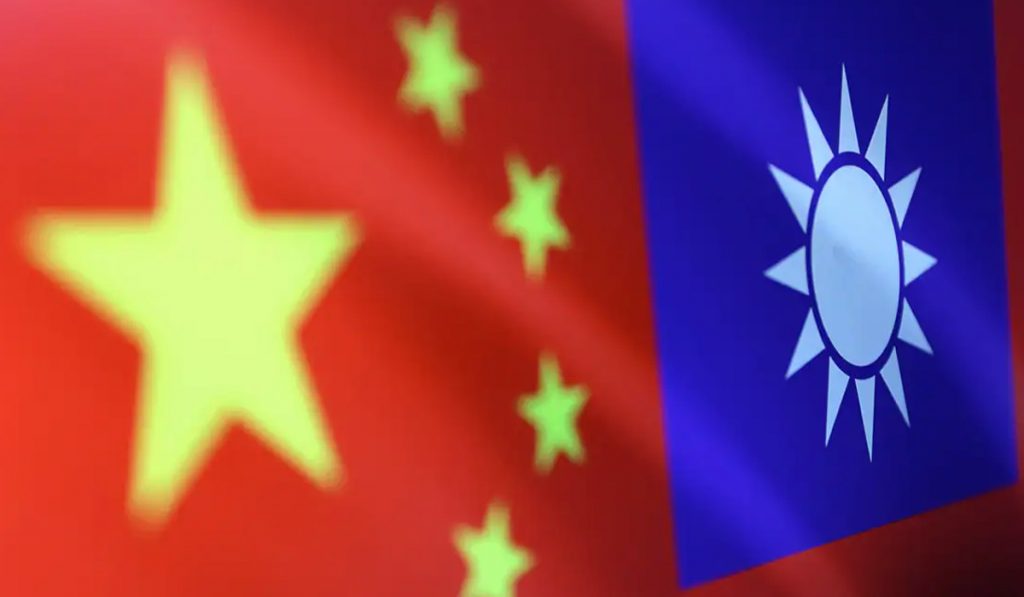
Taiwan on Wednesday accused China of attempting to create a legal pretext for an invasion of the self-ruled island by misinterpreting United Nations Resolution 2758 of 1971, a key international decision in the longstanding China-Taiwan dispute. Taiwan’s foreign ministry said Beijing’s claim that the UN resolution recognises its sovereignty over Taiwan was misleading and aimed at justifying potential military action in the future.
China considers Taiwan a breakaway province and has maintained a longterm policy to merge the island with the mainland, including by force if necessary. According to US intelligence assessments, Chinese President Xi Jinping has directed the military to prepare for a possible invasion of Taiwan by 2027, with 2049 — the centenary of the founding of the People’s Republic of China — set as the target year for unification. While most countries recognise China diplomatically, they maintain only informal relations with Taiwan. Major powers, including the United States, the UK, and India, oppose any attempt to alter the status quo by force.
The latest dispute arose from a statement by China’s foreign ministry on Tuesday, which referred to Taiwan as a “reactionary” entity and its founders as a “clique,” asserting that Resolution 2758 granted China rights over all Chinese territory, including Taiwan. In response, Taiwan said the claims were “deliberately misleading” and designed to create a legal basis for military aggression. The ministry stressed that only Taiwan’s democratically elected government represents the island’s 23 million people in the UN system and other international forums.
China’s foreign ministry maintained that the “one China” principle is indisputable, asserting that reunification would occur regardless of Taiwan’s position. The statement emphasised that any challenge to Resolution 2758 constitutes a challenge to China’s sovereignty and to the authority of the UN.
Experts and historical records, however, contradict Beijing’s interpretation. UN Resolution 2758, passed in 1971, addressed only the question of representation at the UN. It recognised the People’s Republic of China (PRC) in Beijing as the sole representative of China and expelled the representatives of Chiang Kaishek, then leader of the Republic of China (ROC) based in Taiwan. The resolution did not mention territorial sovereignty or grant China claims over Taiwan. After the Chinese civil war in 1949, the Communist Party established the PRC on the mainland, while Nationalist forces retreated to Taiwan and maintained the ROC government.
The ROC continued to represent China at the UN until 1971, when the UN General Assembly granted the seat to the PRC. Resolution 2758 addressed only which government held China’s UN seat and did not make determinations about the island’s territorial status. Nathan Attrill, a China-Taiwan affairs analyst at the Australian Strategic Policy Institute, noted that the resolution “was about representation, not sovereignty. It did not endorse Beijing’s claim that Taiwan is an inalienable part of its territory.”
The decision merely recognised Beijing as the more legitimate representative of China in the UN. In response to the recent controversy, the US Department of State said China’s “intentional mischaracterisation and misuse of Resolution 2758” is part of broader coercive efforts to isolate Taiwan from the international community. Analysts have warned that Beijing’s reinterpretation of the resolution could be used to justify future aggressive actions against Taiwan under the guise of legality.The episode highlights ongoing tensions across the Taiwan Strait, with both sides maintaining sharply contrasting interpretations of international law and historical agreements. Taiwan continues to assert its democratic governance and international standing, while China reinforces its claims over the island, contributing to the growing geopolitical friction in the region